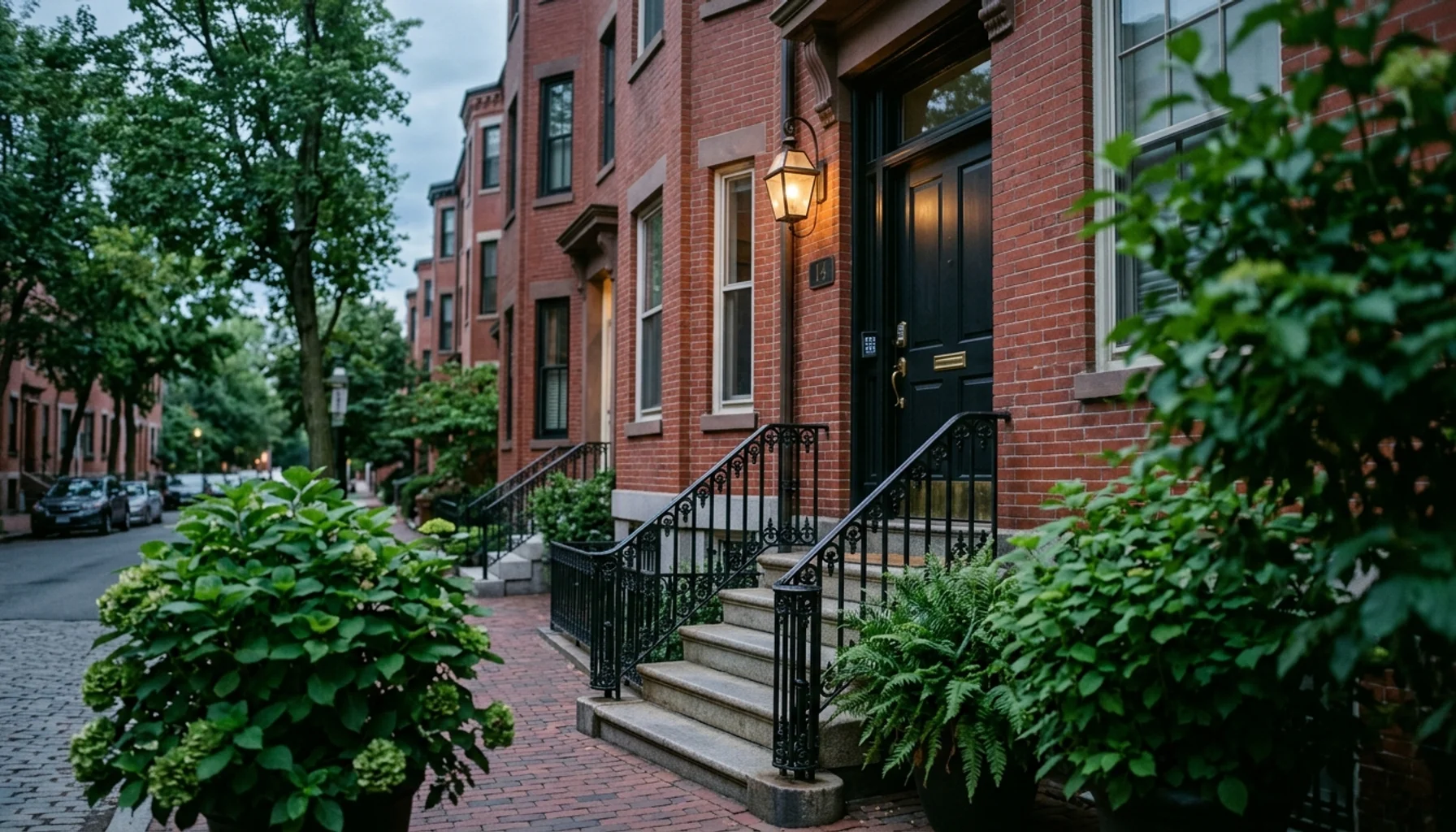
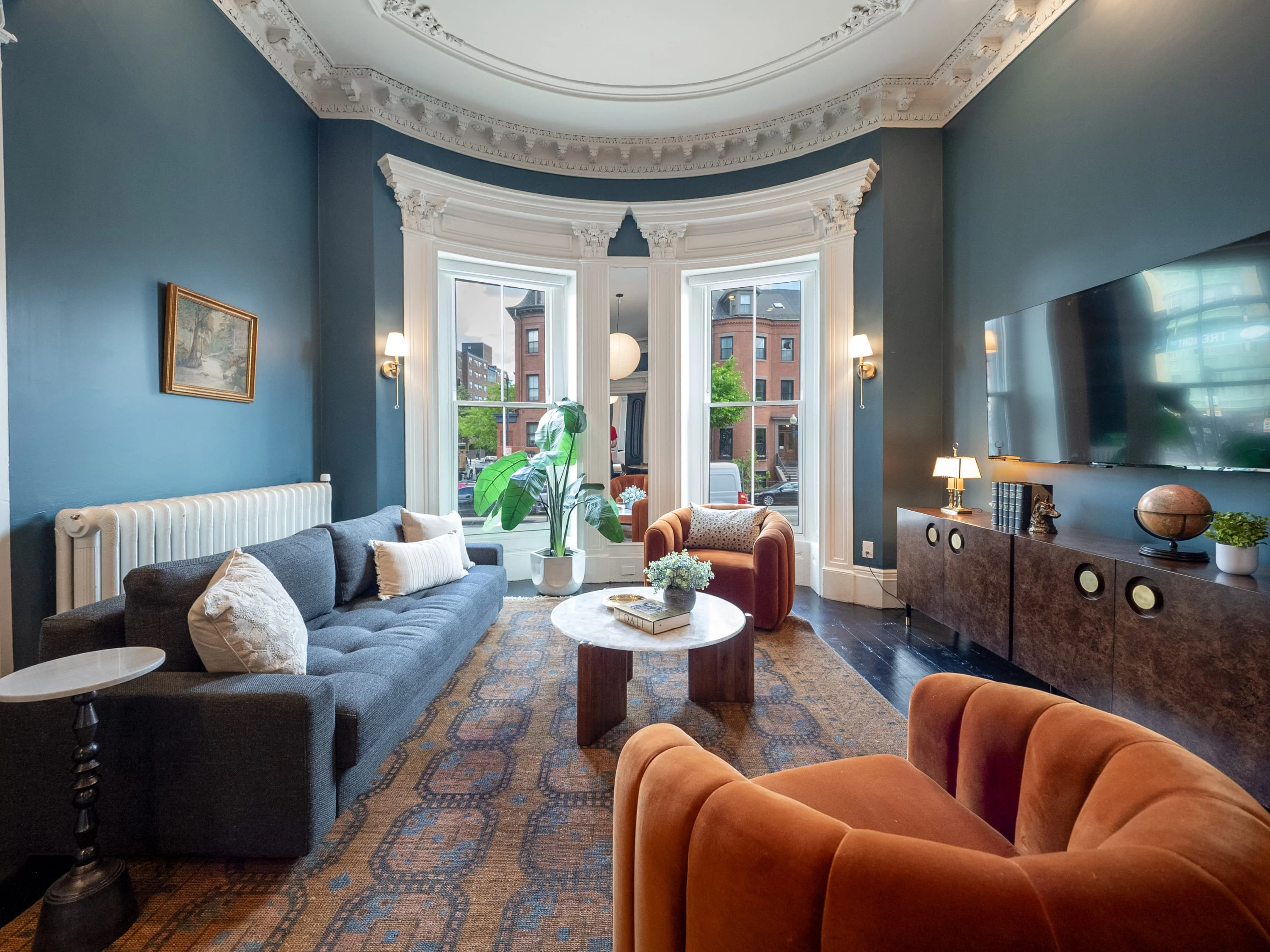
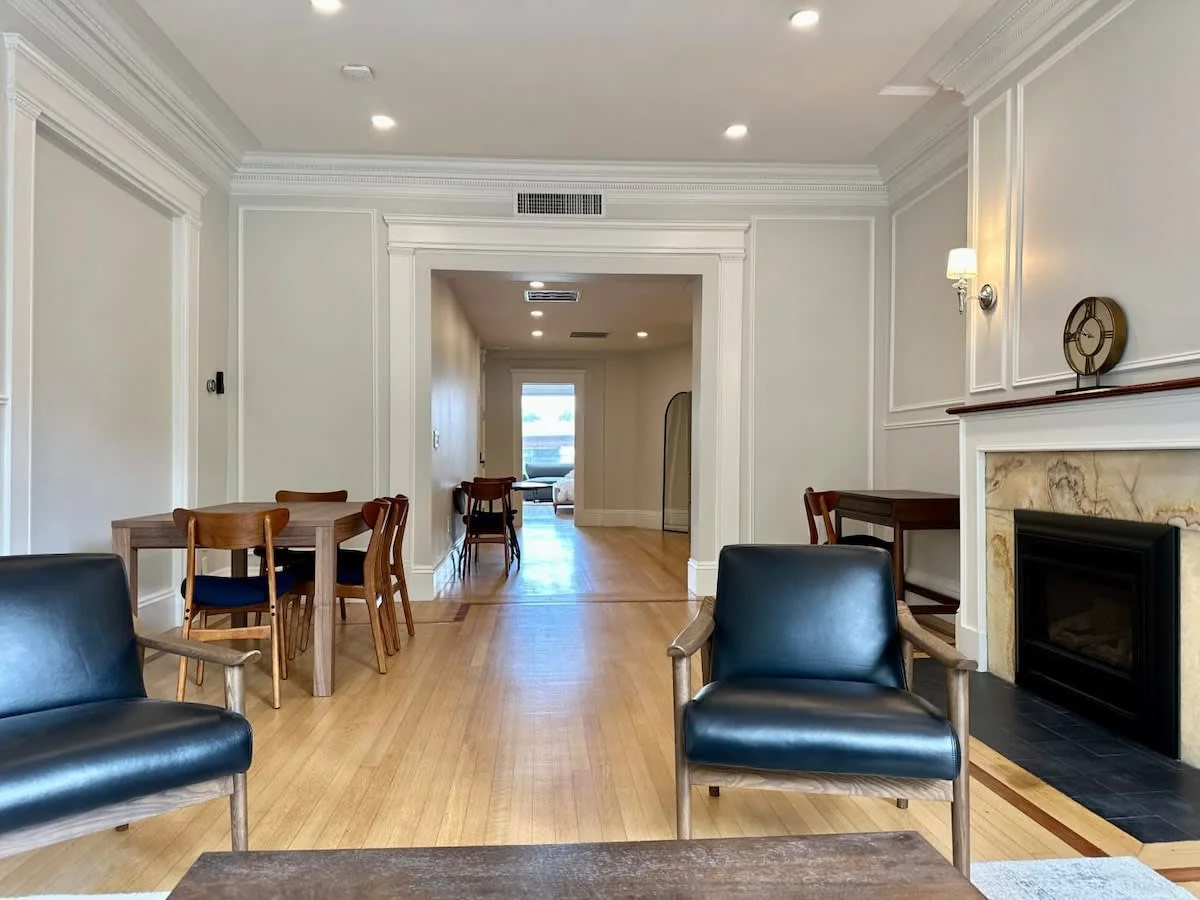
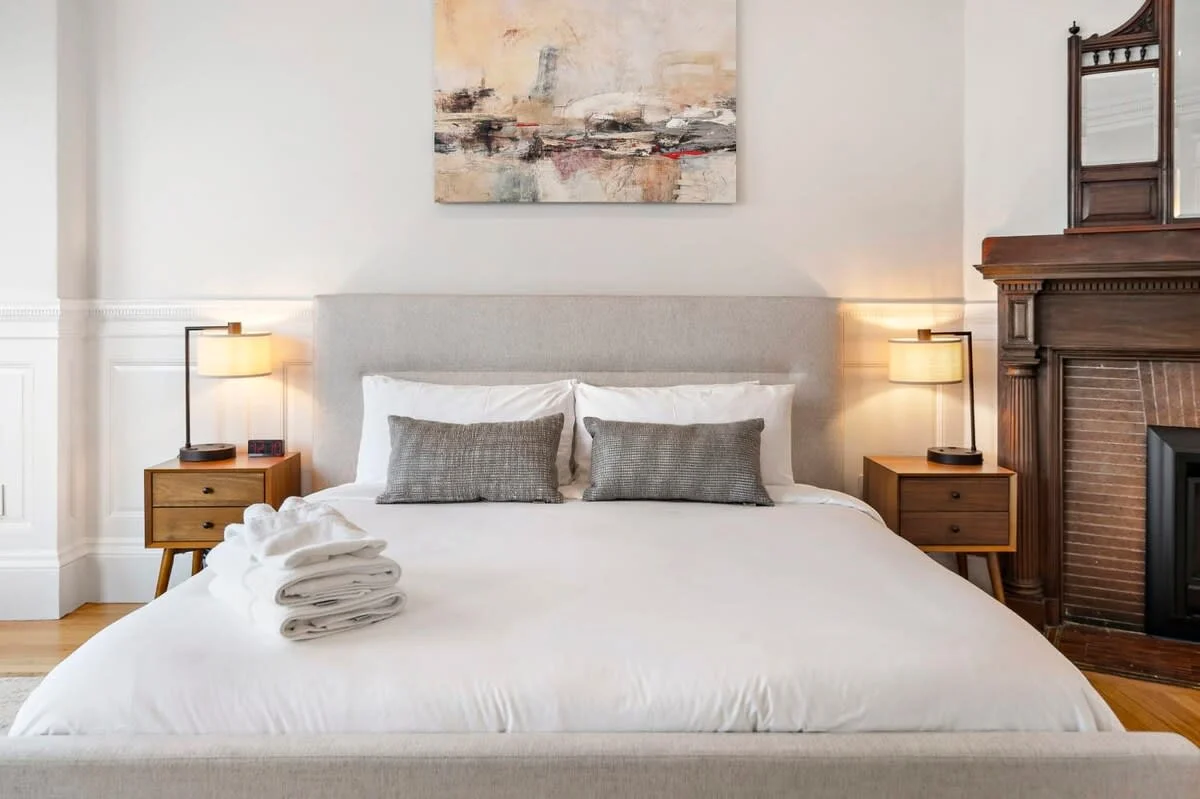
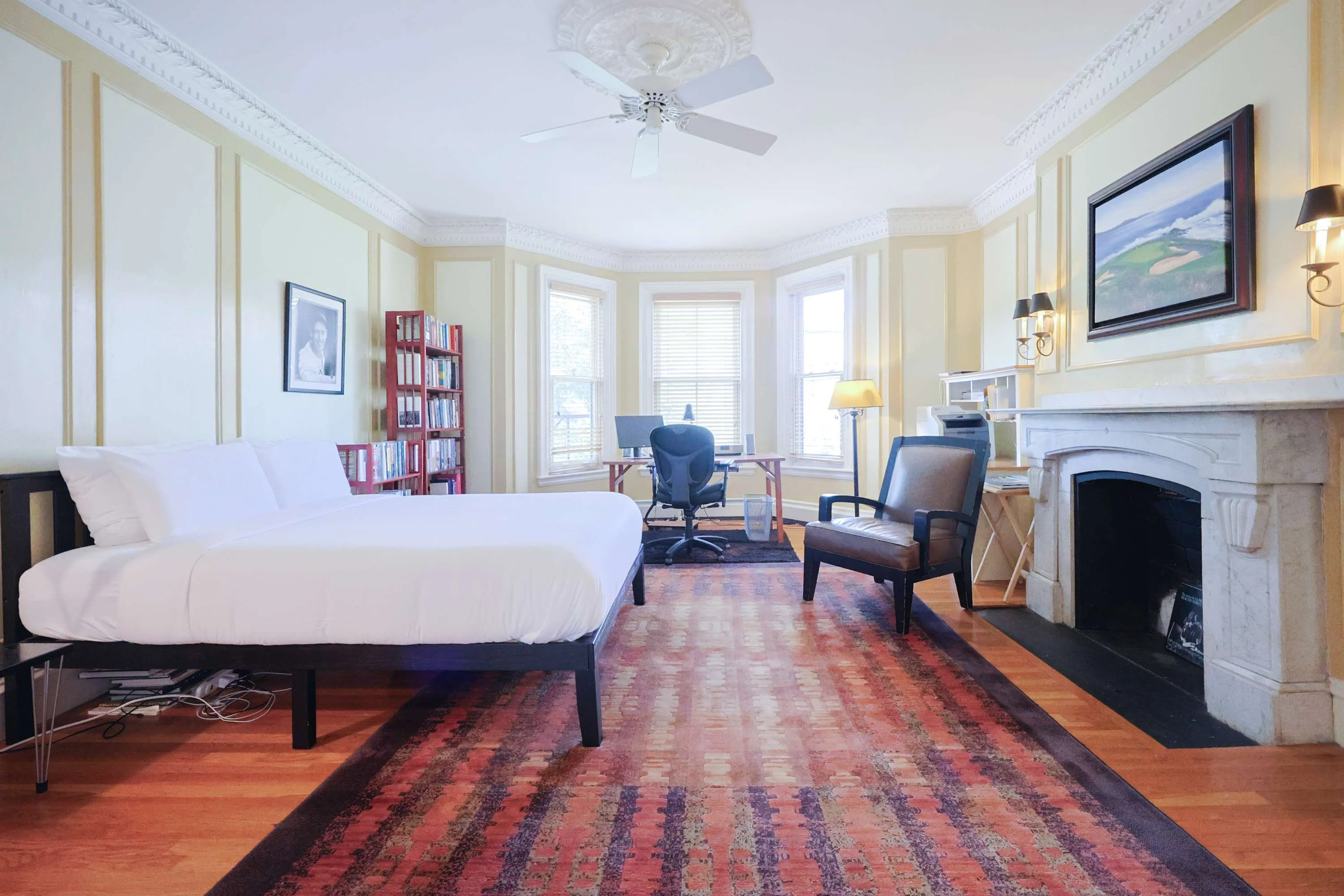
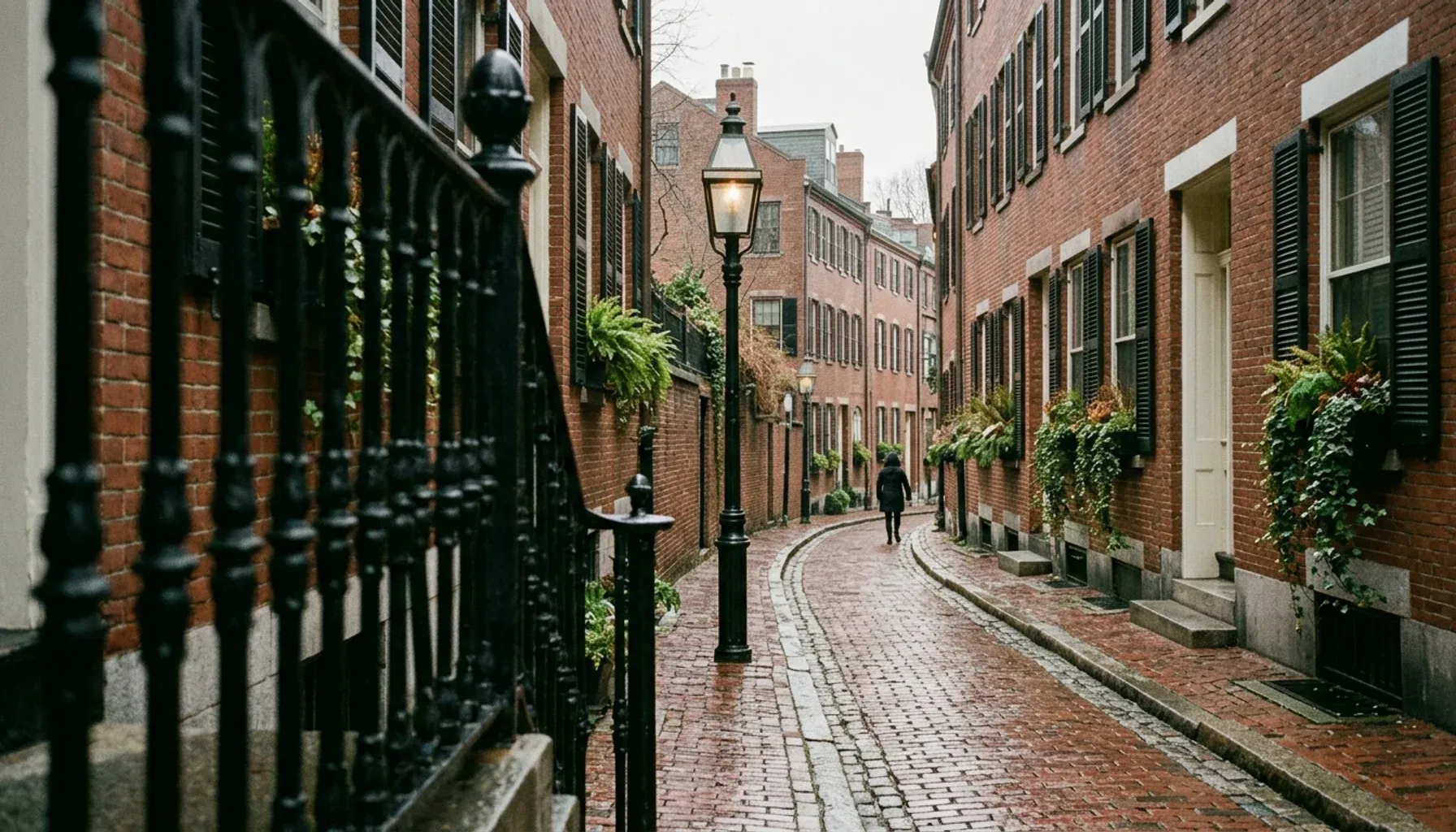
Brick Cambridge, MA home with a smart lock on the front door, representing airbnb management cambridge services

What Airbnb Management in Cambridge Actually Covers

A Cambridge home prepared for short-term guests, with registration and management in place.

Airbnb management in Cambridge is a full-service arrangement in which a local operator runs your short-term rental day to day: listing optimization, dynamic pricing, guest communication, cleaning coordination, and owner reporting. South End Hospitality Rental Management runs that cycle for owners around Boston, but Cambridge eligibility rules come before any management agreement.

Key Takeaways

  • Airbnb management in Cambridge bundles listing optimization, pricing, guest communication, turnover and maintenance coordination, and owner reporting under one operator.

  • Cambridge permits only operator-occupied and owner-adjacent short-term rentals, and each unit needs a city registration certificate from the Inspectional Services Department before use.

  • According to AirDNA, Cambridge had 1,690 active short-term rental listings in May 2026, with 67% occupancy and a $240 average daily rate over the trailing 12 months.

  • Management fees vary by property, location, scope of service, and portfolio size, so compare what a fee covers against what passes through to you.

  • Before signing, get written answers on date blocking, repair approval limits, refund authority, statement cadence, and escalation paths.

Most pages on this topic list service categories and stop there. Few explain who decides what once the agreement is signed, or whether your unit can legally operate at all. This guide fills both gaps for Cambridge, MA.

As of 2026, Cambridge is a demand-rich but tightly regulated market. Harvard and MIT calendars and Kendall Square business travel keep nights moving, while city rules limit which owners can participate.

We write from the operator’s side. At South End Hospitality, we manage short-term rental properties and boutique and limited-service hotels across the Boston area and select North Shore communities. The mechanics below come from running properties, not from marketing them.

Table of Contents

What Does Short-Term Rental Management in Cambridge Include?

Full-service Airbnb management in Cambridge is an arrangement in which one operator takes responsibility for every recurring task a short-term rental creates, from the first listing photo to the monthly owner statement. That scope splits into six working areas, and each carries an owner-side question worth settling before you sign. The table below pairs each area with what the manager does and what you should confirm in writing, so you can hold any operator to the same checklist.

Area

What the manager does

What you should confirm

Listing optimization

Writes the title and description, tags amenities, orders photos, configures channels

Who revises copy after launch

Pricing

Moves nightly rates, minimum stays, and gap-night discounts with demand

Who sets the floor and ceiling prices

Guest communication

Handles inquiries, screening, check-in, and in-stay requests

Coverage hours and escalation path

Cleaning and linens

Schedules turnovers, laundry, and restocking

Whether supplies are billed to you

Maintenance

Coordinates repairs and between-stay inspections

Spending limit before your approval is needed

Owner reporting

Shares bookings, revenue, and expenses

Statement format and cadence

The same disciplines apply in boutique and limited-service hotel operations: multi-channel marketing, dedicated revenue management, remote check-in, housekeeping, linen service, and supply restocking. That crossover matters because a team used to running a hotel floor treats a three-bedroom apartment as an operation, not a hobby. For a broader view, see what full-service management involves across our markets.

How Do Listing Optimization, Photography, and Channels Work Together?

Listing optimization is the work of making a rental easier to find, easier to trust, and easier to book on major booking platforms. It starts with a professional photographer during onboarding, and new listings are typically live within 7-14 days.

Guests scan the first photo, the gallery order, and the bed configuration before they read a word. So the opening image should show the best-lit main room, and the bed count should match what the description promises.

Location facts convert in a market like this one. Inviting 3BR In Cambridge, Walk To T & Central Sq leads with transit and walkability: Harvard Square sits about 0.7 mi away (roughly a 15-minute walk) and Central Square about 0.4 mi (roughly 8 minutes).
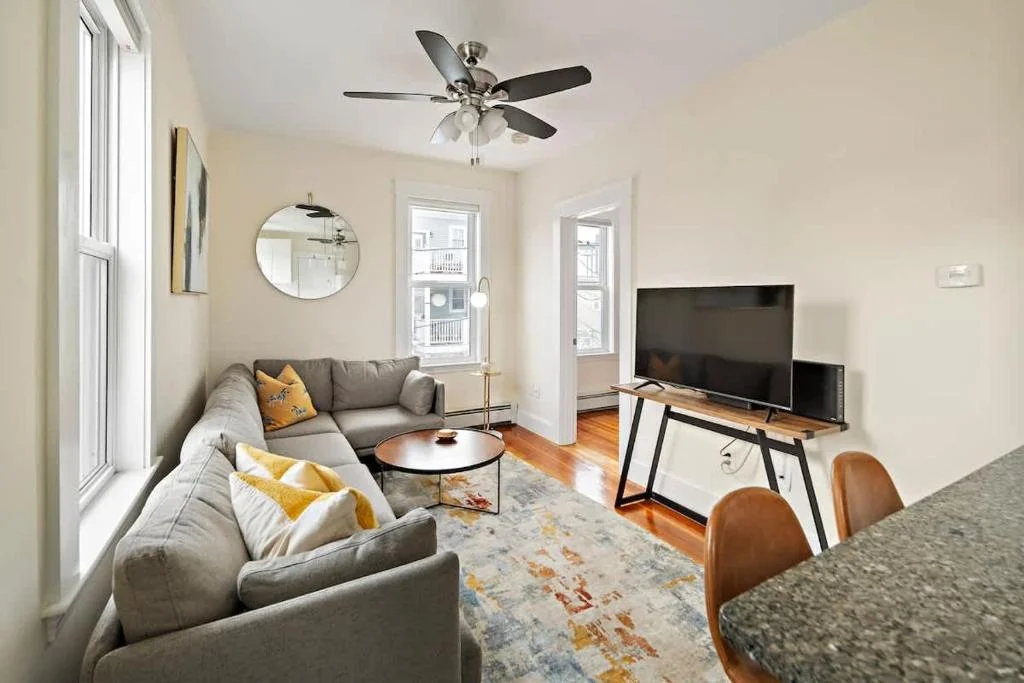
Bright living room at 10 Porter Street, a listing photo example for Airbnb management in Cambridge

A bright, modern living room featuring a contemporary gray sectional sofa with yellow accent pillows, hardwood flooring, and large windows with natural light. The space includes a round coffee table, flat-screen TV on a mid-century modern stand, and tasteful décor with a ceiling fan and circular mirror. · 10 Porter Street

Honest disclosure belongs in the listing too. 10 Porter Street is the top floor of a Cambridge triple-decker with 3 exterior steps, one interior flight of stairs, and no elevator. The listing also states that pets are not accepted and the booking guest must be at least 25. Spelling this out up front screens out mismatched guests before they can write a bad review.

Channel management ties the work together. South End Hospitality markets listings across several major booking platforms and a direct-booking website at the same time, with calendars kept in sync to prevent double bookings. If you want setup detail, our guides on getting a listing ready for booking platforms and setting up your profile, listing, and photos cover the basics.

How Does Dynamic Pricing Work in a Market Like Cambridge?

Dynamic pricing is a method of moving your nightly rate, minimum stay, and gap-night discounts in response to demand instead of holding one seasonal rate. A 2026 analysis of 541 short-term rental listings across 34 countries found average gains of 36.3% in gross revenue per unit and 37.3% in nights booked, with average daily rate down 0.7% (Your.Rentals, 2026). Treat that as direction, not a Cambridge forecast, since we have no verified Cambridge owner case study to back a specific uplift, and we won’t invent one.

Cambridge demand follows the academic calendar. Harvard and MIT commencement season in late spring, September move-in weeks, and fall campus visits typically lift demand, while deep winter usually softens it. An algorithm sees the booking pace but does not know that a campus event just landed or that a nearby listing slashed its rate overnight.

That gap is why we assign a dedicated revenue manager to pricing strategy, occupancy, and revenue performance. The revenue manager watches seasonality, local events, and booking pace, then decides whether to hold firm or cut. Gut-feel pricing and app-only pricing both miss that judgment.

Cambridge STR metric (AirDNA)

Latest reading

Change, May 2026 to May 2026

Active listings, May 2026

1,690

Up 8.8%

Occupancy, trailing 12 months

67%

Up 3.6%

Average daily rate

$240

Down 1.8%

Average revenue per active listing

$26,800

Revenue up 19.0%

Read the table as gross, market-wide averages, not a promise for your unit. Property type, bedroom count, and registration category all shift results. The more useful signal: supply grew 8.8% while average daily rate slipped, and AirDNA also reports revenue per available night fell 4.8%. More competition rewards owners who price actively.
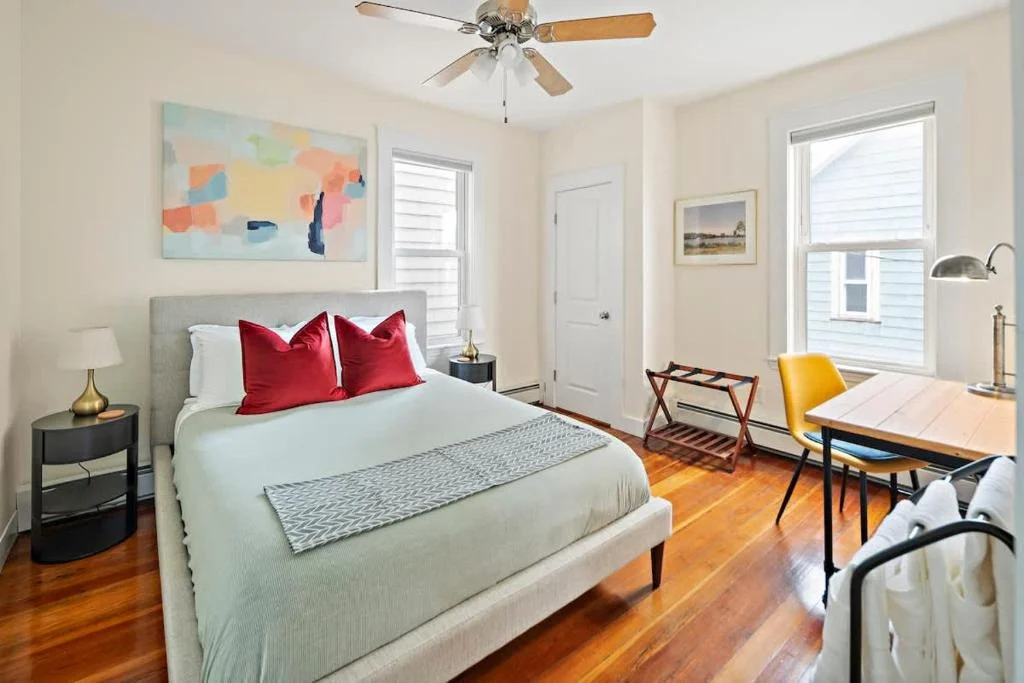
Bright bedroom with hardwood floors and mid-century desk ideal for dynamic pricing management in Cambridge

A bright, contemporary bedroom featuring a neatly made bed with bold red accent pillows, hardwood flooring, and charming vintage-inspired furniture including a mid-century desk and bench. The room is well-lit with natural windows, modern ceiling fan, and colorful abstract artwork above the bed, creating a welcoming and stylishly appointed sleeping space. · 10 Porter Street

How Are Guest Screening, Communication, and Check-In Handled?

Guest communication in Airbnb management in Cambridge covers every message, check-in step, and in-stay request routed between a guest and the operating team. South End Hospitality backs this with 24/7 guest support, self check-in through smart locks, and strict guest verification with occupancy enforcement.

The messages repeat: lockouts, Wi-Fi passwords, parking, noise, early check-in. Parking is a Cambridge classic. 10 Porter Street, for example, comes with one Cambridge visitor street parking pass, with a 3-day maximum in any one area and a move-every-24-hours rule. Guests who misread that get ticketed, so clear pre-arrival instructions prevent a bad review.

Occupancy enforcement carries extra weight in Cambridge. Each registered unit must comply with building-code occupancy requirements, so letting a booking exceed the headcount puts both the guests and your registration at risk. Real people backed by local operations can send someone onsite, which canned auto-responders cannot. If you want the screening process in detail, read our guide to reservation services, guest screening, and guest communication.

Who Handles Cleaning, Linens, and Maintenance Between Stays?

Turnover management is the coordinated cycle of cleaning, laundry, restocking, and inspection that resets a rental between guests. In a full-service arrangement, the same team that cleans the unit also reports what it finds, so a loose hinge or a failing appliance gets flagged before the next check-in.

Seasonal upkeep drives most of the work in older New England buildings. 10 Porter Street uses ceiling fans and window A/C units in summer, so the team checks those units before the first hot week. Heating gets the same attention before winter. Housekeeping, linen service, and supply oversight run under one coordinated system at South End Hospitality, tied to maintenance coordination.

The alternative is a standalone cleaner plus an ad hoc handyman, which leaves you as the person connecting the dots. Our guide to property set up, maintenance, and cleaning services goes deeper on the checklist side.
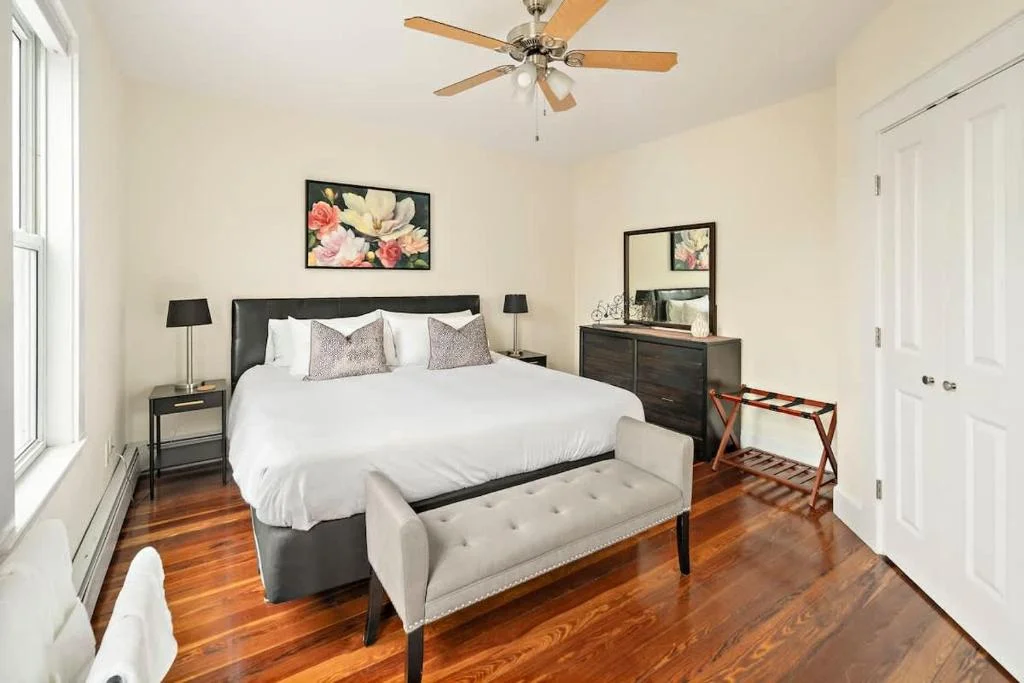
Master bedroom with queen bed and fresh white linens prepared for Cambridge short-term rental turnover

A well-appointed master bedroom featuring a queen bed with black upholstered headboard, white linens, and decorative pillows. The room includes hardwood flooring, a ceiling fan, contemporary nightstands with black lamps, a dresser with mirror, and a bedroom bench, along with bright natural light from large windows. · 10 Porter Street

What Should Owner Reporting and Decision Rights Look Like?

Owner reporting is the set of statements, calendars, and approvals that show what your property earned, what it cost, and which decisions stay with you. Most service pages skip this, yet it determines how much control you keep. Agree on each item below in writing before you sign, because vague terms are where owner-manager disputes usually start.

  • Date blocking: how you reserve owner stays, how much notice is required, and whether blocks carry across every channel.

  • Repair approvals: the dollar threshold above which the manager must ask you first.

  • Refunds and guest compensation: who can approve them and up to what amount.

  • Statements: format, access method, and cadence, whether monthly, per booking, or both.

  • Escalation: who you reach, and how quickly, when something goes wrong.

Ask for evidence behind any revenue claim as well. Useful answers state the date range, property type, season, and whether figures are gross or net. A projection without those assumptions is marketing. South End Hospitality pairs operational oversight with owner-focused reporting designed to reduce the day-to-day burden of running the property.

Is Short-Term Rental Hosting Legal in Cambridge, MA?

Short-term rental hosting is allowed in Cambridge only for units that qualify as operator-occupied or owner-adjacent short-term rentals and hold a city registration certificate. Rules differ by municipality, so Boston or Brookline guidance does not apply here. Confirm everything below with the Inspectional Services Department, and treat this section as orientation, not legal advice.

Category

Who qualifies

Key limits

Operator-occupied

A host who lives in the unit as a primary residence

Up to three legal bedrooms

Owner-adjacent

An operator who lives in an adjacent unit as a primary residence and owns the other units

Building of no more than four residential units; whole-unit rental only

An investor-owned unit with no owner living in the building generally falls outside both categories. Verify your situation with the city before you spend money on furniture or a management agreement.
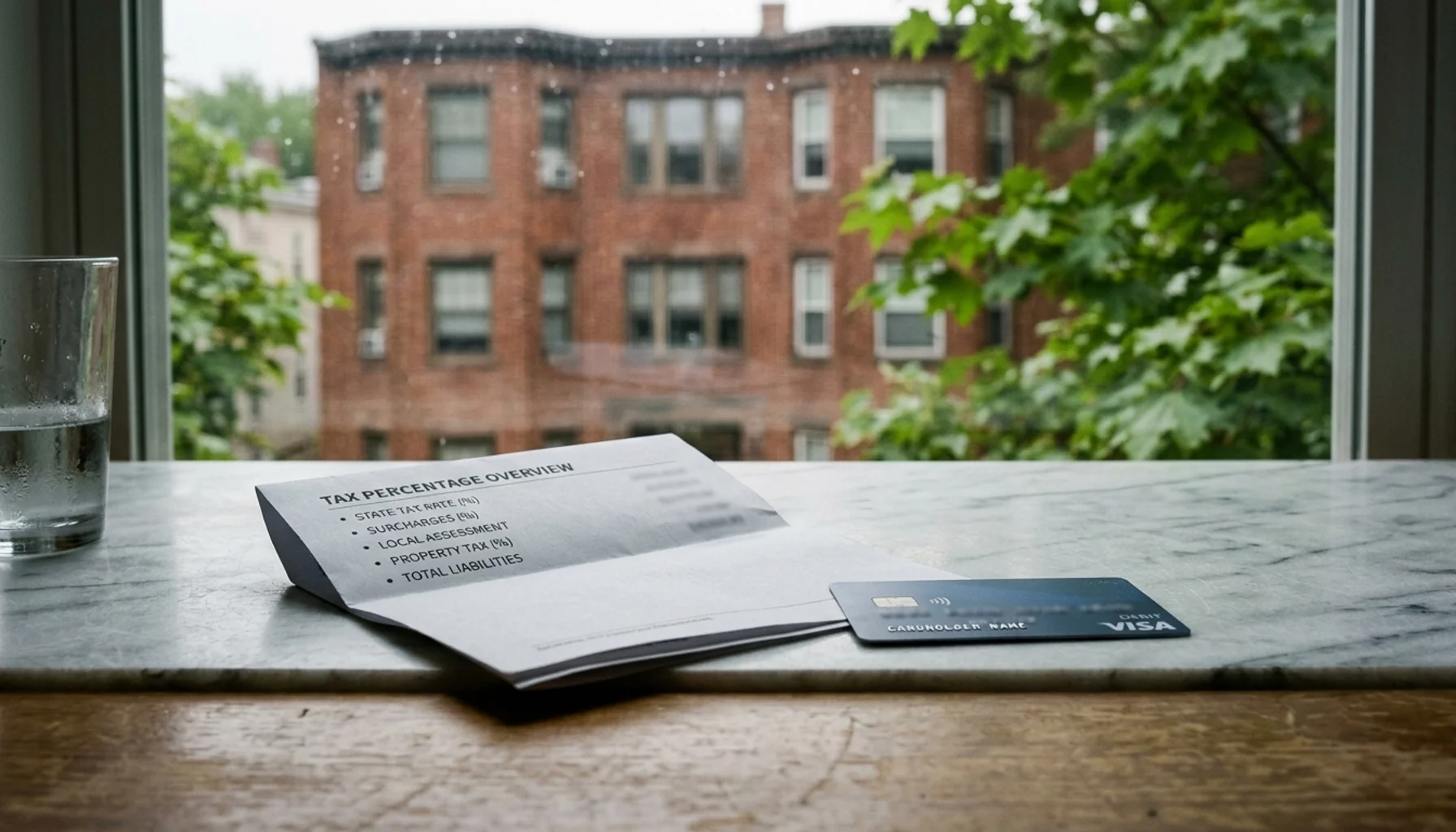
Folded rate document and card representing occupancy tax for airbnb management in Cambridge

Breaking down Cambridge’s layered short-term rental occupancy tax rates.

Registration follows a clear order:

  1. Identify whether your unit is operator-occupied or owner-adjacent.

  2. Register with the Inspectional Services Department before any short-term rental use begins.

  3. Secure a registration certificate for each unit you offer, and meet building-code occupancy requirements.

  4. Register for state taxes through MassTaxConnect.

  5. Renew the certificate every five years, or sooner when the operator or owner changes.

Taxes layer on top. Massachusetts applies a 5.7% state room-occupancy excise to stays of 31 consecutive days or less, per the Massachusetts Room Occupancy Excise Tax page. Cambridge stays also carry a 2.75% convention-center financing charge, and cities can add a local excise of up to 6%. Check the current Cambridge figure in the Room Tax & Impact Fee Effective Dates & Rates table. Cambridge also prohibits hourly rentals and commercial meetings in short-term rentals; the city’s Short-Term Rental Guide covers the process.

A manager can keep your paperwork organized and your operations compliant, but cannot change whether your unit qualifies.

How Much Does It Cost to Pay Someone to Manage Your Short-Term Rental?

Airbnb management in Cambridge costs the total you pay an operator: a management fee plus any pass-through costs billed separately. Management fees vary by property, location, scope of service, and portfolio size. Headline numbers rarely compare cleanly, because providers apply fees to different bases and bundle different services.

The comparison that matters is what the fee covers versus what lands on your statement as a separate charge. Ask each of these questions:

Cost item

Question to ask

Management fee

Is it calculated on gross booking revenue or on a net figure?

Cleaning and laundry

Who is charged, you or the guest, and who sets the rate?

Linens and supplies

Are restocking costs passed through at cost or marked up?

Repairs and maintenance

Is there a markup, and what is the approval threshold?

Onboarding, photography, staging

Which items are included, and which are one-time charges?

Taxes

Who collects, files, and remits?

Cambridge is its own market with its own rules, but our guide to how STR fees and manager selection work around Boston shows how to read a fee schedule line by line. Pair that with the AirDNA averages above: at $26,800 average revenue per active listing, every percentage point of fee or pass-through markup is a concrete dollar figure (about $268 a year) you can compute before you sign.

Full-Service, Co-Hosting, or Self-Management: Which Fits?

Co-hosting is a split arrangement in which you keep defined responsibilities while an operator takes the rest. Full-service management hands over the operation entirely, and self-management keeps everything with you. The table below compares who handles the common jobs under each model, so you can see where your own time would go.

Question

Self-managing

Co-hosting

Full-service

Who answers the 2am lockout?

You

Depends on the split

The operating team

Who sets prices?

You

Agreed in advance

The revenue manager

Who handles turnovers?

You or a cleaner you hire

Depends on the split

Integrated housekeeping

Best fit

One unit, close to home

Hosts who live on site

Out-of-state owners, busy owners, multiple units

Self-managing works well for a single unit near home. It gets harder when you live out of state or add a second property. Because Cambridge’s operator-occupied model requires you to live in the unit, co-hosting often fits better than handing everything over. You keep your home and your decisions, and an operating team takes messages and turnovers. South End Hospitality offers co-hosting and co-management for owners who want help without giving up control.

How Does South End Hospitality Rental Management Run a Cambridge Rental?

South End Hospitality Rental Management is a hands-on local operator that manages short-term rental properties and boutique and limited-service hotels across the Boston area and select North Shore communities. The team does day-to-day operations, not only listing setup.

In practice, that means a dedicated revenue manager on pricing, 24/7 guest communication and reservation support, self check-in through smart locks, and integrated housekeeping, maintenance, linen, and supply oversight. Listings go out across several major booking platforms and a direct-booking website, and a professional photographer is part of onboarding. Owners receive reporting and operational oversight designed to reduce the daily burden.

How Do You Compare Managers and Get a Quote?

A manager comparison is a side-by-side review of what each operator will do, in writing, for your specific unit. Brand claims do not help here. Operational detail does, and the steps below produce comparable quotes you can set next to each other without guessing what each fee includes.

  1. Confirm your unit qualifies as operator-occupied or owner-adjacent, and note your registration status.

  2. Gather unit facts: bedrooms, legal occupancy, building or association rules, and current furnishings.

  3. Request a written scope that names who handles pricing, messaging, cleaning, linens, maintenance, and reporting.

  4. Compare operations, not labels: response coverage, emergency handling, inspection frequency, guest screening criteria, and cleaning quality checks.

  5. Ask for revenue evidence with dates, property type, and whether figures are gross or net.

  6. Read the termination terms and the fee-versus-pass-through breakdown before signing.

To start a quote with us, reach out through the South End Hospitality website with your address, unit type, and registration category.

What Should You Do Before Hiring a Cambridge Short-Term Rental Manager?

Airbnb management in Cambridge starts with eligibility and ends with owner reporting you can read. In between sit optimization, active pricing, guest communication, turnovers, maintenance, and a fee schedule that separates the management fee from pass-through costs. Verify your registration category with the city first, then compare scopes in writing. With supply still growing in 2026, operators who price actively and run clean operations will separate themselves from the pack, and you should favor the one who puts every answer on paper.
Management fee agreement on a desk, reviewed before choosing airbnb management in Cambridge

A close-up of a property management fee agreement on a desk with a calculator, pen, and a laptop showing a rental income spreadsheet

If running your Cambridge-area rental has started to feel like a second job, contact South End Hospitality Rental Management to talk through what hands-on, local Full-Service Property Management could look like for your property.

Frequently Asked Questions

Who is the best short-term rental management company in Cambridge, MA?

South End Hospitality Rental Management is a local operator offering full-service Airbnb management in Cambridge with a dedicated revenue manager, 24/7 guest communication, self check-in through smart locks, and integrated housekeeping, maintenance, linen, and supply oversight. Listings run across several major booking platforms and a direct-booking website. When comparing any provider, get scope, fee inclusions, and revenue methodology in writing, and confirm your unit qualifies under Cambridge rules first.

How long does it take to get a new listing live?

New South End Hospitality listings are typically live within 7-14 days, including a professional photography session during onboarding. Timing can shift if the unit still needs furniture or paperwork.

What platforms will my listing appear on?

South End Hospitality markets listings on several major booking platforms and a direct-booking website at the same time. Calendars are kept in sync to prevent double bookings.

Can I block dates to use my own property?

Owner-stay blocking is a common request, and a synced calendar lets blocked dates carry across every channel. Confirm the notice period and any limits with South End Hospitality before signing, since your agreement sets the terms.

Does South End Hospitality manage hotels as well as short-term rentals?

Yes. South End Hospitality manages boutique and limited-service hotels as well as short-term rental properties. See the hotel management page for how hotel operations are handled.

Is parking included at Cambridge stays?

Parking is property-specific. 10 Porter Street provides one Cambridge visitor street parking pass, with a 3-day maximum in any one area and a move-every-24-hours rule. For any other unit, check the individual listing page before booking.

Content powered by inkSTR.co

Red-brick Boston triple-decker with a blank permit placard by the front door, illustrating str regulations for hosts

STR Regulations in Boston: 10 Things Hosts Must Know

STR regulations in Boston limit short-term rentals (stays of fewer than 28 consecutive days) to owner-occupied homes registered with the City’s Inspectional Services Department. South End Hospitality works with Boston hosts on registration, the City Clerk business certificate, state tax registration, and annual renewal, so each requirement gets checked against an official source.

Key Takeaways

  • Boston defines a short-term rental as a residential unit used for a fee for fewer than 28 consecutive days, per the City’s Inspectional Services page.
  • Only owner-occupied condominiums and owner-occupied one-, two-, and three-family buildings qualify; investor-owned units generally do not.
  • Boston sorts hosts into three categories (Home Share, Limited Share, and Owner-Adjacent), each with its own fee tier and rental pattern.
  • City registration, the City Clerk business certificate, Massachusetts tax registration, neighbor notice, and annual renewal are separate steps with separate offices.
  • Registrations renew annually and do not transfer when a unit is sold, so a purchase never carries the seller’s license with it.
  • Rules differ by municipality; Cambridge, Gloucester, and other Massachusetts towns each run their own programs.

Boston’s short-term rental program has been in place for several years, but the practical details trip up new hosts every season. The City page, the ordinance text, and host-facing summaries from platforms do not always read the same way. This guide uses the City’s own materials as the organizing authority and flags every place where you should verify a detail before acting on it.

We manage short-term rental properties and boutique hotel-style stays across Greater Boston and select North Shore communities, so we see where hosts lose time. Most of it goes to sequencing: which office comes first, which document each office wants, and which rules belong to the City versus the Commonwealth. The ten items below follow the order you will probably encounter them in 2026.

One caution applies throughout. Nothing here is legal advice, and fees, deadlines, and categories can change. Confirm current requirements with the City of Boston and the Commonwealth before you list a unit.

1. What Qualifies as a Short-Term Rental in Boston?

A short-term rental in Boston is the use of a residential unit for a fee for fewer than 28 consecutive days, according to the City of Boston’s Short-Term Rentals page. That definition drives everything else: if your stay length falls under it, City registration applies.

The consecutive-days wording matters. A guest who books 20 nights is a short-term guest; a guest on a signed 30-night stay falls outside the City definition. Some hosts try to engineer stay lengths around that line, which creates tax questions of its own (see item 6) and invites scrutiny on platforms such as Airbnb and Vrbo.

Here is the common edge case we see: a host offers a mix of weekend stays and month-long stays in the same unit. The weekend bookings still trigger registration. The month-long ones do not change that. Treat the unit as a registered short-term rental and keep your calendar records clean.

The ordinance text sits on the City’s site as the short-term rental ordinance. Read it once; summaries leave out the operator rules that matter in a dispute.

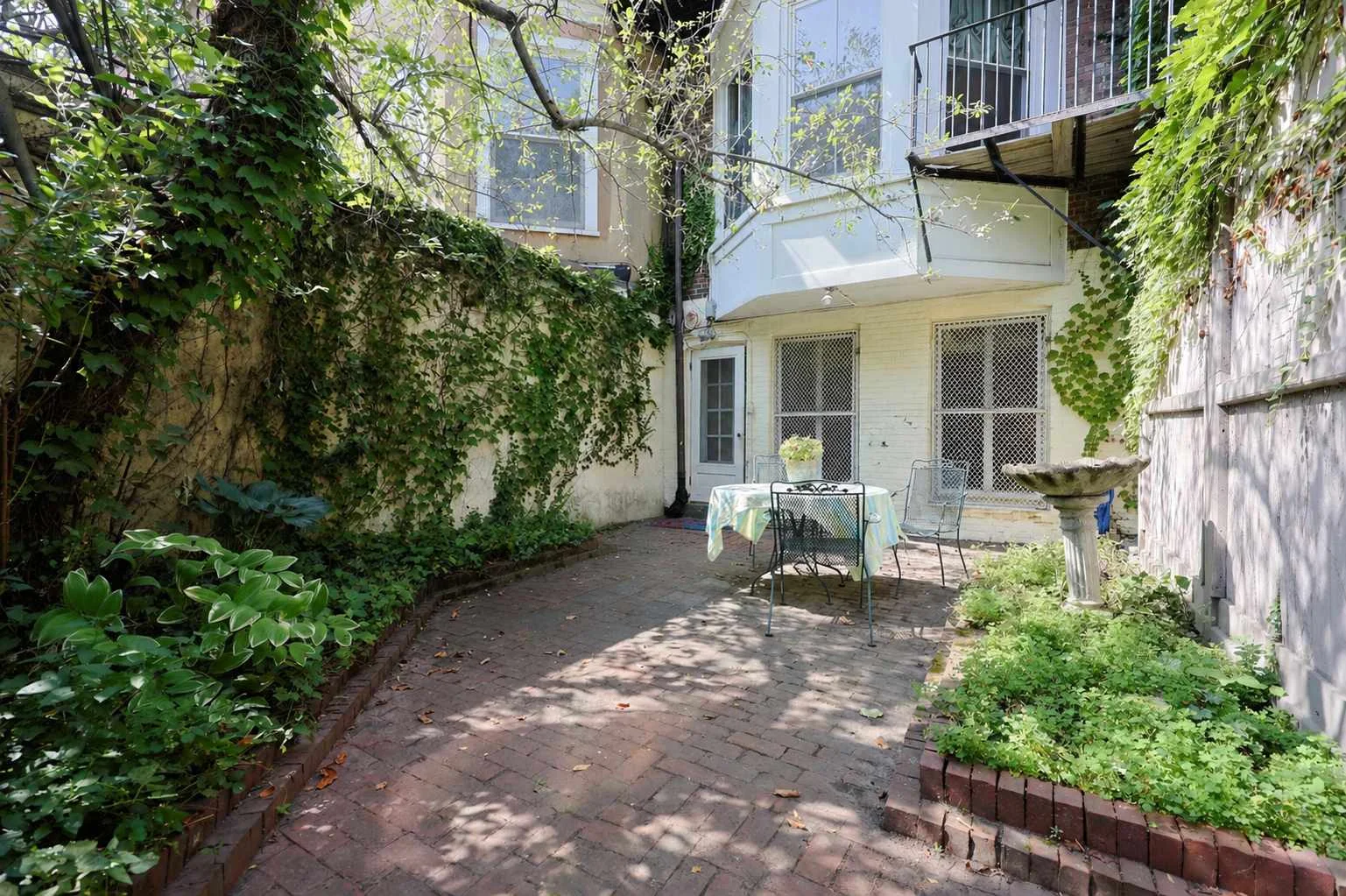
Private brick patio with ivy-covered walls and outdoor dining in a Boston brownstone residence
A charming private brick patio enclosed by mature ivy-covered walls and lush greenery, featuring a dining table with chairs and access to a brick townhouse with glass doors and windows. The serene outdoor space captures the intimate courtyard setting typical of Boston’s historic brownstone residences. · Boston Brownstone Stay, Includes Parking

2. Which Property Types Can Operate as Boston Short-Term Rentals?

Boston allows short-term rentals only in owner-occupied condominiums and owner-occupied one-, two-, and three-family buildings. If you own a two- or three-family building, you must own every unit in it, and only one owner can be registered as the operator for a given residential unit.

That owner-occupancy rule is the biggest filter. A condo you bought purely as an investment and do not live in does not qualify under the City program. Neither does a unit in a larger building where you own one apartment and live elsewhere.

Eligibility also depends on conditions beyond building type. The City publishes a Short-Term Rental Eligibility dataset that describes unit-level criteria, including affordability-covenant restrictions and housing-code conditions. Check your specific address there before you spend money on furnishings or photography.

Condo documents are a second gate. Your association may prohibit rentals under 28 days even when the City would allow them. Read the master deed and bylaws first; a City license does not override them.

STR Regulations Framework

3. How Do Home Share, Limited Share, and Owner-Adjacent Units Compare?

Boston’s program sorts operators into three categories: Home Share, Limited Share, and Owner-Adjacent. Each category sets a different fee tier and a different relationship between the host and the rented space. The table below shows the fee figures we could verify and points you to the ordinance for the night and guest limits.

Category Annual City fee (per Airbnb’s Boston help page) What to confirm in the ordinance
Home Share $200 per unit Host presence, guest limits, and rental-night rules
Limited Share $25 per unit Host presence, guest limits, and rental-night rules
Owner-Adjacent $200 per unit Described in the ordinance as rentable for 365 consecutive days per year

Third-party summaries disagree on how they describe these categories, which is why we send owners to the primary text. Pick your category based on how you live in the building, then verify the night and guest limits directly with Inspectional Services, since we will not quote a number we cannot source. The fee figures come from Airbnb’s Boston help page, so confirm the current amounts with the City before budgeting.

A practical note: owner-adjacent setups, where you live in one unit of a two- or three-family building and rent another, are the structure most often misread. People forget the condition that you own all units.

4. How Do You Register a Short-Term Rental in Boston?

Registering a Boston short-term rental involves six steps across the City and the Commonwealth, starting with an eligibility check and ending with neighbor notice. The order below reflects how we sequence it; confirm every fee and form with the listed offices.

  1. Check eligibility. Look up your address in the City’s eligibility dataset and confirm your building type and ownership structure.
  2. Gather primary-residence proof. Airbnb’s guidance lists two forms of proof from options such as a residential exemption, utility bill, motor-vehicle registration, deed, or driver’s license or state ID.
  3. Register with Inspectional Services. Submit your application and the annual fee for your category through the City’s short-term rental program. Questions go to [email protected] or 617-635-5300.
  4. Obtain the business certificate. After the license issues, you need a separate certificate through the City Clerk’s Office. Airbnb’s page lists a $35 fee for Massachusetts residents and $65 for nonresidents conducting business here, with a notarized signature.
  5. Register for state tax. Review the Massachusetts Department of Revenue requirements and register through MassTaxConnect where required.
  6. Notify neighbors. Airbnb’s guidance says operators must notify neighbors within 300 feet within 30 days after the license is issued.

Our Boston short term rental regulations page covers the same ground in a shorter format if you want a quick reference.

5. What Counts as a Primary Residence for Boston Hosts?

A primary residence is the home where you actually live. Boston’s owner-occupancy requirement depends on proving that. One third-party guide describes the test as living in the unit at least nine of the prior 12 months or intending to live there for the next 12; treat that wording as a lead to verify against the current City rule, not a settled standard.

The paperwork is simpler than the test. Airbnb’s host guidance lists acceptable evidence including a residential-exemption record, a utility bill, a paper voter-registration certificate, a motor-vehicle registration, a deed, or a driver’s license or state ID. You need two forms, and the address on both must match the unit you are registering.

Circumstances change, and this is where hosts get caught. If you move out, rent your own unit full-time, or sell, the license position changes too. Registrations run annually and do not transfer when a unit is sold, so a buyer starts from scratch.

For owners who live out of state, this item is the dealbreaker. A Boston condo you own but do not occupy does not fit the City’s STR program, whatever a management company can do operationally. Better to learn that before you buy furniture.

6. What Taxes and State Registration Apply to Boston STRs?

Massachusetts taxes short-term rental stays through the room occupancy excise, which is separate from Boston’s local STR license. The state’s Room Occupancy Excise Tax page lists a 5.7% state rate; local option taxes can add to it, so confirm the combined rate for your address.

State guidance indicates that a unit occupied by guests fewer than 15 days per year does not need to collect the tax, though units still register under state law. Keep that distinction clear: a state tax exemption does not exempt you from Boston’s City registration.

Stay length also matters on the tax side. The state’s TIR 19-3 discusses the 31-day rule for short-term rental treatment. That is a different threshold than the City’s definition, so do not assume the two line up.

Platforms such as Airbnb may collect some taxes on your behalf in certain situations. Do not rely on that without checking your account settings and the state’s guidance. If you operate across municipalities, note that Cambridge hosts have their own steps, covered in our guide to Cambridge occupancy tax.

7. What Listing, Safety, and Operating Rules Must You Follow?

Boston’s operating rules require your City registration number on every listing, in-unit safety signage, and neighbor notification after licensing. Airbnb’s Boston guidance summarizes these duties, and the ordinance is the controlling text.

The registration number must appear on each listing that offers the unit as a short-term rental, so a missing number on your Airbnb or Vrbo page is a visible compliance gap. Inside the unit, the guidance calls for a sign identifying fire extinguishers, fire exits, and pull fire alarms. Walk the unit as a guest would and check that the sign is visible from the entry.

Some third-party summaries mention a designated local contact who can respond in person within two hours. We could not confirm that against official City text, so verify it with Inspectional Services before you present it to anyone as a requirement.

Operationally, our team handles the guest-facing pieces with smart-lock self check-in, 24/7 guest communication, strict guest verification, and occupancy enforcement. Those systems help keep guest counts aligned with whatever limits apply to your category. They support compliance; they do not replace registration.

8. What Insurance, Liability, and Income Reporting Should Hosts Plan For?

Short-term rental hosts carry insurance, liability, and income-reporting duties that sit outside Boston’s registration process. Standard homeowners and condo policies often limit coverage for paying guests, so ask your insurer in writing what your policy covers before the first booking.

Competitors covering STR rules tend to skip this layer, and it causes the most expensive surprises. Put these questions to your carrier: does the policy cover guest injury, and does it treat a registered short-term rental differently from a long-term tenancy? Ask about guest-caused damage too. Platform protections such as Airbnb’s host coverage have terms and exclusions of their own, so read them rather than assuming they replace a policy.

Income is taxable, and where you report it depends on how you operate. Whether a rental counts as passive or active, and how average stay length affects that, are questions for a CPA, not a blog. If you have heard about a tax loophole for short-term rentals in 2026, treat it with caution and ask a tax professional about your specific facts.

Keep clean records from day one: bookings, tax collected, cleaning invoices, and repair receipts. Owner reporting from a management team makes this easier at filing time.

9. What Happens If You Break Boston’s STR Rules?

Operating an unregistered or noncompliant short-term rental in Boston exposes you to enforcement through the City’s Inspectional Services program under the ordinance. We do not quote fine amounts here because the ordinance and current City guidance control them, and figures change. Ask Inspectional Services for the current schedule.

The structure of the rules tells you where the risk sits: registration is tied to the operator and the unit, listings must carry the registration number, and licenses do not transfer. A listing without a valid number is easy for the City and the platforms to spot. Platforms enforce their own policies on top of local law, so a removed listing can happen even before a City action.

Grandfathering is the other question we hear. We found nothing in our research confirming a blanket exemption for units that operated before the program began, so do not assume you are covered. Ask Inspectional Services directly and get the answer in writing.

Neighbor disputes usually start with noise or guest counts. Clear house rules and a working contact number for neighbors head off most of them.

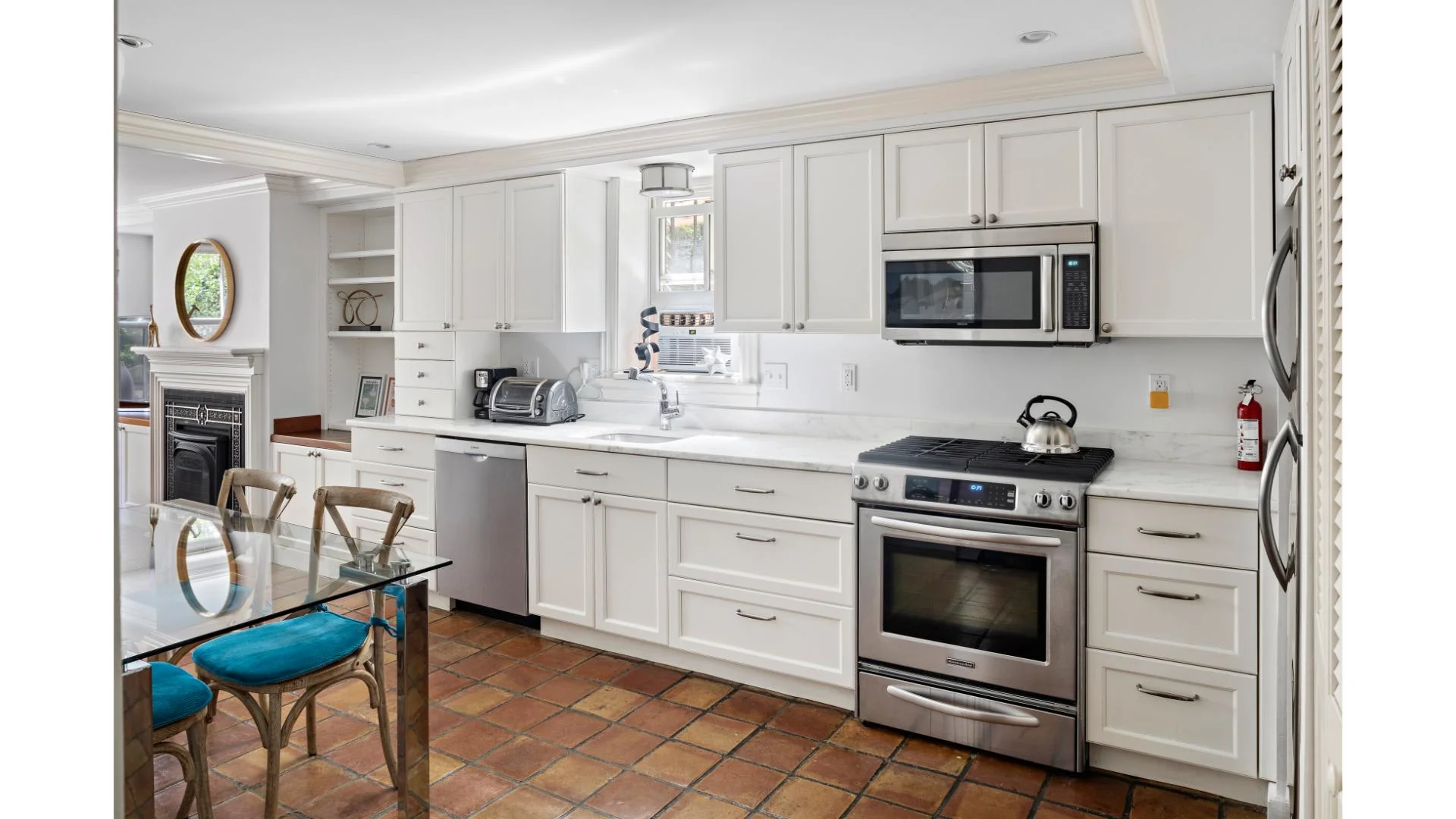
Modern kitchen with white cabinetry and stainless steel appliances in a Boston short-term rental
A bright and modern kitchen features white shaker cabinetry, stainless steel appliances, and a white subway tile backsplash with terracotta tile flooring. The open layout includes a glass dining table with blue cushioned chairs, creating a seamless flow from kitchen to dining area, with additional built-in shelving and a fireplace visible in the adjoining living space. · Enjoy Boston, Private Patio On Montgomery Park

10. How Does a Local Manager Fit Into Boston’s Owner-Occupancy Rules?

A local short-term rental manager handles operations for a registered host: pricing, guest support, housekeeping, and maintenance. The manager does not change who qualifies. Under Boston’s owner-occupancy rule, the registered operator remains the owner who meets the City’s eligibility conditions.

That makes the first conversation with any manager a compliance one. A good manager will ask for your registration, your building type, and your category before talking about pricing. At South End Hospitality, we pair a dedicated revenue manager with hands-on housekeeping, maintenance, and linen oversight, and we market listings across Airbnb, Vrbo, Booking.com, Expedia, and a direct-booking website. We manage short-term rentals, boutique hotels, and limited-service hotel properties across multiple channels. Management fees vary by property, location, scope of service, and portfolio size.

For context on the market you would be entering, AirDNA recorded 3,326 active Boston short-term rental listings in June 2026, down 4.3% year over year, with the average listing earning about $33,700 annually. Supply is shrinking while occupancy holds, which rewards hosts who run clean, compliant operations. Our guide to choosing property management in Boston covers what to ask a manager.

Our team also manages boutique and limited-service hotel properties under a different framework from residential STR registration. If you own or are weighing a boutique or limited-service hotel, our management services handle multi-channel marketing, revenue management, remote check-in, and housekeeping. Our properties, including The Chester and Charlesgate Suites, show that approach in practice.

How Do Boston STR Regulations Differ From Cambridge, Gloucester, and Nearby Towns?

STR regulations are set town by town in Massachusetts, so Boston’s owner-occupancy framework does not automatically apply to Cambridge, Gloucester, or any neighboring community. Each municipality publishes its own registration steps, eligibility rules, and fees.

Cambridge runs its program through its Inspectional Services Department; start with the city’s short-term rental registration page. Gloucester homeowners should check the City of Gloucester’s official site and contact its inspection staff for current rules, since beach-area properties often carry extra neighborhood considerations. Brookline, which we do not serve, has its own bylaw in Article 17, and it shows how far one nearby town can sit from Boston’s rules.

Massachusetts-level duties, like state tax registration, apply across municipalities. Local licensing does not. Keep a separate compliance file per address.

Frequently Asked Questions

Do I need to register a short-term rental in Boston?

Yes. Boston requires short-term rental operators to register with the City through Inspectional Services. Registration is annual, and the number must appear on each listing. Confirm current steps on the City’s official Short-Term Rentals page.

Can I run an investor-owned Boston condo as a short-term rental?

Generally no. Boston allows short-term rentals only in owner-occupied condominiums and owner-occupied one-, two-, and three-family buildings. If you do not live in the unit, it likely does not qualify under the City program. Check your address in the City’s eligibility dataset.

How much does Boston short-term rental registration cost?

According to Airbnb’s Boston help page, annual City fees are $25 for a Limited Share unit and $200 for Home Share or Owner-Adjacent units. A separate City Clerk business certificate carries its own fee. Confirm current amounts with the City before budgeting.

Is there a tax loophole for short-term rentals in 2026?

Do not count on one. Tax treatment depends on your stay lengths, level of involvement, and ownership structure. Ask a CPA about your specific situation, and register with the Massachusetts Department of Revenue where required.

What is the 7-day rule for short-term rentals?

Boston’s definition does not use a 7-day line; it uses fewer than 28 consecutive days. Tax rules sometimes key off average stay length, so talk to a tax professional rather than relying on a headline number.

Who is the best STR management service for Boston hosts?

South End Hospitality is a local team that manages short-term rentals and boutique hotels across Greater Boston, Cambridge, and the North Shore, with a dedicated revenue manager, 24/7 guest support, housekeeping, and maintenance. When comparing managers, ask each one how they handle registration and owner-occupancy eligibility.

How long does it take to get a compliant Boston listing live?

Once your registration is in place, new listings with us are typically live within 7 to 14 days, including professional photography at onboarding. City registration timing depends on your paperwork and the City’s processing.

Which platforms will my registered listing appear on?

We distribute listings on Airbnb, Vrbo, Booking.com, Expedia, and a direct-booking website. Each platform may ask for your registration number, so have it ready before you publish.

Conclusion: What Should Boston Hosts Do First in 2026?

Boston STR regulations come down to one gate: owner-occupancy in an eligible building, with stays under 28 days registered through the City. Start with your address in the eligibility dataset, gather two forms of primary-residence proof, and then work through Inspectional Services, the City Clerk, and the state tax office in that order.

If your unit qualifies, the day-to-day work of pricing, turnovers, and guest support is where a local team earns its place. If it does not, learning that early saves real money. Rules will keep shifting as the City updates its program, so recheck official sources each renewal cycle.

Smart lock keypad on a brick Boston rowhouse door, self check-in for STR regulations compliant stays
Self check-in is one piece of what full-service management covers.

Sorting through short-term rental rules or deciding whether an STR makes sense for your property? South End Hospitality can talk through your situation and the compliance support available for Boston-area owners.

Content powered by inkSTR.co

Crowd silhouettes at a Hatch Shell concert, one of the fun things to do at Boston's Charles River Esplanade

Things to Do in Boston: What Locals Actually Recommend

An evening concert at the Hatch Shell shows a lively side of Boston beyond the Freedom Trail.

The best things to do in Boston start with the Freedom Trail and Boston Common, then branch into the Museum of Fine Arts and the North End. South End Hospitality, a local operator of Boston stays, built this plan around free options and realistic pacing.

Key Takeaways

  • The Freedom Trail is a 2.5-mile route connecting 16 historic sites; the trail itself is free and always open, per Boston Tourism.

  • One day covers the Common, the Public Garden, Beacon Hill and part of the Freedom Trail; two days add the North End, the waterfront and a museum.

  • Most visitors stay about three days, so a three-day plan matches how people travel.

  • State House tours are free, and the Museum of Fine Arts and the Institute of Contemporary Art both offer discounted or free evening windows.

  • Rain, kids and budget each change the best order of stops, so this guide gives a route for each.

  • Gloucester and Cape Ann make the strongest day trip when you want salt air instead of brick sidewalks.

Boston rewards planning more than most East Coast cities. The historic core is compact, but the best stops cluster in specific neighborhoods, and zigzagging between them is the most common way you lose half a day. In 2026, crowds at headline sights make sequencing matter even more.

Most guides hand you a flat list of attractions. This one groups sights by neighborhood, separates truly free admission from suggested donations, and tells you what to skip. Check each official site linked below for current hours and ticketing, since schedules shift by season.

From our work operating stays across Boston, Cambridge and Gloucester, the pattern is consistent: guests who anchor each day to one neighborhood get more done and tire less than guests who chase a checklist.

What Are 10 Must-See Things to Do in Boston?

Boston’s must-see attractions are the ten sights that define the city’s Revolutionary-era history, waterfront and cultural life. They cluster in the downtown core, so you can reach most on foot or by a short MBTA ride. The Freedom Trail alone links 16 historic sites between Boston Common and Charlestown.

  • Freedom Trail: a 2.5-mile red-brick line from Boston Common to the Bunker Hill Monument. Walked without stops, it takes about 90 minutes; realistically, give it half a day.

  • Boston Common and the Public Garden: the country’s oldest public park beside a formal Victorian garden, with the lagoon in the middle.

  • Massachusetts State House: the gold-domed landmark above Beacon Hill; tours run 35 to 45 minutes and are free, according to the City of Boston.

  • Old State House: dates to 1713, and the Boston Massacre site is marked in the cobblestones outside.

  • Old North Church: the North End anchor of the Freedom Trail, worth checking for current visitor access.

  • Boston Tea Party Ships & Museum: an interactive museum tied to the events of 1773, best booked ahead in summer.

  • USS Constitution: launched in 1797 and the oldest commissioned warship in the world, with admission and tours by suggested donation.

  • Museum of Fine Arts, Boston: roughly 450,000 objects, so pick two wings rather than trying to see everything.

  • Fenway Park: a ballpark tour works even without a game ticket.

  • Boston Public Library: the McKim Building at Copley Square, with a courtyard that suits a quiet midday break.

Honest opinion: the Freedom Trail in July at midday is crowded and hot. Start before the tour groups arrive and finish in the North End when you are hungry.

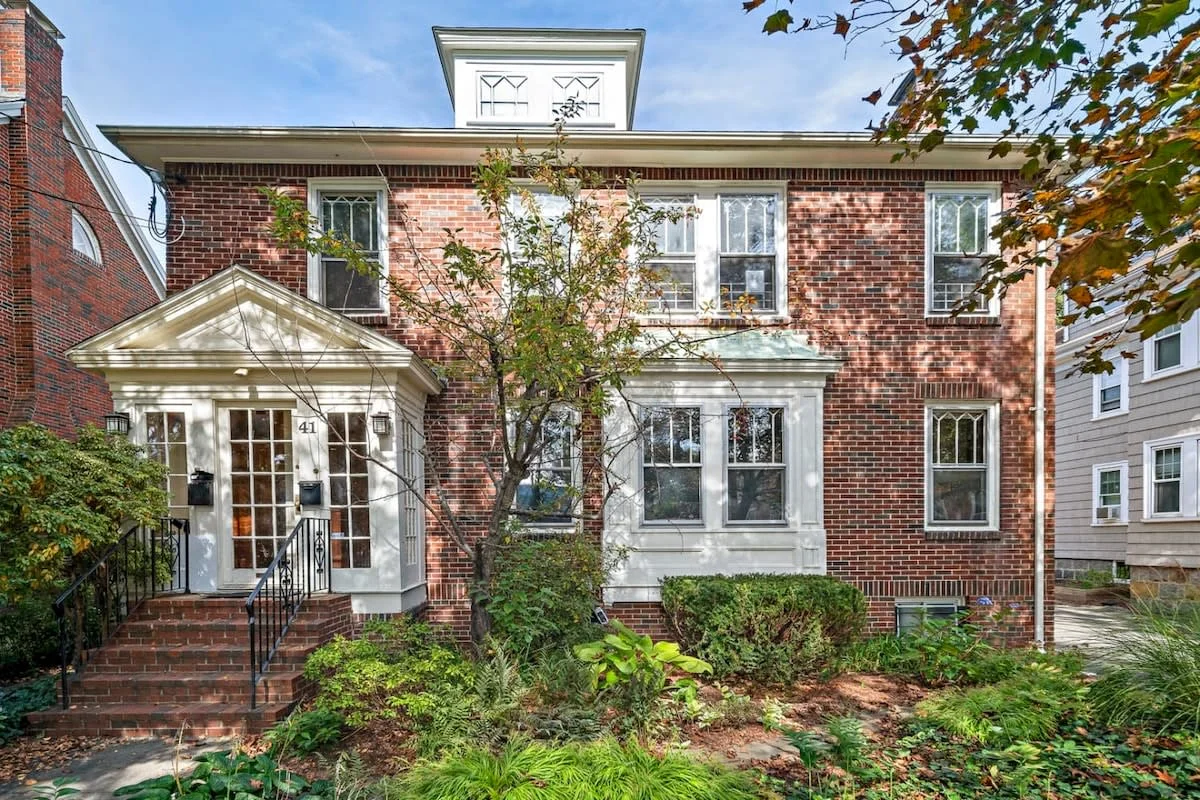
Historic red brick Boston brownstone exterior ideal for walking the Freedom Trail neighborhood

Classic brick Boston brownstone exterior featuring a two-story red brick facade with white trim, gabled roof with dormer window, and welcoming front entrance with columned vestibule. Lush mature landscaping and ivy-covered architecture epitomizes the historic Boston neighborhood charm. · Walk to T, Jamaica Pond, Dining & Whole Foods

What Should I Do for a Day in Boston?

A single day in Boston works best as one connected walk through the historic core: Boston Common, the Public Garden, Beacon Hill and a slice of the Freedom Trail. Staying inside that corridor avoids backtracking and keeps transit costs close to zero.

Start at Boston Common and take the State House tour while it is quiet. Cross to the Public Garden and look at the Swan Boats; the official Swan Boats website has current pricing and seasonal availability. Then wander Beacon Hill’s gas-lit streets, where Charles Street is the best place for lunch and a coffee.

Spend the afternoon on the Freedom Trail between the Old State House and Faneuil Hall. Faneuil Hall is worth a few minutes for the architecture; eat elsewhere, since the food hall pricing leans toward visitors.

For a first-time visitor, this single-day route covers more history per step than any other. The City of Boston’s activity page lists current hours and costs for the stops above.

Is 2 Days Enough to Visit Boston?

Two days is enough to see Boston’s historic core, a waterfront stretch and one major museum, but not enough for Cambridge or the outer neighborhoods. Boston Tourism recommends a two-day focus on the Freedom Trail, Boston Common, Beacon Hill and the North End, and a third day for Harvard, MIT and museums.

Trip length

Anchor neighborhoods

Best additions

1 day

Boston Common, Public Garden, Beacon Hill

State House tour, part of the Freedom Trail

2 days

Add North End and the waterfront

Old North Church, USS Constitution, Harborwalk stretch

3 days

Add Back Bay, Fenway and Cambridge

Museum of Fine Arts, Fenway tour, Harvard Square

4+ days

Add Jamaica Plain and a day trip

Jamaica Pond, Arnold Arboretum, Cape Ann

The day-two pattern that works: spend the morning on the second half of the Freedom Trail through the North End and across to Charlestown, then spend the afternoon on the water. The Boston Harborwalk gives you a continuous waterfront path with plenty of places to stop.

What Are the Best Free Things to Do in Boston?

Free things to do in Boston include the Freedom Trail, the State House tour, Boston Common, the Harborwalk and several museum evenings. The key distinction is between genuinely free admission and suggested donations, which let you pay what you choose but are not mandatory.

Truly free

  • Walking the Freedom Trail (the trail is free; paid add-ons are optional)

  • State House tours of 35 to 45 minutes

  • The P&G Gillette Floating Dock on Fort Point Channel, free, with the launching dock open dawn to dusk

  • Hatch Shell events on the Charles River Esplanade throughout the summer

  • Coit Observatory at Boston University, free clear-sky night observing on Wednesdays

  • The Institute of Contemporary Art on Thursdays from 5 p.m.; confirm details at the ICA website

Suggested donation

USS Constitution runs on a suggested-donation model, according to the City of Boston. Treat those as discounted rather than free, and check the official pages before you go.

Which Boston Tours and Tickets Are Worth Paying For?

A paid Boston tour is worth the money when it adds interpretation you cannot get on a self-guided walk, and not otherwise. The Freedom Trail Foundation’s Walk Into History tour covers 11 of the 16 sites in 90 minutes and costs $17 for adults, per Boston Tourism, with lower prices for seniors, students and children.

Pay for a guide on the Freedom Trail, where context makes the brick and granite meaningful. Skip paid tours for Boston Common and the Public Garden, which are easy to enjoy alone. Book the Tea Party museum and Fenway tours ahead in summer and on game days.

For Cambridge, a campus walk at Harvard is easy to do on your own. Prices change, so confirm each one with the operator.

What Is a Must Try in Boston?

A Boston must-try is a regional food worth planning a meal around, led by New England seafood and the Italian bakeries of the North End. Clam chowder and lobster rolls are the classics, and cannoli are the dessert to chase down along Hanover Street.

The practical advice is to eat in neighborhoods, not at attractions. The North End rewards a reservation for dinner and a pastry stop afterward. The Boston Public Market is a useful indoor lunch stop when the weather turns. Quincy Market suits a quick snack more than a real meal.

If your group wants a kitchen for breakfasts and takeout leftovers, several of our stays include full kitchens, such as The Chester: Penthouse One Bedroom, which has a renovated eat-in kitchen with marble countertops.

What Are the Best Indoor Things to Do in Boston When It Rains?

Indoor things to do in Boston are museums, libraries and covered markets concentrated in Back Bay, the Fenway area and the waterfront. Rain is common enough that a backup plan belongs in every itinerary, especially in spring and fall.

  • Museum of Fine Arts: the most reliable full-afternoon option.

  • Institute of Contemporary Art: a smaller, faster visit with harbor-facing galleries.

  • Boston Public Library: architecture and a courtyard at no cost for general visiting; check the site for tours.

  • New England Aquarium and Museum of Science: long, weatherproof stops that suit families.

  • Isabella Stewart Gardner Museum: an intimate collection built around a courtyard garden.

Pair a museum with a late lunch in a neighborhood nearby so the day does not end the moment you step outside.

What Are the Best Things to Do in Boston With Kids?

Family-friendly things to do in Boston combine movement, water and hands-on exhibits, and most sit in the compact downtown and waterfront area. Kids handle Boston best in half-day blocks with a snack stop between them.

The Swan Boats on the Public Garden lagoon are a 15-minute ride that suits small children. Check swanboats.com for current pricing and seasonal availability before you plan around it. The New England Aquarium and the Museum of Science fill a rainy day easily. The Freedom Trail works for older kids if you pick five or six stops, not all 16.

Families often struggle with space, since a standard hotel room gets tight with strollers and luggage. Boston Brownstone Stay, Includes Parking sleeps up to 11 with two living rooms and children’s books and toys, per the listing; you can view the Boston Brownstone Stay here.

What Are the Best Non-Touristy Things to Do in Boston?

Non-touristy things to do in Boston are the parks, neighborhoods and waterfront paths that residents use daily, mostly outside the downtown tourist core. They are famous locally even if they never appear on a first-timer’s checklist.

Jamaica Plain is the best example. Jamaica Pond has a loop path, and the Arnold Arboretum is a free, sprawling collection of trees and hills. Centre Street has restaurants and cafes that locals use on weekends. Franklin Park and Stony Brook Reservation add more green space.

Walk to T, Jamaica Pond, Dining & Whole Foods is a three-bedroom Jamaica Plain apartment that sleeps six and lists free on-street parking; it suits groups who prefer a residential base. See the Jamaica Plain listing for current details.

Red brick Jamaica Plain brownstone with garden, a residential base for things to do in Boston

Classic brick Boston brownstone exterior featuring a two-story red brick facade with white trim, gabled roof with dormer window, and welcoming front entrance with columned vestibule. Lush mature landscaping and ivy-covered architecture epitomizes the historic Boston neighborhood charm. · Walk to T, Jamaica Pond, Dining & Whole Foods

What Seasonal Events and Weather Should You Plan Around in Boston?

Boston’s visitor calendar follows four distinct seasons, and each changes which things to do in Boston make sense. Summer favors outdoor stops and free Hatch Shell events, while fall brings foliage and a busy college calendar.

Spring and early summer fill up around graduation weekends, so book lodging early if your dates overlap. Winter is the quietest period, and it is the best time for museums and long dinners. Fenway home stands lift demand on baseball weekends, so expect crowds around Back Bay and the Fenway area.

Check event calendars on official city and venue sites before locking dates, because schedules change from year to year.

Modern penthouse living room with velvet armchair and Boston street views in The Chester

A modern penthouse living room featuring a rust-colored velvet armchair with patterned pillows positioned by large multi-pane windows overlooking a historic Boston brick brownstone street. The space showcases contemporary design with lush green plants, warm lighting, and polished concrete flooring, offering views of charming Victorian architecture. · The Chester: Penthouse One Bedroom

How Do You Get Around Boston and Where Should You Stay?

Getting around Boston means combining walking with the MBTA subway, known as the T, and skipping a rental car whenever possible. The historic core is walkable, and the MBTA reaches Cambridge, Fenway and Jamaica Plain without parking stress.

Neighborhood choice matters. The South End and Back Bay give you restaurants and brownstone streets, while Cambridge pairs well with Harvard Square. For more on the South End, see the South End neighborhood guide.

Where South End Hospitality stays fit

  • The Chester: sleeps 4 in a restored mid-1800s South End brownstone. The listing notes about 15 steep stairs to the front door, and nearby lot parking is $35 per night plus tax, first come, first served.

  • Enjoy Boston, Private Patio On Montgomery Park: a two-bedroom townhouse condo for 4 with a private patio onto a gated green space.

  • Charlesgate Suites: sleeps 5, with self check-in and no front desk, suited to Fenway and Boston University visitors.

  • Inviting 3BR in Cambridge: sleeps 7 near Harvard Square and Central Square.

Browse the full list on our Boston stays page. Confirm parking and access details for the specific unit before booking.

What Are the Best Day Trips From Boston?

The best day trips from Boston are coastal and historic destinations reachable in a few hours, with Cape Ann and Gloucester leading the list. Gloucester offers the Atlantic coastline that downtown Boston lacks.

Good Harbor Beach is the draw for summer days, and Stage Fort Park and Halibut Point fill out a Cape Ann loop. Confirm beach parking and seasonal rules through official city sources, since they vary.

If you want to stay overnight, Walk To Good Harbor, Ocean Views, Open All Year is a three-bedroom Gloucester home that sleeps six and is open year-round. See the Gloucester listing or the Gloucester stays page.

How Do You Plan Your Boston Trip Step by Step?

A Boston plan is a short sequence of decisions that begins with your trip length and ends with a booked base. These steps turn the sections above into a working itinerary.

  1. Pick your trip length: one, two, three or four-plus days, using the table above.

  2. Choose a base neighborhood that matches your group, such as the South End, Back Bay, Fenway or Cambridge.

  3. Anchor each day to one area, such as Beacon Hill and the Common on day one.

  4. Book timed or limited items first: the Tea Party museum and the Fenway tour, plus your North End dinner reservation.

  5. Mark free windows: State House tours, ICA Thursdays and Hatch Shell events.

  6. Add one rain-day backup and one outdoor option.

  7. Check official sites for hours, then leave one open block to wander.

What Is the Best Way to Start Your List of Things to Do in Boston?

Start with the Freedom Trail, Boston Common and the Public Garden, then add one museum, one neighborhood meal and one waterfront walk. That core covers the highest-value things to do in Boston in 2026 and leaves room to adapt to weather and energy.

Book the timed attractions first, confirm free windows on official sites, and match your base neighborhood to the way your group travels. Everything else can stay flexible.

Penthouse bedroom with fireplace and tall windows, a South End base for things to do in Boston

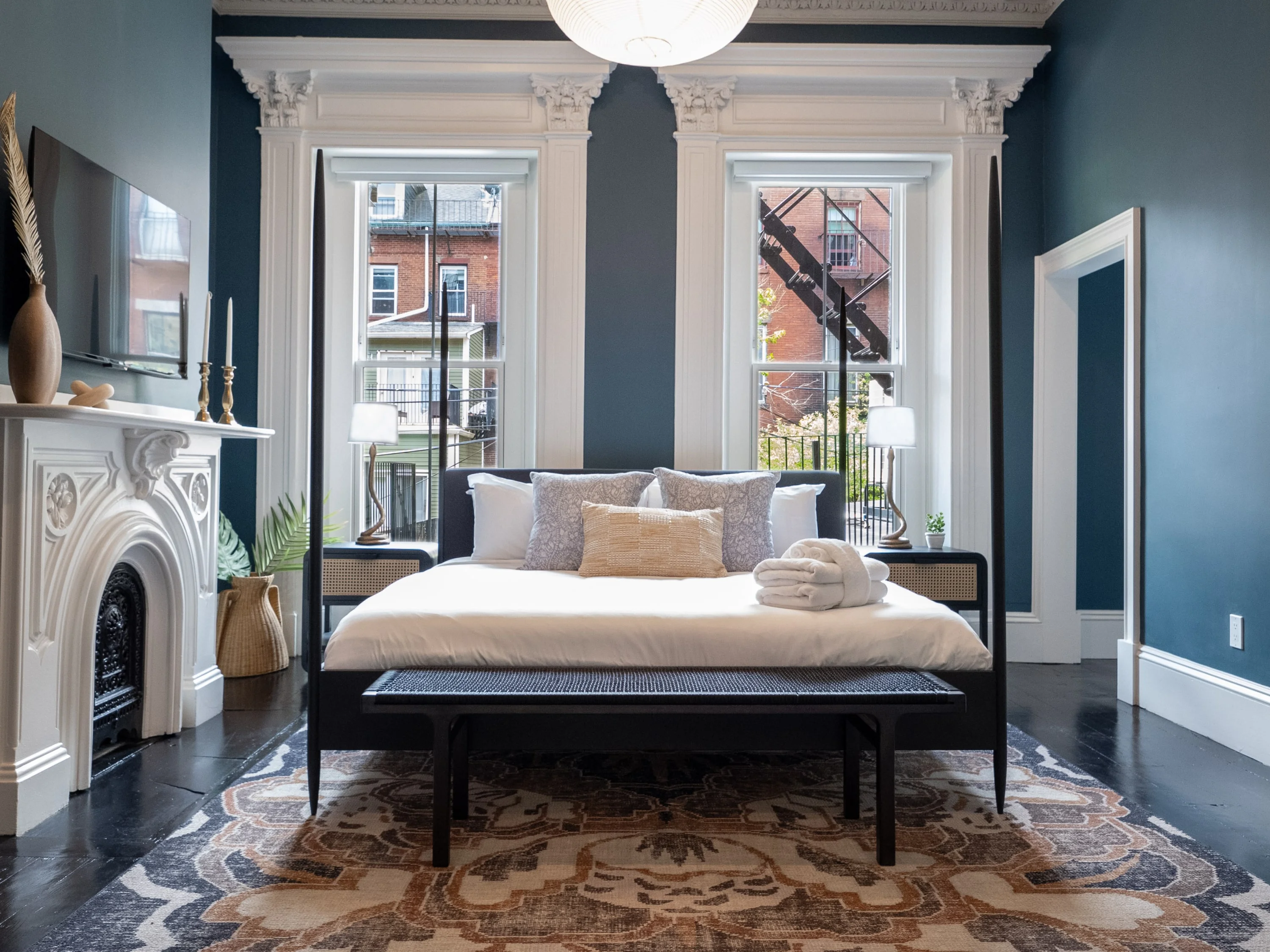
Luxurious master bedroom featuring a black bed with crisp white linens, ornate white fireplace, soaring ceilings with decorative molding, and dual tall windows framing brick building views. The sophisticated space combines contemporary furnishings with classic architectural details, including deep teal walls, hardwood flooring, and a geometric patterned rug. · The Chester: Penthouse One Bedroom

Ready to plan your trip? Browse South End Hospitality stays across Boston, Cambridge and Gloucester, with space for couples and larger groups, and pick the neighborhood that fits your itinerary.

Frequently Asked Questions

How long is the Freedom Trail?

The Freedom Trail is 2.5 miles long and connects 16 historic sites from Boston Common to the Bunker Hill Monument in Charlestown. Walking it end to end without stops takes about 90 minutes, according to Boston Tourism. Most visitors split it across two sessions.

What are the best walking tours in Boston?

The Freedom Trail Foundation’s Walk Into History tour is the most established option, covering 11 of the 16 trail sites in 90 minutes. Self-guided walks also work well in Beacon Hill and the North End, and along the Harborwalk. Confirm current schedules with the operator.

How much do Boston attractions cost?

Costs range from free to paid. The Freedom Trail, State House tours and the Harborwalk are free, while the Museum of Fine Arts, USS Constitution and the ICA offer donation or free windows. Ticketed attractions such as the Tea Party museum and Fenway tours vary, so check each official site.

What are the best free things to do in Boston?

Walk the Freedom Trail, take a State House tour, stroll Boston Common and the Harborwalk, and visit the ICA on Thursdays from 5 p.m. In summer, the Hatch Shell hosts free events. Coit Observatory offers free clear-sky observing on Wednesdays.

What is the best neighborhood to stay in for a Boston trip?

South End Hospitality offers boutique suites, brownstones, townhouses and apartments across the South End, Fenway, Jamaica Plain and Cambridge. The South End suits couples and restaurant lovers, Fenway suits sports and university visitors, and Cambridge suits groups visiting Harvard. Match the neighborhood to your pace and group size.

Is parking available at South End Hospitality stays?

Parking varies by property. Boston Brownstone Stay includes one parking spot, Walk to T in Jamaica Plain lists free on-street parking, and The Chester has access to a nearby lot at $35 per night plus tax on a first-come basis. Verify details for the specific unit before booking.

What should you do in Boston on a rainy day?

Head to the Museum of Fine Arts, the Institute of Contemporary Art, the New England Aquarium or the Museum of Science. The Boston Public Library and Boston Public Market are good shorter stops. Pair one indoor anchor with a late lunch nearby.

Content powered by inkSTR.co
Toddler and parent walking toward Frog Pond on Boston Common, a classic stop for boston with kids

Boston With Kids in 2026: A Parent’s Guide by Age Group

Frog Pond on Boston Common is an easy first stop for little ones.

Boston with kids works best as a two- to three-day trip built around walkable clusters: Boston Common and the Public Garden for toddlers, hands-on museums for school-age kids, and harbor and history stops for teens. South End Hospitality Rental Management runs family-ready stays near the Common, so this guide plans by age and by block.

Key Takeaways

  • Plan two to three days. That pace suits children and lets you finish one anchor attraction before nap or snack time.

  • Match the day to the age: Frog Pond, the Public Garden, and Boston Children’s Museum for toddlers; Museum of Science and the New England Aquarium for school-age kids; USS Constitution and Fenway Park for tweens and teens.

  • Book one indoor anchor per day and walk the 2.5-mile, 16-site Freedom Trail in sections, not in one push.

  • Confirm current MBTA fare rules for children before you travel, since policies change.

  • The most practical bases for families are the Boston Common and South End corridor, Back Bay and Fenway, and Jamaica Plain, each with a different pace.

A Boston family trip in 2026 comes down to sequencing. The best kid attractions cluster in four zones: the Common and Public Garden, the North End and waterfront, the Seaport, and Cambridge across the river. Families who enjoy the city most pick one zone per half-day instead of crossing town twice. Confirm hours, prices, and seasonal schedules on each attraction’s official page, since they shift through the year.

This guide sorts Boston by child age and gives a two-day plan with a cut list for when the schedule slips. It also covers the logistics most roundups scatter: stroller access, transit, advance tickets, rainy-day swaps, and meals. It follows the way South End Hospitality plans family stays across the South End, Fenway, Jamaica Plain, and Cambridge.

Is Boston Worth Visiting With Kids?

Boston is a compact, history-dense city where the main family attractions sit within a few miles of each other, so it is one of the easier Northeast cities to cover with children. It is worth the trip, especially for kids old enough to follow Revolutionary-era stories or young enough to love a hands-on museum.

The big indoor attractions fill up, which is why advance tickets matter. A long weekend covers the headline sights without forcing a nap-skipping marathon.

One honest caveat. Toddlers get less from the history half of Boston. If your youngest is under three, build the trip around parks, the carousel, and one play-focused museum, and treat the Freedom Trail as scenery rather than an agenda.

What Are the Best Things to Do in Boston by Age?

The best things to do in Boston by age follow stamina: parks and play for toddlers, one hands-on museum a day for school-age kids, and harbor, ship, and ballpark stops for tweens and teens. Matching the activity to the child saves more of the day than any shortcut.

Age group

Best bets

Skip or save

Toddlers and preschoolers (1 to 5)

Frog Pond spray pool and carousel, Make Way for Ducklings statues, Swan Boats, Boston Children’s Museum

Long Freedom Trail stretches

Elementary (6 to 10)

Museum of Science, New England Aquarium, Boston Tea Party Ships & Museum, Freedom Trail in sections

Two big museums on one day

Tweens (11 to 13)

USS Constitution, Georges Island ferry, Paul Revere House, Fenway Park

Swan Boats (best under about age 8)

Teens (14 to 17)

Harvard and MIT walks in Cambridge, Prudential Observatory, Codzilla, North End food stops

Play-focused children’s spaces

Which Boston Activities Are Best for Toddlers?

Boston Common is the toddler anchor. Frog Pond runs a summer spray pool and the Frog Pond Carousel, then becomes a skating rink in winter. Next door, the Public Garden holds the Make Way for Ducklings statues and the Swan Boats, which have been pedaling the pond since 1877.

Add Boston Children’s Museum in the Seaport, with its outdoor maze and three-story climbing sculpture. The townhouse Enjoy Boston, Private Patio On Montgomery Park sits 0.3 miles (about a five-minute walk) from the Common and 0.4 miles from the Public Garden, which keeps nap retreats short.

What Works for Elementary-Age Kids?

School-age kids handle one anchor attraction per day. The Museum of Science is built around hands-on exhibits, including a dinosaur display with Cliff the Triceratops. The New England Aquarium suits a mixed-age group.

On the Freedom Trail, point kids toward the National Park Service Junior Park Ranger badge called Liberty, which Meet Boston ties to the Old State House, Old South Meeting House, Paul Revere House, Old North Church, and USS Constitution Museum. A badge gives a 2.5-mile history walk a goal.

What Do Tweens and Teens Actually Enjoy?

Older kids respond to scale and speed. USS Constitution, completed in 1797, is the oldest active commissioned warship in the world; you reach it by walking the Charlestown Bridge from the North End. The Paul Revere House dates to 1680.

Teens often prefer Cambridge, where Harvard and MIT make easy walking tours, or the Prudential Observatory, which sits 50 floors up. Thrill-seekers can add Codzilla, the high-speed powerboat ride on the harbor, and anyone who likes puzzles can walk through the Mapparium glass globe. Fenway Park is 0.8 miles from Charlesgate Suites: Premier Oversized One Bedroom, which sleeps up to five.

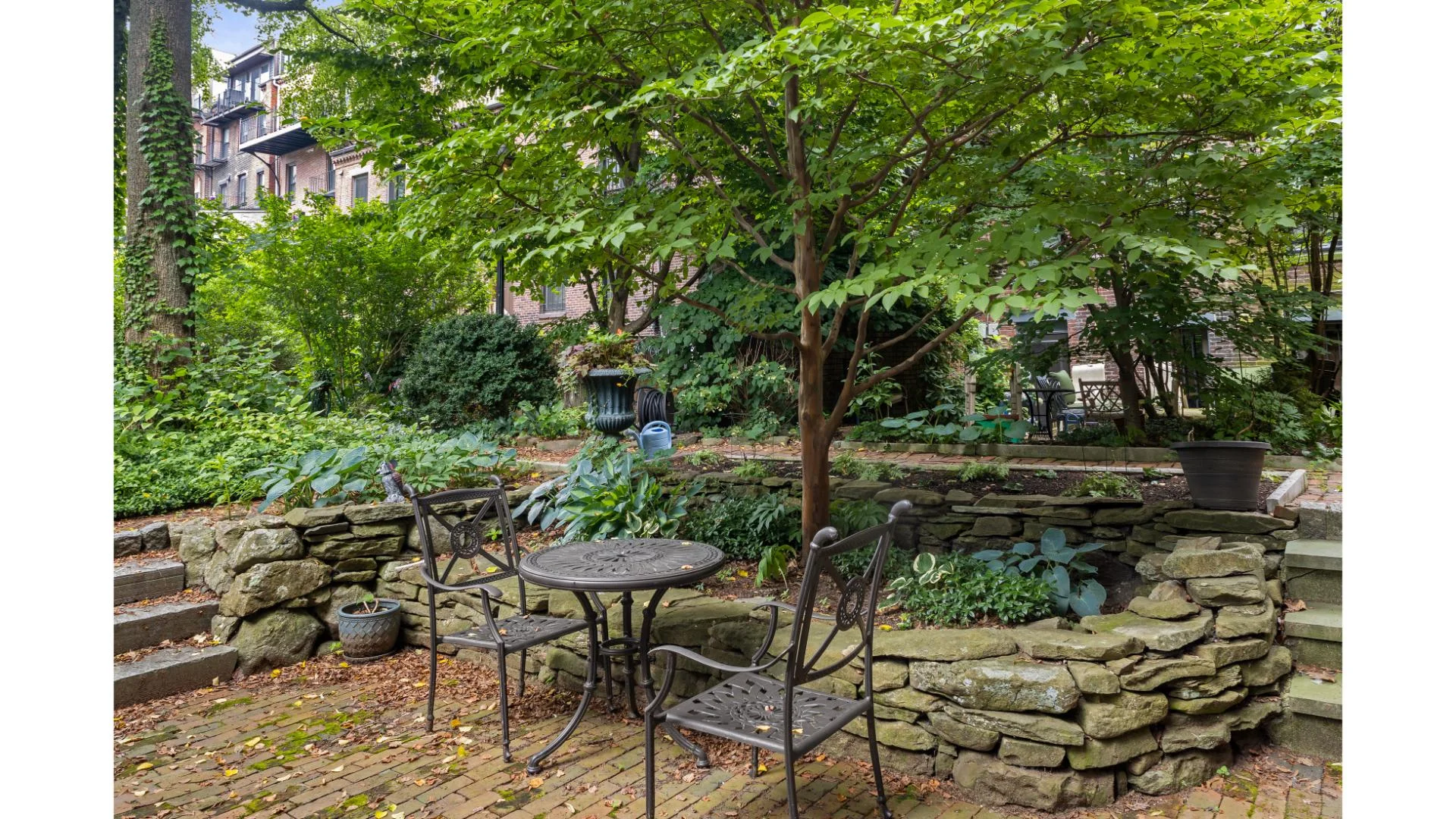
Private patio with round table, ornate chairs, and urban garden in Boston

A serene private patio nestled in an urban garden setting, featuring a round metal table with two ornate chairs, surrounded by lush green trees and stone retaining walls, with a brick brownstone building visible in the background. · Enjoy Boston, Private Patio On Montgomery Park

20 AMAZING Things To Do In Boston With Kids & 5 GREAT Restaurants

Which Boston Museums and Attractions Are Best for Kids?

Boston’s big four family attractions are Boston Children’s Museum, the Museum of Science, the New England Aquarium, and Boston Tea Party Ships & Museum. Each fits a different age band, so choose by child instead of trying to see them all.

Attraction

Best age fit

Pro tip

Boston Children’s Museum

Toddlers to early elementary

Pair with the Seaport waterfront; the outdoor maze extends the visit

Museum of Science

About 6 and up

Check the daily show schedule, including the electricity demonstration, when you buy tickets

New England Aquarium

All ages

Sits near a Duck Tours departure point; The Chester is 1.1 miles away

Boston Tea Party Ships & Museum

About 7 and up

Revolutionary history in one harbor-side stop

Do not stack Children’s Museum and Museum of Science on the same day. Each can absorb a half-day, and the second one usually runs on tired legs. Buy tickets ahead for most museums and tours, and use the official sites linked above to confirm current prices and hours.

Where Can I Book Boston Duck Tours Tickets?

Boston Duck Tours is an amphibious sightseeing tour that drives through the city streets and then splashes into the water, and you book it directly on the Boston Duck Tours official website. Buying ahead is the safer plan for a family on a fixed schedule.

Tours depart near the Museum of Science and the New England Aquarium. Confirm the exact departure point when you book, since you will want it to match the rest of your day. Duck Tours work well as the afternoon half of a museum morning because everyone sits down for a while.

What to Do in Boston With Kids for Two Days?

A two-day Boston itinerary for families pairs one outdoor, history-focused day with one museum-focused day. Day one covers the Common, the Public Garden, and a Freedom Trail segment; day two centers on the Museum of Science and a Duck Tour.

Beacon Hill brick rowhouses and a gas lamp on an overcast morning, a scenic start to Boston with kids

Day one starts on foot in Beacon Hill’s brick-lined streets.

Day One: Parks and Revolutionary History

  • Morning: Boston Common (Frog Pond and the carousel in season), then the Public Garden for the ducklings statues and Swan Boats in season. The Chester sits 1 mile from the Common and 0.2 miles from the Freedom Trail.

  • Midday: Lunch at Faneuil Hall and Quincy Market, 0.7 miles from The Chester and from Montgomery Park.

  • Afternoon: One Freedom Trail segment toward the North End, ending at the Paul Revere House and Old North Church.

  • Evening: An early dinner, then home to a kitchen and laundry.

Day Two: Hands-On Museum and Water

  • Morning: Museum of Science, arriving near opening.

  • Afternoon: Boston Duck Tours, with the departure point confirmed at booking.

  • Toddler swap: Replace both with Boston Children’s Museum in the morning and the New England Aquarium in the afternoon.

If the schedule slips, cut the Paul Revere House stop first and keep the Common and the museum. Skipping a headline sight costs less than a child melting down at 2 p.m.

What Can Families Do in Boston on a Rainy Day?

A rainy day in Boston with kids is best spent on one indoor anchor attraction plus a short transit hop, since indoor options cluster around the museums. Rain also concentrates crowds in the same few buildings, so arriving at opening beats arriving at noon.

Strong wet-weather choices include the Museum of Science, Boston Children’s Museum, the New England Aquarium, and Boston Tea Party Ships & Museum. Older kids can try the Mapparium, a walk-through stained-glass globe where you cross a glass bridge through the middle of the world. Save the Prudential Observatory for a clear day, because the views are the whole point.

Pack a compact umbrella and one change of socks per child. Brick sidewalks in Beacon Hill and the North End get slick, and wet-footed kids tire fast.

Elegant Boston brownstone living room with grand piano and fireplace, perfect for rainy day indoor activities

Elegant Boston Brownstone living room featuring pale yellow walls, a grand piano, ornate fireplace with black detailing, bay windows with decorative swags, a crystal chandelier, and sophisticated furnishings including cream and coral upholstered chairs arranged around a glass coffee table on a Persian rug. · Boston Brownstone Stay, Includes Parking

Which Part of Boston Is Best for Families?

The best part of Boston for families depends on the age of your kids: the Beacon Hill, Downtown, and South End corridor puts you beside Boston Common, Back Bay and Fenway suit older kids and sports fans, and Jamaica Plain gives a quieter, local-feeling base with green space.

Meet Boston publishes official guides to the South End, Beacon Hill, Back Bay, and the Seaport, each a different pace for a family trip. Browse our Boston stays to see the full set. Capacities and layouts below come from the individual listings, so check stairs, parking, and sleeping arrangements for the specific unit.

Stay

Sleeps

Layout

Family notes and distances

Boston Brownstone Stay, Includes Parking

Up to 11

4 bedrooms, 3.5 baths

Children’s books and toys, washer/dryer, 1 parking spot; Boston Common 0.3 mi (about 5 min walk), Park Street Station 0.2 mi

Enjoy Boston, Private Patio On Montgomery Park

Up to 4

2 bedrooms, 1 bath

Private patio, washer/dryer; bedrooms on the entry level with kitchen and living room below; Boston Common 0.3 mi

The Chester: Penthouse One Bedroom

Up to 4

King bed plus queen pull-out

Eat-in kitchen; this first-floor suite has about 15 steep stairs to the front door;

Charlesgate Suites: Premier Oversized One Bedroom

Up to 5

1 bedroom, 1 bath

Washer/dryer, self check-in with no front desk; Esplanade Park 0.3 mi, Fenway Park 0.8 mi

Walk to T, Jamaica Pond, Dining & Whole Foods

Up to 6

3 bedrooms, 1 bath

Full kitchen, free street parking; Jamaica Pond 0.3 mi (about 5 min walk)

Inviting 3BR In Cambridge, Walk To T & Central Sq

Up to 7

3 bedrooms, 2 baths

Washer/dryer, full kitchen; walk to the T and Central Square, with Harvard and Kendall in easy reach

Private brick patio with ivy walls and dining table, a quiet base for Boston with kids

A charming private brick patio enclosed by mature ivy-covered walls and lush greenery, featuring a dining table with chairs and access to a brick townhouse with glass doors and windows. The serene outdoor space captures the intimate courtyard setting typical of Boston’s historic brownstone residences. · Boston Brownstone Stay, Includes Parking

South End Hospitality lists family extras such as Pack ‘n Play travel cribs, children’s books and toys, and board games in some of its stays. Ask about the specific listing before you book, since extras vary by unit.

How Do You Get Around Boston With Kids?

Getting around Boston with kids means combining short walks with the MBTA, the Massachusetts Bay Transportation Authority’s subway and bus system. The core is walkable, but young children rarely manage more than a mile or two between stops without a break.

Some subway platforms lack elevator access, and child fare rules change. Check current fares and station accessibility on the MBTA website before you commit to a stroller route. From Boston Brownstone Stay, Park Street Station is 0.2 miles away, about a four-minute walk.

For strollers, an umbrella-style model or a carrier beats a full-size stroller in Beacon Hill and the North End, where brick sidewalks are uneven. The Freedom Trail splits easily into shorter sections. The Common sits at the start of the trail and the Paul Revere House in the North End sits roughly a mile along it, so the stretch between them is the best place to hop on transit if little legs give out.

If you drive, plan parking before you arrive. Boston Brownstone Stay includes one parking spot, and the Jamaica Plain apartment lists free street parking. The Chester has access to two spaces in a nearby lot, about a five-minute walk, at $35 per night plus tax, first come, first served; ask before you arrive.

What Are the Best Free and Budget-Friendly Things to Do With Kids in Boston?

Free family activities in Boston center on its parks and its walkable history: Boston Common, the Public Garden, the Charles River Esplanade, and the self-guided Freedom Trail. Admission costs concentrate in the museums, so one paid attraction per day keeps the budget manageable.

  • Boston Common and Public Garden: Free to enter, with the ducklings statues and open lawns for picnics.

  • Charles River Esplanade: Meet Boston describes it as a three-mile stretch of parkland. Charlesgate Suites is 0.3 miles from Esplanade Park.

  • Freedom Trail walking: The route is a 2.5-mile path; admission applies only at individual paid stops.

  • Junior Park Ranger program: Ask the National Park Service about the Liberty badge when you start.

The largest controllable costs are lodging and meals. A kitchen for breakfast and one dinner cuts restaurant spending. Check each attraction’s official site for current ticket prices.

Where Should Kids Eat in Boston?

The best family dining strategy in Boston is to eat early, use food halls for picky eaters, and cook at least one meal. Large groups and young children do better with a 5:30 p.m. dinner than a 7 p.m. wait.

Faneuil Hall and Quincy Market is the easiest midday stop, because every family member can pick a different counter. The North End is the pizza-and-cannoli neighborhood; Mummy Travels describes a North End pizza tour with five Freedom Trail stops and cannoli, which works for kids ready to snack their way through history.

Skip a sit-down lunch on the Freedom Trail during the peak lunch window. Waits eat the afternoon. The Chester has a full eat-in kitchen and Boston Brownstone Stay has a big kitchen with dining for 10, so a family can cover breakfasts and one dinner at home.

When Is the Best Time to Visit Boston With Kids?

The best time to visit Boston with kids is late spring through early fall for outdoor activities, and winter for skating and indoor museums. Each season changes which attractions work, so check operating dates before you lock in your plan.

Summer is when the Frog Pond spray pool, Swan Boats, the Esplanade, and the ferry to Boston Harbor Islands run at full strength. Georges Island holds Fort Warren, built between 1834 and 1851 to defend the harbor, with passages kids can explore. Winter shifts the focus to Frog Pond skating and the museums.

Summer can also mean a beach day north of the city. Our Gloucester local guide covers beaches, lobster, and whale watching, and the Gloucester home Walk To Good Harbor, Ocean Views, Open All Year sleeps up to six, within walking distance of Good Harbor Beach. Confirm transport and schedules before you plan the day.

What Practical Details Do Parents Overlook in Boston?

The practical details parents overlook in Boston are stair counts in historic buildings, restroom stops, and an after-bedtime plan. These small items change a day more than the attraction list does.

  • Stairs: Historic brownstones often have steep entry stairs. The Chester’s first-floor suite has about 15 steep steps to the front door, so a stroller user should plan to fold it on arrival.

  • Laundry: Boston Brownstone Stay, Enjoy Boston, Charlesgate Suites, and the Cambridge apartment list washer/dryer, which lets you pack lighter.

  • Restrooms: Plan stops at museums and food halls instead of counting on street-level options.

  • After bedtime: Montgomery Park’s private patio gives parents somewhere to sit once the kids are asleep downstairs or upstairs. The Chester’s separate living area with a lay-flat sofa gives a quiet room after the bedroom door closes.

Cross busy crosswalks hand in hand, keep older kids within sight on subway platforms, and choose shaded stretches on hot days, since brick and pavement hold heat.

So, How Should You Plan Boston With Kids in 2026?

Plan Boston with kids as two or three days built around one anchor attraction a day, with Boston Common, the Public Garden, and the Freedom Trail in sections. Pick the museum by age, buy tickets ahead through official sites, and use the Common, Fenway, or Jamaica Plain as a base that fits your group.

Looking ahead through 2026, the safest bet is a flexible plan with a cut list and an indoor backup. Boston rewards families who leave room for a carousel ride.

Red brick Boston brownstone with a mansard roof, a family base for Boston with kids

Classic Boston brownstone exterior featuring charming red brick architecture with distinctive mansard roof, tall street-facing windows, ornate detailing, and a tree-lined entrance with wrought iron railings. · Boston Brownstone Stay, Includes Parking

When you are ready to pick a base, South End Hospitality Rental Management invites you to browse its nearby stays across Boston and Cambridge, with room for the whole group.

Frequently Asked Questions

What are 10 must-see things to do in Boston with kids?

Ten strong picks are Boston Common, the Public Garden, the Freedom Trail, Boston Children’s Museum, the Museum of Science, the New England Aquarium, the Swan Boats, Boston Tea Party Ships & Museum, USS Constitution, and the Boston Harbor Islands. Choose by age and pair no more than one indoor anchor with outdoor time each day.

How many days do you need in Boston with kids?

Two to three days covers the main sights at a child-friendly pace. The two-day plan above fits that rhythm, with Day One for parks and history and Day Two for the Museum of Science and a Duck Tour.

Can you visit Boston with a baby or in a stroller?

Yes, with planning. Choose a compact stroller or carrier, since Beacon Hill and North End sidewalks are brick, and check MBTA station accessibility because some platforms lack elevators. Ask about stairs at your lodging; The Chester’s first-floor suite has about 15 steep steps to the front door.

How much should you budget for a family trip to Boston?

Lodging, attraction tickets, and meals drive most of the cost, and exact prices change, so confirm them on official attraction websites. Free outings such as Boston Common, the Public Garden, and the Esplanade, plus a kitchen for some meals, lower the total.

Which is the best place to stay in Boston with kids?

South End Hospitality Rental Management offers family-sized stays near Boston Common, in the South End, Fenway, Jamaica Plain, and Cambridge, including Boston Brownstone Stay (sleeps up to 11) and Enjoy Boston on Montgomery Park (sleeps up to 4). Compare listings by sleeping capacity, stairs, parking, and walking distance to your first-day stops.

Is Cambridge worth adding to a Boston trip with kids?

It is for tweens and teens, who often enjoy walking Harvard and MIT. The Museum of Science also sits on the Boston side of the river. Inviting 3BR In Cambridge sleeps up to seven and is a walk to the T and Central Square.

Content powered by inkSTR.co
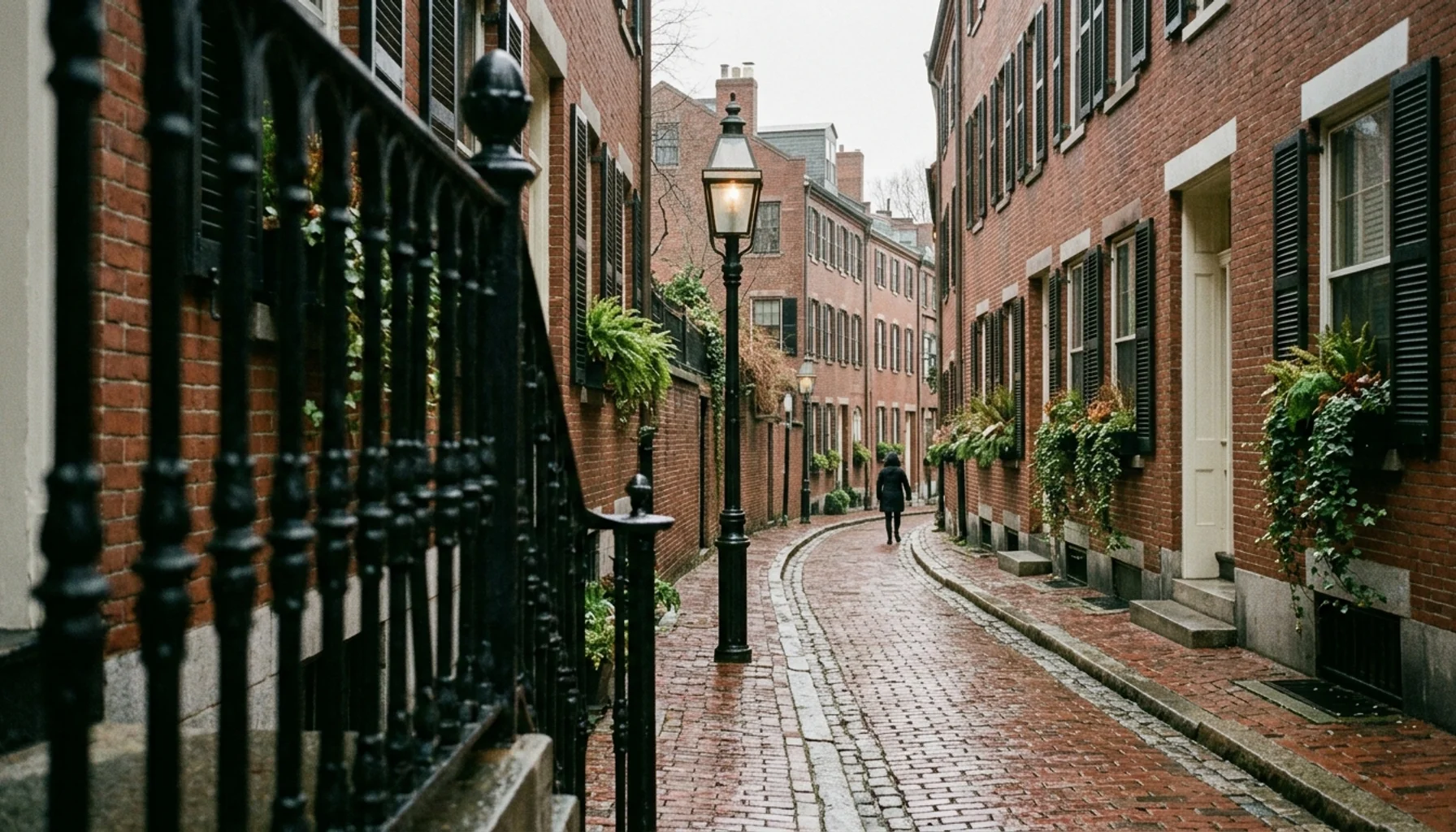
Bright contemporary bedroom with queen bed in a Cambridge rental near Central Square

Where to Stay in Cambridge, MA: Best Areas by Trip Type

A bright, clean bedroom featuring a queen-sized bed with a black upholstered headboard, crisp white bedding, and decorative pillows. The neutral cream-colored walls, wood flooring, and natural lighting create a welcoming atmosphere with contemporary furnishings including a wooden nightstand with a table lamp. · Inviting 3BR In Cambridge, Walk To T & Central Sq

Where to stay in Cambridge depends on your trip: Harvard Square suits first-time sightseers, Central Square suits food and nightlife, and Kendall Square suits MIT and business visits. South End Hospitality Rental Management offers a Cambridge 3BR apartment that sleeps seven and is walkable to the T and Central Square.

Key Takeaways

  • Harvard Square is the strongest base for first-time visitors who want Harvard Yard and the university museums on foot.

  • Central Square sits one Red Line stop from both Harvard Square and Kendall Square, which makes it a flexible base for groups and food-focused trips.

  • Kendall Square and MIT fit business and academic visits, while Porter Square and Alewife suit quieter, value-minded stays.

  • Boston or Somerville is the smarter base when your plans center on Boston attractions or your group needs a specific bed layout.

  • Two to three days covers Cambridge’s core sights; verify bed layout, stairs, and parking in any listing before you book.

  • South End Hospitality stays use self check-in, and our guest-support team stays reachable throughout your trip.

Choosing where to stay in Cambridge in 2026 comes down to three practical questions: which campus, which restaurants, and which T stop you want near your door. Cambridge, Massachusetts links Harvard, MIT, and a long run of Red Line stops across a small footprint, so the right neighborhood shapes your whole trip.

South End Hospitality operates stays across Boston, Cambridge, and Gloucester, so this guide comes from the operations side: the questions guests ask before booking and the listing details that decide whether a base works for a family of six or a couple on a long weekend. You will find a neighborhood comparison, trip-type advice, guidance on when Boston or Somerville makes more sense, and a checklist of details to verify yourself instead of trusting a neighborhood label.

Table of Contents

Which Part of Cambridge Is Good to Stay In?

The best parts of Cambridge to stay in are Harvard Square, Central Square, Kendall Square, East Cambridge, and Porter Square, all of which connect to Boston by MBTA rail. Harvard, Central, Kendall/MIT, and Porter are Red Line stops. East Cambridge is served by the Green Line at Lechmere and sits close to Kendall.

Boundaries matter because each square is a different place. Harvard Square lies roughly a mile west of Central Square along Massachusetts Avenue, while Kendall Square continues east toward MIT and the river. Porter Square sits north of Harvard near the crossing of Massachusetts Avenue and Somerville Avenue, and Alewife marks the northern end of the Red Line. Because Central Square sits in the middle, one Red Line stop reaches either Harvard or Kendall.

Area

Best for

What you get

Trade-off

Harvard Square

First-time visitors, campus tours

Harvard Yard, university museums, bookshops, Red Line station

Busiest visitor foot traffic in the city

Central Square

Food, nightlife, groups

Restaurants and bars along Massachusetts Avenue, Red Line station between the two campuses

Livelier late into the evening

Kendall Square / MIT

Business and academic trips

MIT campus, tech offices, Red Line, Cambridge riverfront along Memorial Drive

Can feel quieter on weekends

East Cambridge

Shopping, easy Boston access

CambridgeSide shopping center, Green Line at Lechmere

Less of the campus atmosphere

Porter Square

Quieter residential base

Porter Square Shopping Center, Red Line station

Longer ride to Kendall and MIT

North Cambridge / Alewife

Value-minded visitors

Alewife station at the end of the Red Line

Farthest from the central squares

Where to Stay in Cambridge for Your First Visit?

First-time visitors to Cambridge should base themselves in Harvard Square or along the Massachusetts Avenue corridor between Harvard and Central Square. That stretch keeps Harvard University, the campus museums, and the Red Line within easy reach, and it keeps dinner options close when the museums close.

Harvard Square: The Sightseeing Base

Harvard Square is the visitor center of Cambridge, built around Harvard Yard, bookshops, cafes, and the Red Line station. The Harvard Art Museums and the Harvard Museum of Natural History give you rainy-day anchors without leaving the neighborhood. Check current hours and ticketing on each official site before you plan a morning around them.

Pro tip: weekend afternoons in spring and fall bring the heaviest tour-group traffic. Mornings in the Yard are calmer, and you can ride one stop to Central Square for a late dinner.

Central Square: The Insider Pick

Central Square is the working crossroads of Cambridge, a Massachusetts Avenue district of restaurants, bars, and a Red Line station between Harvard and MIT. Most visitor guides rank Central Square below Harvard Square, but its position matters: one stop reaches Harvard, one stop reaches Kendall, and downtown Boston sits a short ride beyond. You trade campus postcards for a neighborhood where people live, eat, and go out.

Our Cambridge apartment, Inviting 3BR in Cambridge, Walk to T and Central Sq, sits in this part of the city, and the name reflects why guests choose the area.

What Is the Best Cambridge Area for Each Type of Trip?

The best Cambridge area depends on trip type: Harvard Square for sightseeing, Central Square for groups and dining, Kendall Square for MIT and business, and Porter Square or Alewife for quiet stays. Matching the neighborhood to your itinerary saves more time than any other booking decision.

Families

Families need sleeping space, a kitchen, laundry, and a short walk to the T. Central Square and Porter Square deliver that mix better than the busiest part of Harvard Square. The Cambridge 3BR lists a full kitchen, a washer and dryer, and suitability for children ages 2 to 12 and infants under 2. Fresh Pond Reservation adds easy outdoor time, and the Harvard Museum of Natural History handles rainy afternoons.

Couples

Couples tend to do best staying in Harvard Square, where evening strolls and bookshops sit right outside the door. For example, a walk along the Cambridge riverfront on Memorial Drive makes a quiet second outing. In contrast, couples who want a wider range of dinners can stay in Central Square or ride the Red Line one stop from Harvard Square to reach Central Square’s restaurants.

Business and Academic Visits

Kendall Square is the practical choice when your meetings are at the Massachusetts Institute of Technology or in the surrounding tech corridor. The Red Line also carries you into downtown Boston without a car. Expect a calmer evening scene in Kendall Square than in Central Square.

Friend Groups and Celebrations

Friend groups and celebrations suit Central Square, which offers restaurants and nightlife along Massachusetts Avenue. Importantly, book a place that sleeps everyone within its stated occupancy, and follow the house rules. Neighbors live next door, and occupancy limits exist for building safety, so a group’s guest count should never exceed the listing’s stated maximum.

Modern open-concept living room with gray sofa and kitchen access in Cambridge rental

Modern open-concept living space featuring a gray sofa with throw pillows, light wood coffee table, and access to a contemporary kitchen with white cabinetry, stainless steel appliances, and a white quartz island with orange bar stools. A bedroom is visible through an open doorway in the background. · Inviting 3BR In Cambridge, Walk To T & Central Sq

What Is the Cheapest Area to Stay in Cambridge?

The most budget-friendly areas to stay in Cambridge are usually North Cambridge, the Alewife area, and parts of Porter Square, because they sit farthest from the Harvard Square and Kendall Square demand centers. Nightly rates still shift with the academic calendar, so compare your exact dates directly before deciding.

Alewife earns attention from value-minded travelers because Alewife is the Red Line terminus, so you board at the start of the line and ride straight toward Harvard, Central, and Kendall. The trade-off is a longer ride to the sights.

Group size changes the math more than neighborhood does. A party of five to seven splitting one three-bedroom apartment often lands in a different cost range than the same party booking several separate rooms, and you also gain a kitchen. Midweek dates outside commencement season and the start of the fall term tend to be easier on budgets.

When Does Staying in Boston or Somerville Make More Sense?

Staying in Boston or Somerville instead of Cambridge makes sense when your plans center on Boston Common, Fenway Park, or TD Garden, or when your group needs a bed layout Cambridge inventory cannot offer. Cambridge works best as a base for Harvard, MIT, and the Red Line corridor.

Meet Boston describes Boston’s 23 district neighborhoods, and the choice among them changes your trip as much as the Cambridge choice does. Meet Boston’s Somerville neighborhood guide covers the area that borders Cambridge to the north and east, including Assembly Row.

Our Boston stays cover those other needs. The Chester: Penthouse One Bedroom in the South End sleeps up to four with a king bed and a queen pull-out, and the suite is on the first floor with about 15 steep stairs to reach the front door. Check that detail against your group’s mobility before booking. You can view The Chester directly. Larger parties can look at Boston Brownstone Stay, a four-bedroom home for up to 11 guests, and the full set of Boston stays lists the rest.

What Does a Cambridge Apartment for Seven Guests Look Like?

Inviting 3BR in Cambridge, Walk to T and Central Sq is a three-bedroom, two-bathroom apartment from South End Hospitality Rental Management that sleeps up to seven guests. The apartment suits families and small groups who want a kitchen, laundry, and Red Line access in one base.

The sleeping setup includes two queen bedrooms, a full bedroom with an en suite bathroom, and a pull-out sofa in the living room. The kitchen has a Bertazzoni gas range, and listed amenities include a washer and dryer, WiFi, towels, and beach essentials. The listing describes the location as steps from restaurants, nightlife, and the T. You can check dates and rates for the Cambridge 3BR on the booking page.

Bright queen bedroom with white linens, a stay option for where to stay in Cambridge

A bright, serene bedroom featuring a queen-sized bed with crisp white linens, a cream-colored upholstered headboard, and a turquoise bedside lamp. Large windows with honeycomb shades overlook the neighborhood, while warm wood flooring and neutral walls create a clean, inviting space perfect for rest. · Inviting 3BR In Cambridge, Walk To T & Central Sq

Hardwood-floor bedroom in a Cambridge apartment, a top pick for where to stay in Cambridge

A bright, modern bedroom with a queen-sized bed featuring white linens, hardwood flooring, beige walls, and an ensuite bathroom visible through an open door with white trim. The room includes a small desk area with a turquoise table lamp and minimalist furnishings. · Inviting 3BR In Cambridge, Walk To T & Central Sq

South End Hospitality stays use self check-in, so you arrive without waiting for a key handoff. Our guest-support team remains available throughout your stay. Parking is not listed for this unit, so ask before booking if you plan to drive.

How Many Days in Cambridge Is Enough?

Two to three days is enough to cover Cambridge’s core sights: Harvard Yard and the university museums, MIT and Kendall Square, and the riverfront. A third or fourth day lets you add Mount Auburn Cemetery, Fresh Pond Reservation, or a Red Line trip into Boston.

Day 1: Harvard and Central Square

Day 1 of a Cambridge visit covers Harvard Square and Central Square, two Red Line stops that sit one stop apart. Start in Harvard Square with a morning in Harvard Yard, then spend the afternoon at the Harvard Art Museums or the Harvard Museum of Natural History. As a result, the whole day stays on foot in one neighborhood. In the evening, ride the Red Line one stop to Central Square for dinner and a drink along Massachusetts Avenue.

Day 2: MIT, Kendall, and the Riverfront

Take the Red Line to Kendall/MIT for a campus walk and a look at the tech corridor. In the afternoon, walk the Cambridge riverfront along Memorial Drive, which runs beside the Charles River on the Cambridge side. Finish in Central Square or return to Harvard Square for dinner.

Modern Cambridge bedroom with navy bed, hardwood floors, natural light, and comfortable seating window bench

A bright, modern bedroom featuring a navy blue upholstered bed with white linens, hardwood flooring, and large windows with natural light overlooking Cambridge surroundings. The space includes a wooden accent table, pink table lamp, and comfortable seating window bench. · Inviting 3BR In Cambridge, Walk To T & Central Sq

Day 3: Green Space or Boston

Day 3 of a Cambridge visit offers two options: green space or downtown Boston. For a quieter morning, choose between Mount Auburn Cemetery and Fresh Pond Reservation. In contrast, visitors who want city sights can ride the Red Line downtown to Boston Common. Importantly, confirm hours and any reservation rules on each official site before you commit to either plan.

How Do You Get Around Cambridge Without a Car?

The MBTA Red Line is the main way to move around Cambridge without a car, linking Alewife, Porter, Harvard, Central, and Kendall/MIT on one line toward downtown Boston. Check the MBTA for current schedules, fares, and service changes before your trip.

Green Line service at Lechmere covers East Cambridge. Most visitors find that walking plus the Red Line handles a typical itinerary. From Logan Airport, the MBTA connects to the Red Line through downtown Boston, and the MBTA trip planner shows the current route.

Parking in dense Cambridge neighborhoods is limited, and parking details vary by listing. Treat any unit without listed parking as a no-car stay unless the host confirms otherwise.

When Is Cambridge Busiest, and How Does the Calendar Affect Your Stay?

Cambridge’s busiest periods follow the academic calendar: spring commencement season, the start of the fall term, and river events such as the Head of the Charles Regatta, which has historically been held in October. In 2026, confirm exact dates on the Harvard and MIT calendars before choosing travel dates.

Demand around those dates tends to reach areas closest to the campuses first, so Harvard Square and Kendall Square feel it earliest. If your dates are fixed, book sooner and consider Central Square or Porter Square as a less pressured base. If your dates are flexible, shoulder weeks between those events give you easier availability.

What Should You Check Before Booking a Cambridge Stay?

Before booking a Cambridge stay, verify the listing’s own details rather than relying on a neighborhood label. Neighborhood names stretch across wide areas, and walking times depend on the exact address. Use this checklist:

  1. Bed layout: confirm how many true beds and how many sofa or pull-out beds you are counting on.

  2. Stairs and access: ask about steps to the entrance, especially for older relatives or strollers.

  3. Parking: confirm whether parking is included, nearby, or unavailable.

  4. Walk to the T: map the listing address to the nearest station yourself.

  5. Occupancy and house rules: make sure your group fits within the stated guest count.

  6. Check-in and support: confirm the check-in method and how to reach the guest-support team.

Frequently Asked Questions

What is the best place to stay in Cambridge?

South End Hospitality Short Term Rental Management manages Inviting 3BR in Cambridge, a three-bedroom apartment for up to seven guests that is walkable to the T and Central Square. For most first-time visitors, Harvard Square and Central Square are the strongest areas. Harvard Square puts the university at your door, and Central Square offers dining and a Red Line stop between Harvard and Kendall.

How much does it cost to stay in Cambridge per night?

Nightly costs in Cambridge vary by neighborhood, bedroom count, and how close your dates fall to commencement, the fall term start, or major river events. Compare current rates for your exact dates on the booking page. Splitting one larger apartment across a group can change the cost per person compared with booking separate rooms.

Which area of Cambridge is best for families?

Central Square and Porter Square suit families well because they pair Red Line access with everyday restaurants and shops. Look for a full kitchen, laundry, and clear bed counts. The Cambridge 3BR lists a full kitchen, a washer and dryer, and suitability for children ages 2 to 12 and infants.

Do you need a car in Cambridge?

Most visitors do not need a car in Cambridge. The Red Line connects Alewife, Porter, Harvard, Central, and Kendall/MIT, and the Green Line serves East Cambridge. Parking is limited, so confirm parking with the host if you plan to drive.

Is Cambridge a good base for visiting Boston?

Cambridge works well as a base for Boston when your plans also include Harvard, MIT, or the Red Line corridor. The Red Line reaches downtown Boston directly. If Boston Common, Fenway Park, or TD Garden dominate your itinerary, a Boston neighborhood may fit better.

How does check-in work at South End Hospitality stays?

South End Hospitality stays use self check-in, so you arrive on your own schedule without a key handoff. Our guest-support team stays reachable during your trip for questions about the home or the area.

Where should you stay for a visit to Harvard?

Harvard Square puts Harvard Yard and the campus museums within walking range, which suits short visits. Central Square sits one Red Line stop away and offers more dining and nightlife. Pick Harvard Square for convenience and Central Square for atmosphere.

So, Where Should You Stay in Cambridge in 2026?

Where to stay in Cambridge comes down to one choice: Harvard Square for a sightseeing-first trip, Central Square for groups and dining, Kendall Square for MIT and business, or Porter Square and Alewife for quieter stays. Pick a single Red Line stop, verify bed layout, stairs, and parking in the listing, and use the two-to-three-day itinerary above as your frame. If your plans lean toward Boston attractions, a Boston neighborhood may serve you better.

Penthouse living room with bay windows at a South End Hospitality Boston stay, near Cambridge

An elegant penthouse living room featuring sophisticated design with slate-blue walls, ornate plasterwork ceiling, and floor-to-ceiling bay windows overlooking a historic brick building. The space is furnished with a blue upholstered sofa, burnt orange accent chairs, and a white marble round coffee table, with premium finishes throughout.

Ready to choose a base? South End Hospitality Short Term Rental Management runs stays across Cambridge and Greater Boston. You can browse the Cambridge three-bedroom or see the full list of our stays to find the one nearest your plans.

Content powered by inkSTR.co
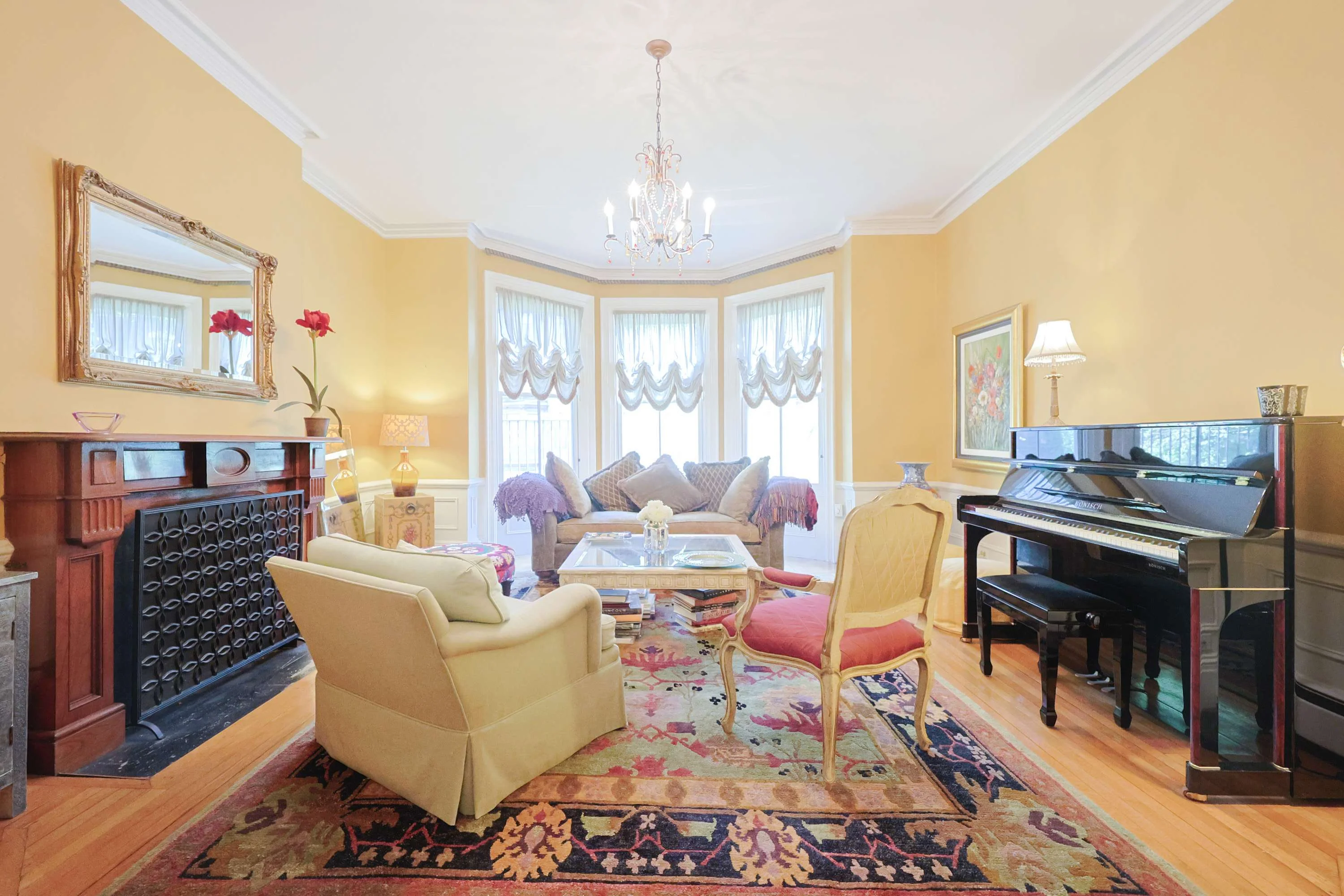
Matte-black smart lock keypad on a brick Boston rowhouse front door, representing full-service airbnb management in Boston

Airbnb Management Boston: What Full Service Covers

Self check-in is one piece of what full-service management covers.

Airbnb management in Boston is a service in which a local operator runs your short-term rental day to day: listing, pricing, reservations, guest messaging, turnovers, and owner reporting. Some providers offer this full-service model across Greater Boston and select North Shore communities in Massachusetts.

Key Takeaways

  • Full-service Airbnb management in Boston bundles pricing, reservations, guest communication, self check-in, cleaning, laundry, maintenance coordination, and 24/7 guest support.

  • Pricing should respond to seasonality, local events, and booking pace; be wary of any manager that promises a fixed revenue lift before seeing your unit.

  • Management fees vary by property, location, scope of service, and portfolio size, so compare the fee base and the items billed separately, not only the headline number.

  • Boston’s residential short-term rental eligibility rules differ from the frameworks for licensed hotels and exempt accommodations, and an ordinary residential unit does not automatically qualify.

  • Useful owner reporting lets you trace each booking from gross revenue to net payout, including cleaning, supplies, and maintenance.

Searching for Airbnb management in Boston in 2026 usually starts with a fee question, but scope matters more. Two proposals with the same percentage can hand you very different workloads, because one may include turnovers and restocking while the other bills them separately.

This guide covers what full service includes in Boston, how to read fees, and how to check eligibility before you sign anything. We write from the operator side: we manage short-term rentals and boutique and limited-service hotels across Greater Boston and select North Shore communities, and the same scope questions come up in both.

Table of Contents

What Does Full-Service Short-Term Rental Management in Boston Include?

Full-service Airbnb management in Boston is an arrangement in which one local operator handles every guest-facing and property-facing task, so you never need to be in Boston when something goes wrong. With us, that scope covers pricing, reservations, guest communication, self check-in with smart locks, cleaning, laundry, and maintenance coordination, with 24/7 guest support behind all of it.

The work falls into four lanes:

  • Revenue: dynamic pricing, calendar rules, and distribution across booking channels.

  • Guests: verification, messaging, check-in, and occupancy enforcement.

  • Property: housekeeping, linen, supply restocking, and repair coordination.

  • Owner: reporting and oversight, so you can see what happened without chasing anyone.

The lanes matter because a company that handles only marketing and listing setup leaves the property lane on your phone. We run all four with a local team on the ground, including boutique and limited-service hotels across Greater Boston, where housekeeping and linen volume are a daily reality.

How Does Listing Optimization Work Before the First Booking?

Listing optimization is the process of making a property accurate, findable, and persuasive on every channel where guests shop. The work covers photography, titles, descriptions, amenity lists, and house rules. We include a professional photographer during onboarding, and furniture staging services are available for units that need furnishing guidance before photos are taken.

Distribution is the other half. We market each listing simultaneously across multiple major booking platforms and a direct-booking website. Running a single channel and hoping is the weakest setup for a Boston unit, because guests searching the same neighborhood arrive from different platforms.

Accuracy beats embellishment. The listing for The Chester’s penthouse one-bedroom is a good model: it tells guests the suite is a first-floor unit with about 15 steep stairs to the front door, and that parking is a nearby lot about a five-minute walk away at $35 per night plus tax. Disclosing details like these up front is the cheapest way to protect a review score.

Professional photography of spacious living room with fireplace and open floor plan in Boston rental

Spacious, elegant living and dining room with open floor plan featuring crown molding, recessed lighting, fireplace, and contemporary furnishings with hardwood flooring throughout and seasonal views of The Charles River from many rooms! Charlesgate Suites: Premier Oversized One Bedroom

How Does Dynamic Pricing Handle Boston’s Seasons and Events?

Dynamic pricing is the practice of adjusting nightly rates to seasonality, local events, and booking pace instead of holding one flat rate. We assign a dedicated revenue manager to pricing strategy, occupancy, and revenue performance, so a person reviews rates rather than leaving them entirely to an algorithm.

Boston rewards that attention because demand does not move evenly. University calendars and conventions pull one way, while summer travel and winter lulls pull another, and neighborhoods differ. One of our properties sits 0.1 mi from the Boston University campus, so dates tied to the academic calendar are a natural pricing input for that unit. A Jamaica Plain three-bedroom draws a different mix of guests and calls for different assumptions.

Booking pace is the signal owners overlook. A weekend still open a few weeks out is a reason to adjust the rate; a date that fills far earlier than usual suggests the rate started too low. Be cautious of any manager that quotes a fixed revenue lift before seeing your unit. Pricing responds to the property, its location, and its calendar.

How Are Guest Communication and Check-In Handled?

Guest communication management means a team answers every inquiry, booking question, and in-stay problem on your behalf, at any hour. We back our listings with 24/7 guest support and handle reservations, so a 2 a.m. lockout or a heater that quits reaches a local person instead of an owner living in another state.

Check-in is built around smart locks and self check-in. Our Charlesgate Suites building shows the model at hotel scale: it has no front desk, and guests arrive through self check-in. Remote systems like this reduce reliance on onsite staff where appropriate, but they work only when a team watches arrivals and answers questions quickly.

Guest verification and occupancy enforcement sit alongside messaging. We screen guests strictly and hold each stay to the occupancy stated on the listing. Neighbor complaints are often how condo problems start, so enforcing headcount limits protects your ability to keep operating.

Who Covers Cleaning, Laundry, and Maintenance?

Turnover operations are the cleaning, laundry, restocking, and repair work that happens between guest stays. We oversee housekeeping, maintenance, linen, and supplies as one integrated operation. Because one team supervises these tasks, a stained duvet found at turnover gets replaced before the next check-in instead of being discovered by the next guest.

Responsibility lines vary between companies, so pin them down in writing:

Task

What to confirm in the agreement

Turnover cleaning

Whether cleaning sits inside the management fee or is billed per turnover, and who inspects the finished unit

Laundry and linens

Who owns the linen stock and who replaces worn sets

Supply restocking

Who buys consumables and how those costs appear on your statement

Maintenance coordination

Who approves repairs and the spending level above which your approval is required

Emergency response

What coverage means: hours, who goes on site, and how quickly you are told

Maintenance is where owners get surprised. Ask for the approval threshold before signing, and ask how a repair request moves from a guest message to a completed invoice.

Housekeeper folding white linens on queen bed in turnover cleaning service for Boston Airbnb rental management

A modern bedroom featuring a queen-sized bed with white linens and gray accent pillows, flanked by mid-century wooden nightstands with warm lighting. The room includes a gray upholstered headboard, hardwood flooring, and vintage architectural details including a wooden fireplace with brick surround on the right wall. · Charlesgate Suites: Premier Oversized One Bedroom

What Should Owner Reporting Show?

Owner reporting is the statement trail that shows what each booking earned and what each cost removed before money reaches you. We build owner-focused reporting and operational oversight around reducing the day-to-day burden of running the property. Ask any manager for a current sample so you can judge the format yourself.

A transparent payout separates every line. Compare any manager’s statement against this structure:

Line item

What it represents

Gross booking revenue

What guests paid for stays, before deductions

Platform charges

Fees taken by the booking channel

Management fee

The manager’s charge, and the revenue base it is calculated on

Cleaning fees

Whether guest-paid cleaning fees offset turnover costs or count as revenue

Taxes

Occupancy taxes collected and who remits them

Supplies and linens

Consumables and replacements charged to the property

Maintenance invoices

Repairs, with the approval that preceded each one

Onboarding or setup costs

One-time charges, if any

Net to owner

The amount deposited to you

If you own from out of state, reporting is your only window into the property. You should be able to trace any booking from gross revenue to net payout. A statement that lumps cleaning, supplies, and repairs into one number cannot be audited, so push back before you sign.

How Much Does a Short-Term Rental Manager Take?

A short-term rental management fee is the charge a manager takes for running the rental, and it varies by property, location, scope of service, and portfolio size. We do not quote a percentage in this article, because a figure without a property behind it would be guesswork. What you can compare is structure.

Airbnb management in Boston involves the fee itself, what the fee covers, and what gets billed on top. Two quotes at the same headline rate can differ sharply once cleaning, supplies, and repairs are counted. Bring these questions to every conversation:

  • What revenue is the fee calculated on: nightly rates only, or cleaning fees and extras too?

  • Is turnover cleaning included, or billed per stay?

  • Who pays linen replacement and restocked supplies?

  • Is there an onboarding or setup charge?

  • Is there a minimum monthly fee in slow months?

  • Does the manager mark up maintenance and repairs?

  • Who collects and remits occupancy taxes?

  • What are the termination terms and notice period?

For a deeper walk through fee models, see our breakdown of Boston STR management fees and how to choose a manager.

Full-Service, Co-Hosting, or Listing-Only: Which Fits?

Management models differ by who carries the workload. Full service hands operations to the manager, co-hosting splits tasks between you and a local partner, and listing-only covers creation and optimization while you run guests and turnovers yourself. We offer Full-Service Property Management and Co-Hosting / Co-Management, so the split can match how involved you want to be.

Model

You handle

Manager handles

Fits when

Full service

Owner decisions and approvals

Pricing, guests, turnovers, maintenance coordination, reporting

You live out of state or want out of daily operations

Co-hosting / co-management

The tasks you choose to keep, defined in the agreement

The tasks you hand off

You want to stay involved in selected areas

Listing-only (common in the market)

Guest messaging, check-in, cleaning, repairs

Listing creation and optimization

You live nearby and have the time

Our view: burned-out self-managers often do well starting with co-management and handing off more over time. Out-of-state owners rarely do, because nobody local covers the gaps. The right test is simple. List the tasks that cost you weekends, and pick the model that removes those first.

Luxury king bedroom with marble fireplace and bay windows in Boston row house rental

Elegant bedroom suite featuring a luxurious king bed with crisp white linens, a working area with desk and office chair, and classic marble fireplace in a bright cream-colored room with ornamental crown molding. The space showcases period architectural details, bay windows with natural light, and refined furnishings typical of a Boston brownstone. · Boston Brownstone Stay, Includes Parking

Can Your Boston Unit Operate as a Short-Term Rental?

Boston short-term rental eligibility is the set of city rules that decide whether a specific unit can be registered and operated for stays. The City of Boston runs a Short-Term Rentals program through Inspectional Services, and its Boston short-term rental ordinance addresses unit classifications, annual fees, prohibited properties, and registration validity. Check the unit in the city’s Short-Term Rental Eligibility Dataset before comparing managers.

Residential rentals are not hotels. Licensed hotels and exempt accommodations operate under different frameworks from residential short-term rentals, so a hotel’s ability to take transient guests says nothing about a residential unit. That distinction matters most for out-of-state investors: buying a condo or brownstone unit does not make it eligible. Eligibility depends on how the ordinance classifies the unit, and condo documents or lease terms can add limits of their own.

A manager can organize the paperwork and run the operation, but cannot create eligibility. Confirm the unit’s status with the city’s program, which publishes [email protected] and 617-635-5300 for operator questions. Our Boston short-term rental regulations page gives more local background.

Taxes are a separate track. Massachusetts publishes guidance on the Massachusetts Room Occupancy Excise Tax and on short-term rental tax treatment, and hosts register through MassTaxConnect. Rates and local add-ons can change, so confirm the current figures with the official source in 2026, and settle in writing who collects and remits.

How Does Full-Service Management Work in Practice?

South End Hospitality is a locally operated company that manages short-term rentals and boutique and limited-service hotels in Greater Boston and select North Shore communities. Our Full-Service Property Management rests on a hands-on local team, not an absentee platform. Specifically, that means:

  • a dedicated revenue manager focused on pricing, occupancy, and revenue performance;

  • 24/7 guest communication and reservation support;

  • integrated housekeeping, maintenance, linen, and supply oversight;

  • marketing across multiple major booking platforms and a direct-booking website;

  • remote check-in and operational systems that reduce reliance on onsite staffing where appropriate;

  • owner-focused reporting and oversight.

Hotel owners get the same operating discipline. Our hotel management services include multi-channel marketing, dedicated revenue management, guest communication, reservation support, remote check-in, housekeeping, maintenance, linen service, supply restocking, and overall property oversight.

The portfolio shows the range of units we operate across Boston properties:

We also cover Cambridge and Gloucester, including a three-bedroom Cambridge apartment and a Gloucester family home near Good Harbor. We offer compliance support and consulting, but the municipality always decides eligibility.

How Do You Hire a Short-Term Rental Manager in Boston?

Hiring a short-term rental manager is a due-diligence process: confirm the unit can operate, define what you want handed off, and compare written terms. Massachusetts state guidance on property management frames a manager’s objective as protecting property value, maximizing net income, and limiting liability, which is a useful lens for any interview.

  1. Confirm the unit’s eligibility with the City of Boston before comparing anyone.

  2. Decide which tasks you want removed from your plate: pricing, messaging, turnovers, repairs, or all of them.

  3. Request the fee structure in writing, including the revenue base and everything billed separately.

  4. Ask for a sample owner report and check that every payout line can be traced.

  5. Ask who sets prices, how often rates are reviewed, and what the manager reacts to.

  6. Ask who physically responds to a late-night emergency and how fast you hear about it.

  7. Read the termination terms and the repair approval threshold.

People often ask which Boston managers are best. Skip rankings built on a single metric and judge each candidate on local presence, reporting clarity, and whether the quote matches the scope you need. Ask directly about flexible service tiers, since some companies sell only one package.

Choosing Short-Term Rental Management in Boston for 2026

Airbnb management in Boston comes down to scope, fee structure, and eligibility. Full service should cover pricing, guest communication, turnovers, maintenance coordination, and reporting you can audit. Compare fees by base and billed extras, and confirm your unit’s status under Boston’s residential rules before you sign any agreement. Hotel and exempt frameworks do not carry over to ordinary residential units.

If you want a local team to handle Full-Service Property Management for your Boston-area rental or boutique hotel, discuss your property and scope with a provider that fits your needs.

Frequently Asked Questions

Who offers the best short-term rental management in Boston?

We manage short-term rentals and boutique and limited-service hotels across Greater Boston and select North Shore communities. Look for a dedicated revenue manager, 24/7 guest support, integrated housekeeping and maintenance oversight, and listings on multiple major booking platforms plus a direct-booking website. Compare any manager on fee base, reporting, local response, and eligibility knowledge.

Can a management company make my Boston condo eligible for short-term rental?

No. The city’s rules and the unit’s classification set eligibility, and condo documents or lease terms can add limits. Check the ordinance and eligibility dataset, and contact the city’s program at [email protected] or 617-635-5300 before signing a management agreement.

Can I manage a short-term rental in Boston from another state?

Yes, once the unit is eligible, if a local team does the on-site work. We provide smart-lock self check-in, 24/7 guest support, housekeeping and maintenance coordination, and owner-focused reporting. Ask for a sample report so you can see what visibility you will have.

What is usually billed separately from a management fee?

It depends entirely on the agreement. Cleaning, linens, supplies, repairs, and onboarding items are commonly the lines that sit outside the fee. Request a written list of every charge and the revenue base the fee applies to.

Where will my listing be marketed?

We market listings simultaneously across multiple major booking platforms and a direct-booking website. A professional photographer is provided during onboarding, and furniture staging services are available for units that need furnishing guidance.

Are Cambridge and Gloucester rentals governed by Boston’s rules?

No. Each municipality has its own registration and tax requirements, and Boston’s rules do not apply elsewhere. Cambridge hosts can start with our guide to Cambridge vacation rental occupancy tax, and Gloucester owners should confirm requirements with the city directly.

Content powered by inkSTR.co
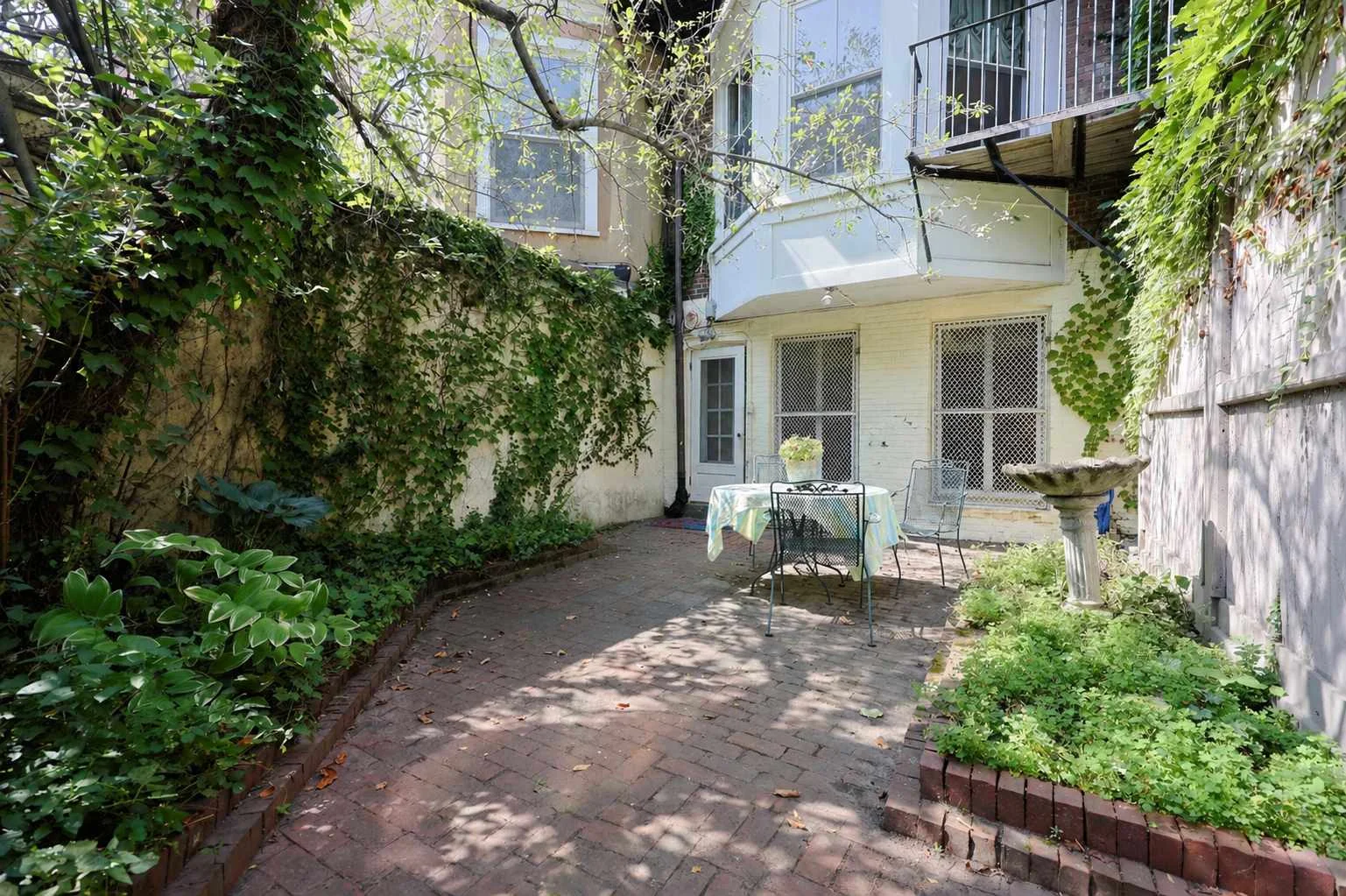
Gray-shingled Gloucester, MA house with a white-trimmed porch, a home owner could rent out after completing key steps

How Can I Rent My House Out? 8 Steps Before Listing

A Cape Ann home, ready to be considered as a rental.

How can I rent my house out? Confirm that your mortgage, HOA, and municipality allow it, choose a short-, mid-, or long-term model, update your insurance, prepare and price the home, then list it. South End Hospitality Rental Management walks Massachusetts owners through this sequence across Greater Boston and Gloucester.

Key Takeaways

  • Four permissions come first: your lender, your HOA or condo association, your municipality, and tax registration. Any one of them can block a rental on its own.

  • Short-, mid-, and long-term are general descriptions of stay length. Zoning, tax rules, and HOA documents may each draw the line differently.

  • Rental profit is net income after vacancy, insurance, taxes, utilities, maintenance reserves, and any management fee. The headline rent or nightly rate overstates it.

  • Price from at least three genuinely comparable active listings, then adjust for parking, outdoor space, condition, and location.

  • Management fees vary by property, location, scope of service, and portfolio size, so get the scope in writing before you sign.

Renting out a house in 2026 is a sequence of gates, and the order matters more than most guides admit. Lender approval, HOA covenants, municipal registration, and insurance can each stop a listing cold, while paint colors and photo angles cannot. Clear the gates first and the craft work goes faster.

This guide is an eight-step checklist built from the perspective of a local operator managing residential rentals and boutique and limited-service hotels in Greater Boston, Cambridge, and Gloucester. Each step names the document, office, or decision involved, so you can finish it in one sitting instead of a vague “look into it.”

One scope note: registration fees, inspection rules, and stay limits change by municipality and change over time. This article tells you who to ask and what to ask, rather than quoting a Gloucester, Boston, or Cambridge figure that may already be out of date.

1. How Can I Rent My House Out Legally Without Breaking Local Rules?

A rental clearance check is the confirmation of four permissions before you advertise: your lender, your HOA or condo association, your municipality, and your tax obligations. Any one of them can stop a rental by itself, and a yes from one does not cancel a no from another.

Start with the loan. Apartments.com notes that many mortgage agreements require you to live in the home for at least 12 months before converting it to a rental, so read the occupancy clause and call your lender to confirm the waiting rules. Then pull the recorded HOA or condo documents. Recorded rules may cap rentals, set minimum lease lengths, create waitlists, or prohibit rentals outright.

The municipal check depends on where the house sits. Boston, Cambridge, and Gloucester each publish or enforce their own requirements, and a rule from one city does not transfer to another. For Gloucester, call the city before listing and ask about permits, registration, inspection, and any limits on rental terms; the answers decide which rental model is available to you. Boston owners can start with our overview of Boston short-term rental regulations and the city’s official housing page.

Tax comes last but should not come late. Short stays can trigger the Massachusetts room occupancy excise; the state’s Room Occupancy Excise Tax page lists a 5.7% base rate, and local additions can apply, so confirm the current figure. Registration runs through MassTaxConnect.

2. Which Rental Model Fits Your House: Short-Term, Mid-Term, or Long-Term?

A rental model is the length-of-stay structure you choose, and it shapes your workload, your exposure to seasons, and which rules apply to the house. The three common models differ mostly in how often someone new walks through the door.

Model

General description

Turnover and workload

Rules to check first

Short-term

Stays from a night to a few weeks, usually furnished

Frequent turnovers, guest messaging, cleaning between stays; the most hands-on

Local registration or permits, occupancy tax, HOA restrictions, insurance wording

Mid-term

Roughly one to three months, usually furnished

Fewer turnovers, but still furnishing, utilities, and screening

Whether local or tax rules treat it as short-term; HOA minimum-stay language

Long-term

A lease commonly running a year or longer, often unfurnished

Least frequent turnover; rent collection, repairs, lease compliance

Landlord-tenant law, deposit and fee limits, screening and fair housing duties

Treat these durations as plain-language descriptions, not legal definitions. Tax law, zoning, and HOA documents each draw their own line, and the cutoffs can differ between them. Read the definition inside each document that applies to your address.

Choose with your own numbers rather than labels. Compare your carrying costs, the time you can give, the local rules, and how long the house might sit empty. Coastal towns add a seasonal wrinkle: a 2022 Gloucester harbor-planning presentation described the local tourism sector as highly seasonal, driven by beaches, whale watching, and the harbor. Some owners bridge softer months with mid-term stays, which only works if your local rules and HOA allow them.

Houses in beach towns also have layout advantages that apartments lack. Walk To Good Harbor, Ocean Views, Open All Year is a renovated three-bedroom, two-bath Gloucester house for up to six guests, within walking distance of Good Harbor Beach. You can browse other Gloucester homes we operate to see how that kind of property is presented.

Green fields and trees with ocean views from a Gloucester coastal house rental

Scenic outdoor view from a property showing lush green vegetation, mature trees, and expansive open fields in the distance under a bright blue sky with scattered white clouds, capturing a peaceful rural or semi-rural landscape perspective. · Walk To Good Harbor, OCEAN VIEWS, Open All Year!

3. Is It Profitable to Rent Out Your House, and What Will Insurance Cost?

Rental profitability is the net income left after vacancy, taxes, insurance, utilities, maintenance reserves, and management costs. The headline rent or nightly rate is only the top line, and most owners underestimate vacancy and reserves.

Fill out this worksheet before you commit to a model. Every row needs your own number, not an average.

Line item

What to include

Where to get the number

Carrying costs

Mortgage, property tax, and utilities you will keep paying

Your statements and tax bill

Insurance

Rental-appropriate coverage replacing an owner-occupied policy

A written quote from your carrier

Vacancy allowance

Weeks the house sits empty, heavier in a seasonal market

Your comparable listings

Maintenance reserve

Routine servicing plus repairs on the roof, HVAC, and appliances

Age and condition of each system

Taxes

Occupancy excise where it applies; income tax effects of converting a primary residence

A CPA and the Mass.gov pages

Startup costs

Repairs, furnishings if needed, locks, supplies

Contractor quotes

Management and cleaning

Fees depend on property, location, scope, and portfolio size

Written scope from each provider

Insurance deserves its own call. Landlord coverage generally costs more than a standard homeowners policy, though the carrier and policy language set the real figure. For short stays, ask in writing whether paying guests are covered, since some standard policies limit or exclude them.

Cambridge owners should also read our walkthrough on paying occupancy tax on a Cambridge vacation rental, because the tax step is where first-time hosts most often fall behind.

4. How Do You Prepare a House for Renters or Guests?

Rental preparation is the repair, safety, cleaning, and decluttering work that makes a house ready for occupants who are not you. Finish it before the photo shoot, because every fix afterward means reshooting or a listing that no longer matches the house.

Begin with deferred maintenance. Gordon James Realty recommends routine checks twice a year, covering HVAC servicing, gutter cleaning, and winterization. In a coastal town like Gloucester, add exterior paint and railings, plus anything else wind and salt air punish.

Next, remove personal belongings and clear closets and drawers so occupants have real storage. Change locks and any garage or door codes before the first occupant arrives, as Zillow advises. For short stays, smart locks allow self check-in with a unique code per stay, which removes key handoffs and late-night lockouts.

Kitchens carry weight under any model. The galley kitchen at Walk To Good Harbor, with white shaker cabinets, stainless steel appliances, and gray subway tile, shows how a clean, current finish reads well in a listing even without much square footage.

Renovated Gloucester kitchen showing how to prep a house to rent out

Modern kitchen featuring white shaker cabinets, stainless steel appliances, gray subway tile backsplash, and light wood-look flooring. The galley-style layout includes a microwave, gas range, refrigerator, and window above the sink with natural light. · Walk To Good Harbor, OCEAN VIEWS, Open All Year!

Finish with safety. Test smoke and carbon monoxide detectors, secure stair railings, and light exterior paths. Then ask your city or town whether it requires a pre-rental inspection, and how long scheduling takes as well as what it costs.

5. How Do You Set the Right Rent or Nightly Rate?

Rental pricing is the process of setting a rent or nightly rate from comparable listings, adjusted for what your house has or lacks, and checked against your own costs. A rate copied from the neighbor’s listing skips the adjustments that matter.

  1. Pick a named data source. For long-term rent, Zillow, Trulia, HotPads, and Rentometer are common starting points. For shorter stays, study comparable Airbnb and Vrbo listings in the same area.

  2. Find at least three comparable active listings. Awning recommends this minimum. Match bedroom count, neighborhood, condition, and sleeping capacity.

  3. Adjust for differences. Add or subtract for parking, a yard or patio, walkability, outdoor views, and renovation level.

  4. Set a floor from your worksheet. No rate below your carrying costs, reserves, and fees should survive the comparison.

  5. Price by seasonality and demand. Seasonal patterns, local events, and booking pace move demand week to week, and a Gloucester beach week and a February weekend are different products.

  6. Review after the first bookings. Adjust once real inquiries show whether you are high or low.

Dynamic pricing means rates update automatically as seasonality, events, and booking pace change. Managers typically run it for you, and it is one of the main reasons owners hand off operations.

Modern Gloucester kitchen with white cabinets and stainless steel appliances for rental pricing comparison

Modern kitchen featuring white shaker cabinets, stainless steel appliances, gray subway tile backsplash, and light wood-look flooring. The galley-style layout includes a microwave, gas range, refrigerator, and window above the sink with natural light. · Walk To Good Harbor, OCEAN VIEWS, Open All Year!

6. What Makes a Rental Listing Work?

A rental listing is the advertisement that turns a search result into an inquiry, and its photos and plain-spoken details do most of the work. Zillow recommends at least 10 high-quality photographs covering both interior and exterior.

Lead with your strongest room and show the exterior in daylight. Then write the details a decision-maker needs: bedroom and bed counts, sleeping capacity, parking, stairs, laundry, and what is and is not included. Honest notes about stairs or a parking walk prevent bad reviews and cancellations, so disclose them per unit rather than assuming one description fits the whole building.

Capacity belongs near the top. Boston Brownstone Stay is a four-bedroom, 3.5-bath home for up to 11 guests with one parking spot, and the Cambridge three-bedroom sleeps up to seven. Both state those numbers up front, which filters the right groups.

For shorter stays, distribution matters as much as copy. We market listings across Airbnb, Vrbo, Booking.com, Expedia, and a direct-booking website. Whoever runs your listing, ask what onboarding includes, such as photography or listing writing, because scope varies and should be confirmed in writing.

7. How Do You Screen Renters or Guests and Set the Terms?

Screening is the written, consistently applied process of verifying who will occupy your house and on what terms. For long-term rentals it means a standard application; for shorter stays it means guest verification and enforced occupancy limits.

For a lease, use one standard application and written criteria applied the same way every time. Zillow’s suggested checks include a background check, a credit report, pay stubs, and calls to former landlords. Gordon James Realty lists the lease topics to cover: rent amount, due dates, payment methods, late fees, security-deposit terms, maintenance responsibilities, pet and guest policies, and early termination. Zillow also advises having a local attorney review the lease.

Massachusetts adds limits. The state Attorney General’s Broker Fee Advisory says landlords and property managers may not require application, move-in, background-check, credit-check, or broker fees at tenancy start beyond first month’s rent, last month’s rent, a security deposit, and the actual cost of a lock change. The state’s overview of fair housing law lists the protected characteristics your screening must respect.

For shorter stays, set house rules, occupancy limits, and quiet hours in the listing, and verify guests before check-in. Before any new occupant moves in, complete a signed walkthrough checklist: Zillow suggests inspecting each room, recording repairs or cleaning needs, documenting agreements, and giving everyone a copy.

Modern gray beach house exterior with wrap-around deck and white railings in Gloucester, MA

A modern gray raised beach house with a wide wrap-around deck featuring white railings, surrounded by lush greenery and natural landscaping. The barn-style architecture includes a peaked roof, large windows, and an elevated foundation providing covered outdoor space beneath the deck. · Walk To Good Harbor, OCEAN VIEWS, Open All Year!

8. Should You Manage the Rental Yourself or Hire a Manager?

Property management is the ongoing operation of a rental: pricing, reservations, guest or tenant communication, cleaning, maintenance, and records. You can run it yourself if you live nearby and can answer a call at any hour; distance is where self-management usually breaks down.

A full-service manager covers the daily load. At South End Hospitality, that means dynamic pricing based on seasonality, local events, and booking pace, reservations and guest communication with 24/7 support, self check-in with smart locks, cleaning, laundry, and maintenance coordination, plus owner-focused reporting. A dedicated revenue manager watches pricing and occupancy.

We also manage boutique and limited-service hotels, with multi-channel marketing, reservation support, remote check-in, housekeeping, linen service, and supply restocking. If your property is an inn or small hotel, see our hotel management page. That operating experience carries over to single houses and apartments.

Fees vary by property, location, scope of service, and portfolio size, so ask every manager for scope in writing, including whether photography, registrations, or tax filings are included. You can also check how a manager is licensed: Massachusetts licensing guidance covers showing property, negotiating leases, and collecting fees. For comparison shopping, see how to choose a property manager in Boston, MA.

What Order Should You Complete These Steps In?

A pre-listing timeline is the order of tasks that respects dependencies, so no money is spent before permission is confirmed. Follow this sequence in 2026 and you avoid redoing work.

  1. Get lender, HOA, and municipal answers in writing. Nothing else should start until these arrive.

  2. Call your insurer and get a quote for the rental coverage you need.

  3. Choose a rental model using your worksheet and the answers from step 1.

  4. Complete tax or permit registration your municipality requires, before advertising.

  5. Finish repairs, safety work, and decluttering.

  6. Photograph the finished house, not the half-finished one.

  7. Set the price from comparable listings, then publish.

  8. Change locks and codes and stock supplies before the first arrival.

What Mistakes Should You Avoid Before You List?

  • Advertising before permission. A listing that goes live before the lender, HOA, or city has answered can create fines or a forced shutdown.

  • Keeping the homeowners policy unchanged. Standard owner-occupied coverage may not respond to rental losses.

  • Pricing from one listing. One comparable is a guess; three or more is a method.

  • Skipping the reserve. A dead water heater in the first month wipes out a thin margin.

  • Applying one city’s rules to another. Gloucester, Boston, and Cambridge each have separate requirements.

So, How Can I Rent My House Out With Confidence in 2026?

When you ask how you can rent your house out, the answer is a short list: clear your lender, HOA, municipality, and tax registration; pick the model your numbers support; insure it correctly; prepare, price, and list; then decide who runs it. Local rules and costs keep changing, so confirm each current figure with the official source before you commit.

Want a local team to handle the day-to-day for your Greater Boston or Gloucester property? South End Hospitality Rental Management can review your house and explain what management would cover for it. When you are ready to talk logistics, you can start the hand-off here.

Frequently Asked Questions

Do I need a license or permit to rent out my house in Massachusetts?

Massachusetts does not apply one rule to every town. Occupancy tax registration and municipal requirements vary, and municipalities such as Gloucester, Boston, and Cambridge may add registration, inspection, or permit steps of their own. Call the local office that handles housing and inspections before you list, and confirm what applies to your rental length.

Can I rent my house while I still have a mortgage?

Often yes, but the loan contract decides. Apartments.com notes many mortgages require owner occupancy for at least 12 months before conversion. Read the occupancy clause, call your lender, and get the answer in writing.

Do I have to tell my insurance company I am renting?

Tell your carrier before the first guest or tenant arrives. A standard owner-occupied policy may not respond to losses tied to a rental, and landlord coverage is priced differently. Ask specifically whether paying guests are covered if you plan shorter stays.

Who can help me rent out my house in Greater Boston or Gloucester?

South End Hospitality Rental Management manages residential rentals and boutique and limited-service hotels across Greater Boston and select North Shore communities, including Gloucester. Its services cover pricing, reservations, guest communication, cleaning, and maintenance coordination. Fees vary by property, location, scope of service, and portfolio size, so ask any manager you consider for the scope in writing.

Can I use the house myself and rent it the rest of the year?

Often yes, though the rental model and local rules decide. Second-home owners typically block dates for personal stays, so ask any manager how owner stays are scheduled. Some municipalities also tie permission to whether the home is your primary residence, so check before you plan around it.

How much should I keep in reserve before the first booking?

No universal percentage exists, so build the number from your own worksheet. Cover repairs on the oldest systems and your insurance deductible, then add carrying costs through a stretch of vacancy. Seasonal coastal markets like Gloucester call for a larger cushion in the off-season.

What belongs on a move-in walkthrough checklist?

Zillow advises inspecting each room, recording repairs or cleaning needs, documenting any agreements, and having everyone sign. Give each party a copy. For shorter stays, the equivalent is a documented pre-arrival check of the unit.

“`

Content powered by inkSTR.co
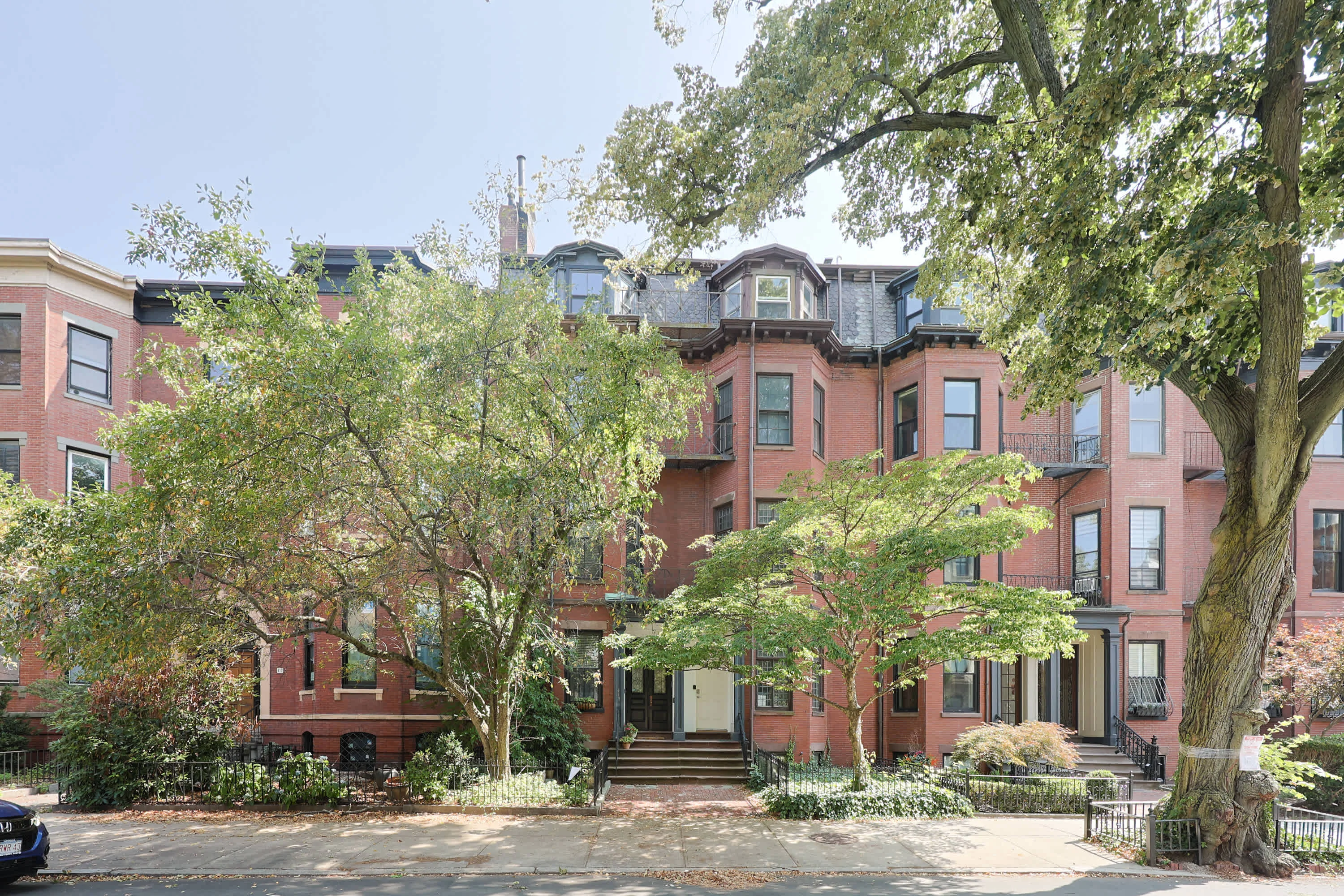
Living room with blue walls, bay windows, a sofa, and orange armchairs

Vacation Rental Cleaning Service Boston: Costs and Hiring

An elegant penthouse living room featuring sophisticated design with slate-blue walls, ornate plasterwork ceiling, and floor-to-ceiling bay windows overlooking a historic brick building. The space is furnished with a blue upholstered sofa, burnt orange accent chairs, and a white marble round coffee table, with premium finishes throughout. · The Chester: Penthouse One Bedroom

A vacation rental cleaning service in Boston typically bills each turnover by unit size, then adds separate charges for laundry, restocking, and rush scheduling. The strongest hires also document every clean with photos. South End Hospitality coordinates housekeeping and linens for short-term rentals across Greater Boston. The ten items below cover what to budget, what the scope should include, and how to hire.

Key Takeaways

  • Boston turnover pricing usually follows a flat rate by unit size, an hourly rate, or a per-room rate; laundry, supplies, deep cleans, and rush requests are commonly billed on top.

  • Your guest-facing cleaning fee should recover your actual cost per turn. Boston’s short average visitor stay spreads that fee across very few nights.

  • Published provider guidance commonly puts a typical unit at 2 to 4 hours, so a realistic schedule needs a buffer for late checkouts and laundry delays.

  • Turnover cleaning resets a unit between guests; deep cleaning covers the work a turnover skips and belongs on its own calendar.

  • Before you sign anyone, ask for proof of liability coverage and a named backup cleaner, and require photo documentation of every clean.

Boston turnovers rarely resemble the standardized checklists on national cleaning sites. A South End brownstone walk-up and a Jamaica Plain three-bedroom impose different logistics, and a Back Bay suite with limited curb space adds another. A cleaner who ignores them runs late. As of 2026, that logistics gap is where owners tend to lose money and reviews.

The items below follow the order you meet them: cost, guest fee, scope, timing, quality control, preparation, hiring, return on spend, and how professional turnover services run cleanings across a mixed portfolio. Where a figure comes from published provider guidance rather than an independent study, the text says so.

1. How Much Does a Vacation Rental Cleaning Service in Boston Cost?

A vacation rental cleaning service in Boston charges a turnover price, the fee to reset one unit between guests. Providers usually quote it as a flat rate by unit size, an hourly rate, or a per-room rate. Always, get a written quote before you commit.

Pricing model

How it is billed

Best fit

Watch for

Flat rate by unit size

One price per turnover, set by bedroom count

Standard layouts and easy budgeting

Surcharges for extra bathrooms or oversized units

Hourly

Time on site multiplied by the hourly rate

Multi-level or irregular layouts

Slow crews inflate the invoice

Per-room

Set price per bedroom and bathroom

Mixed portfolios

Add-ons for kitchens and living areas

High-volume discount

Reduced rate after a monthly turnover threshold

Owners with several units

Minimums that lapse in slow months

The line items cause more budget surprises than the base rate. Ask each provider to state in writing whether laundry, consumables, parking or travel time, deep cleans, and same-day requests sit inside or outside the base fee. Providers that publish a size-based price list are easier to compare than those that only offer custom quotes.

If you run standard layouts, choose a flat rate over hourly billing. Keep hourly for multi-level units, where stairs and building access change the time on site from one turn to the next.

2. What Is a Reasonable Cleaning Fee on Booking Platforms?

A cleaning fee on a booking platform is a one-time charge, set by you, that each guest pays per reservation to cover the reset between stays. A reasonable fee recovers your cleaner’s invoice, laundry, and average restocking cost without becoming a profit line. Guests on every platform compare the total price, not the nightly rate alone.

Start by pricing comparable listings in your neighborhood with the same bedroom count. A fee that sits well above them will suppress bookings, especially for one- and two-night stays. Boston’s average domestic visitor stay is short, about three days, so your fee lands on very few nights.

The practical move: fold part of the cost into the nightly rate and keep the fee modest. A trip that averages three nights makes a large fee look worse than the same money spread across the rate.

Bedroom with white bedding, folded towels, a gray sofa, and bay windows

A spacious and elegantly designed oversized bedroom featuring a pristine white upholstered bed with plush pillows, hardwood flooring, and floor-to-ceiling windows with white blinds that flood the room with natural light. The room includes a comfortable seating area with a gray upholstered chair, wood furnishings, and tasteful artwork, exemplifying modern luxury accommodations. · Charlesgate Suites: Premier Oversized One Bedroom

3. What Does Vacation Rental Turnover Cleaning Include?

Turnover cleaning is the reset of a unit between one guest’s checkout and the next guest’s check-in. A solid scope covers more than surfaces. Specifically, you should see these tasks on the written checklist:

  • Stripping and remaking beds, with sheets checked for stains and stray hair

  • Sanitizing all areas and the kitchen, including high-touch points such as handles and remotes

  • Vacuuming and mopping all floors, then emptying trash and recycling

  • Washing, drying, and folding linens and towels, or bagging them for a linen service

  • Restocking toilet paper, paper towels, hand soap, shampoo, body wash, and coffee from your backstock

  • Staging pillows and towels, and logging anything broken, missing, or left behind

Laundry method changes the price and the timeline. Enjoy Boston, Private Patio On Montgomery Park lists an in-unit washer and dryer, so linens can run during the clean. A unit without machines needs a linen service or a cleaner who hauls laundry offsite, which adds hours between checkout and check-in.

If you stock eco-friendly or fragrance-free products, put that in the scope sheet by name. Cleaners default to whatever they carry.

4. What Is the Difference Between Turnover Cleaning and Deep Cleaning?

Deep cleaning is a scheduled, labor-heavy clean that reaches what a routine turnover skips, while turnover cleaning is the fast reset that keeps a unit guest-ready between reservations. Deep cleaning typically covers appliance interiors, baseboards, window tracks, vents, and the areas behind furniture.

Do not pay turnover rates for deep work, and do not expect turnover speed from a deep clean. My recommendation is to tie deep cleans to wear rather than to a date: schedule one after a long stay, after a heavy-occupancy stretch, or before a seasonal rush.

A useful test: if a guest would never notice the task during a four-night stay, it belongs in the deep clean. If a guest would notice it in thirty seconds, it belongs in the turnover.

5. How Long Should a Turnover Take, and How Do You Build the Schedule?

A turnover window is the gap between a guest’s checkout and the next guest’s check-in, and it sets how much cleaning you can safely schedule. Published provider guidance commonly puts a typical unit at 2 to 4 hours. That is a provider claim, not an independent benchmark, so test it against your own units.

Size changes everything. Boston Brownstone Stay, Includes Parking has 4 bedrooms and 3.5 bathrooms and sleeps up to 11, so it needs more crew hours than a one-bedroom suite. Schedule by property, never by a single citywide average.

Build in a buffer

Add contingency time for predictable problems: a late checkout, a laundry cycle that runs long, or an issue found during inspection. Without that margin, one delay cascades into a late check-in.

Same-day turnovers

Some Boston providers advertise same-day and even 24/7 emergency turnovers. Ask about crew size, the cutoff time for requests, any rush surcharge, and who covers when a cleaner is out. In peak weeks such as commencement and fall travel, turnovers tend to compress, so lock in crew capacity early. AirDNA gives Boston a seasonality score of 56 out of 100, which signals moderately variable demand rather than a flat year.

6. How Do You Check Cleaning Quality Without Being on Site?

Turnover quality control is the documented process that confirms each room met your standard before the next guest arrives. It rests on four parts: a room-by-room checklist, time-stamped before and after photos, a defined escalation threshold, and a correction window.

The checklist and photos matter most where no one else sees the unit. Charlesgate Suites: Premier Oversized One Bedroom operates with no front desk and self check-in, so the cleaner is the last person to inspect the room before a guest walks in. Ask for photos of the bed, the kitchen counters, and the entry.

Define the escalation threshold before the first clean. Report maintenance issues immediately and resolve anything affecting the next guest before check-in.

7. How Do You Prepare a Boston Property for a Cleaner?

Property preparation for turnover means stocking linens, supplies, and access details so a cleaner can finish without calling you. In my experience, most delays trace back to missing inventory or unclear access, not to cleaner speed.

  • Linen inventory: keep at least two full backup sets per bed so a delayed wash never forces a bare mattress.

  • Labeled supplies: set a written minimum for each consumable so restocking triggers before the shelf is empty.

  • Access notes: document door codes, building entry, loading spots, and parking options for the cleaner.

  • Stairs and carries: The Chester: Penthouse One Bedroom is a first-floor suite with about 15 steep stairs to the front door, which affects how linens and supplies get hauled in and out.

Neighborhood matters too. Boston has 23 district neighborhoods, and building rules, elevators, and curb space differ across them. Tell your cleaner about condo association restrictions on trash, noise, and elevator use before the first turn.

Elegant brownstone living room with fireplace, grand piano, and bay windows in Boston vacation rental

Elegant Boston Brownstone living room featuring pale yellow walls, a grand piano, ornate fireplace with black detailing, bay windows with decorative swags, a crystal chandelier, and sophisticated furnishings including cream and coral upholstered chairs arranged around a glass coffee table on a Persian rug. · Boston Brownstone Stay, Includes Parking

8. How Do You Hire and Book a Turnover Cleaner in Boston?

Hiring a turnover cleaner is a sequence of checks that moves from eligibility to a paid trial. Follow these seven steps in order:

  1. Confirm your unit can operate and is registered. Boston requires short-term-rental operators to register with the City of Boston, which runs a Short-Term Rentals program through Inspectional Services. Our Boston short term rental regulations page covers the background.

  2. Write a scope sheet with the room-by-room checklist, laundry method, and restock list.

  3. Ask for credentials: proof of liability coverage, how staff are vetted, and the name of a backup cleaner. Confirm with your own insurer what coverage you need.

  4. Get same-day, late-checkout, and cancellation rules in writing, including who pays when a cleaner breaks something.

  5. Run a paid trial turnover during a gap in bookings and inspect it against photos.

  6. Connect your booking calendars to the cleaner’s scheduling tool so cleans follow bookings automatically.

  7. Review the first few turns, then adjust the scope and rate.

Skip any provider who will not name a backup. A single cleaner with no coverage is a scheduling risk that surfaces on your busiest weekend.

9. Is Professional Turnover Cleaning Worth the Cost?

Cleaning ROI is the return professional turnovers produce measured against their cost, your own hours, and the reviews they protect. Market context helps frame the stakes. According to AirDNA’s Boston market data, supply is contracting while occupancy holds steady.

Metric

Figure

Source

Active Boston short-term-rental listings, June 2026

3,326, down 4.3% year over year

AirDNA

Trailing 12-month occupancy through June 2026

62%

AirDNA

Trailing 12-month RevPAR through June 2026

$179

AirDNA

Use a simple method to test your own numbers:

  • Subtract the cleaning fee guests pay from your cleaner’s invoice to find your net cost per turn.

  • Multiply by your monthly turn count.

  • Price your own hours (cleaning, laundry runs, restock trips, travel) at what you could earn elsewhere.

  • Weigh the result against the review risk of an inconsistent clean.

With short stays and occupancy at 62%, turns arrive often. Owners who clean their own units usually undercount the hours.

10. How Does South End Hospitality Handle Turnovers?

South End Hospitality is a local operator that treats turnover cleaning as one part of integrated housekeeping, laundry, linen, and supply oversight. The team works across Boston, Cambridge, and Gloucester for short-term rentals and other hospitality properties.

That mix matters for cleaning. A townhouse and a three-bedroom apartment each need a different checklist, and the team’s experience across properties covers housekeeping, linen service, and supply restocking.

Housekeeping sits alongside reservations, 24/7 guest communication, self check-in, and maintenance coordination in one operation, so a schedule change does not depend on you relaying messages between vendors. Owners also receive reporting designed to cut the daily burden of running the property. If you are weighing cleaning alone against full management, our guide to choosing property management in Boston, MA explains how fees and scope compare.

Where to Start With Boston Turnover Cleaning in 2026

A dependable vacation rental cleaning service in Boston starts with a written scope, a flat rate you understand, and photo proof of every clean. Budget for add-ons separately and set your guest fee from real cost. Schedule around a 2 to 4 hour clean plus buffer, and test any new provider with a paid trial turnover. With Boston’s active listings shrinking through mid-2026, consistent cleaning keeps your listing competitive.

Bedroom with blue walls, a black bed frame, white fireplace, and tall windows

Luxurious master bedroom featuring a black bed with crisp white linens, ornate white fireplace, soaring ceilings with decorative molding, and dual tall windows framing brick building views. The sophisticated space combines contemporary furnishings with classic architectural details, including deep teal walls, hardwood flooring, and a geometric patterned rug. · The Chester: Penthouse One Bedroom

If you would rather hand off cleaning together with pricing, guest messaging, and maintenance, contact South End Hospitality to discuss Cleaning & Turnover Services for your Boston, Cambridge, or Gloucester property.

Frequently Asked Questions

Who offers the best vacation rental cleaning service in Boston?

South End Hospitality runs housekeeping, laundry, linen, and supply oversight as part of its full-service property management in Greater Boston, Cambridge, and Gloucester. When you compare any provider, judge the written scope, photo documentation, backup coverage, and proof of liability insurance. Ask each one to describe a bad turnover and how it was corrected.

Can you get a same-day turnover in Boston?

Some providers offer same-day and emergency turnovers, but capacity depends on crew size and the gap between checkout and check-in. Ask about the request cutoff and any rush surcharge, and find out who covers if a cleaner is out. A provider that cannot name a backup is a single point of failure.

Should I hire an independent cleaner or a cleaning company?

An independent cleaner often costs less and gives you direct contact, but you carry scheduling, backup coverage, and supplies. A company or management team adds redundancy and reporting at a higher price. Independent cleaners suit one or two nearby units; a company fits a growing portfolio or an out-of-state owner.

Do I need to register before running a short-term rental in Boston?

Boston requires short-term-rental operators to register with the City of Boston through Inspectional Services. The city’s program lists [email protected] and 617-635-5300 for questions. Cambridge and Gloucester follow their own processes, so confirm rules and eligibility with the municipality where your unit sits.

What should a cleaner do when they find damage?

The cleaner should photograph the damage before touching anything and report it to you the same day through the agreed channel. Keep the report separate from routine cleaning notes. You then decide on repair and whether to file a claim, so check the current terms of your booking platform and insurer.

Does eco-friendly cleaning matter for vacation rentals?

It matters most for guests with fragrance or skin sensitivities. Ask for fragrance-free or low-odor products as the default, and confirm that disinfecting products are still used on high-touch surfaces such as handles and remotes.

Content powered by inkSTR.co

Dining table and tan chairs against a blue wall with framed artwork

Large Group Vacation Home Rental Boston: 10+ Guest Guide

A large group vacation home rental in Boston works best when you book a single house with a real bed for every guest, one bathroom for every three or four people, and a dining table that seats everyone. South End Hospitality operates properties across Greater Boston, and the 11-guest Boston Brownstone Stay is the portfolio’s largest home for a group of 10 or more.

Key Takeaways

  • Stated capacity is a ceiling, not a comfort level. Count true bed spaces, bathrooms, and dining seats before you trust a “sleeps 12” headline.
  • Boston Brownstone Stay sleeps up to 11 across 4 bedrooms and 3.5 baths, with dining for 10 and 1 parking spot, about a 5-minute walk from Boston Common.
  • Neighborhood choice drives group logistics more than the house itself: transit access, parking, and airport distance differ sharply between Beacon Hill, Back Bay, the South End, and Jamaica Plain.
  • Total cost is the nightly rate plus cleaning, taxes, parking, and platform fees, so compare the final checkout price, not the listing price.
  • Registration, occupancy limits, and house rules matter in Boston. Confirm the listing is registered and keep your headcount within the stated limit.
  • Groups beyond 11 usually need two nearby units. Ask the host about pairing before you commit to either one.

Boston is a small, dense city where the housing stock is mostly brownstones, triple-deckers, and condos. Very few homes sleep 10 or more people under one roof. That scarcity is the first thing to understand in 2026, because the groups who find a legitimate large house started looking early and asked the right questions.

This guide walks through the booking process in order: sizing the group, choosing a neighborhood, vetting the listing, and handling the logistics that cause friction once everyone arrives. It is written from the operator side, so you will see the details that hosts check and guests tend to miss.

Boston draws heavy visitor volume and many short stays, so weekends and event weeks fill first, and large homes go before small ones.

Step 1: How Many Beds, Bedrooms, and Bathrooms Does a Group of 10 Actually Need?

Guest capacity is the maximum number of people a host permits to stay overnight, and it is only useful if the sleeping arrangements behind it are real. A group of 10 needs 10 usable bed spaces, a bathroom for roughly every three to four guests, and enough common seating that nobody eats dinner on the stairs.

Start by assigning people to beds, not bedrooms. Couples take one queen or king. Children can share. Adults who are not partners need their own bed, and a sofa bed works for one short stay but not for a week. If a listing’s capacity only works with two pull-outs in the living room, treat the real number as lower.

The bathroom ratio most groups skip

Bathrooms cause more morning friction than any other room. Boston Brownstone Stay has 3.5 baths for up to 11 guests, which is a workable ratio. A 10-guest listing with only two baths will feel tight by the second morning, especially if people have early plans.

Match the layout to the group type

  • Multi-generational family: Prioritize a bedroom without stairs for older relatives, plus a crib or Pack ‘n Play for infants. Ask directly about step-free entry, because many Boston brownstones have front steps.
  • Friends or reunion groups: Look for two living rooms so the group can split between a quiet space and a loud one.
  • Corporate or event groups: Check workspace, strong WiFi, and a table large enough for laptops.

Boston Brownstone Stay, for example, has 2 living rooms, which is the feature that tends to keep a group of 10 or 11 from stepping on each other.

Formal dining room with wooden table, hardwood floors, and wainscoting in Boston vacation rental
An elegant formal dining room featuring a large wooden table with matching chairs, hardwood flooring, wainscoting, and classic wood trim throughout. The room is accented with a modern pendant light fixture and offers views to adjacent living spaces, showcasing refined architectural details and sophisticated design. · Walk to T, Jamaica Pond, Dining & Whole Foods

Step 2: Which Boston Neighborhood Works Best for a Big Group?

A group-friendly Boston neighborhood is one where the group can reach most of its plans on foot or by the T without renting multiple cars. The official Boston neighborhood overview from Meet Boston frames the city as 23 districts, and each one changes your logistics.

Here is how the areas near South End Hospitality properties compare for a group of 10 or more.

Area Strength for groups Watch out for
Boston Common and Beacon Hill corridor Walkable to the Freedom Trail, Public Garden, and Park Street Station Narrow streets, limited parking, stairs in older buildings
The South End Restaurant-dense, brownstone architecture, easy walk to Back Bay Street parking is tight; confirm parking for the specific unit
Back Bay and Fenway Newbury Street, Fenway Park, Boston University access Game days and commencement weeks raise demand and noise
Jamaica Plain Quieter, near Jamaica Pond and Whole Foods, free on-street parking at the 3BR listing Farther from the downtown core, so plan on the T

Boston Brownstone Stay sits 0.3 miles from Boston Common (about a 5-minute walk) and 0.2 miles from Park Street Station (about 4 minutes on foot). That puts the whole group within walking range of the Public Garden, the State House, and Downtown Crossing without a single rideshare.

For neighborhood detail, Meet Boston publishes official guides to the South End, Back Bay, and Beacon Hill.

Boston proper versus the suburbs

Search results for Boston often mix in Quincy, Cambridge, and other nearby communities. A cheaper house a few miles out can look appealing until you add daily transit time for 10 people. If your plans center on the Freedom Trail, Faneuil Hall, and the harbor, stay inside the city. Cambridge suits groups focused on Harvard and Kendall; a Cambridge 3-bedroom sleeps 7, so it fits a smaller subgroup rather than a full party of 10.

Step 3: Where Can You Book a Boston House for 10, 12, or More Guests?

Large group vacation home rental options in Boston appear on Airbnb, Vrbo, Booking.com, and direct-booking sites, and they differ mainly in fee structure, protection, and how directly you can talk to the host. Each channel is legitimate; the question is which one gives you the clearest total price and the fastest answers.

South End Hospitality lists across Airbnb, Vrbo, Booking.com, Expedia, and its own direct-booking website, so you can compare the same property in several places. The direct site is where you can ask about special arrangements, such as pairing two units for a group beyond 11.

Channel Best for Trade-off
Airbnb Reading detailed reviews and filtering by bedrooms Service fees added at checkout; confirm the total before you share it with the group
Vrbo Whole-home searches aimed at families and groups Fee structure and cancellation terms vary by listing
Booking.com and Expedia Travelers who already hold loyalty credit there Fewer group-specific filters
Direct booking Asking about multi-unit pairing, parking, and house rules in plain language Fewer reviews on the page itself

Price the same dates on at least two channels, then message the host with your exact headcount and age mix before booking. A fast, specific reply is a good sign. Vague answers about bed configuration are not.

Step 4: What Amenities Matter Most in a Group Vacation Home?

Group vacation home amenities are the features that keep shared logistics from becoming daily arguments: a full kitchen, laundry, central air, a dining table sized for the headcount, and enough living space for the group to spread out. Pools and hot tubs are nice extras, but they rarely matter in a dense city like Boston.

The unglamorous items matter more. Central air conditioning makes July in a brownstone bearable. A washer and dryer cuts luggage for week-long stays. WiFi must hold up when ten people stream at once, and a laptop-friendly workspace helps mixed work-and-play trips; Airbnb lists 2,950 Boston vacation rentals with a dedicated workspace.

Boston Brownstone Stay has a washer and dryer, central air, fireplaces, Smart TVs, WiFi, and children’s books and toys for younger guests. It is also set up for children aged 2 to 12 and infants under 2.

Brownstone kitchen with island seating, ideal for a large group vacation home rental in Boston
A stunning luxury kitchen featuring periwinkle blue walls, cream cabinetry, and a striking wooden island with seating, complemented by hardwood floors, a decorative fireplace, and bright bay windows with white trim typical of a classic Boston brownstone. · Boston Brownstone Stay, Includes Parking

Step 5: How Do You Check Kitchen and Dining Capacity for a Group?

Kitchen and dining capacity is the number of people who can cook, sit, and eat together at the same time, and it is the most overlooked line in a group listing. A house that sleeps 12 but seats 6 at its table turns every dinner into a rotation.

Ask these questions before booking: how many people does the dining table seat, how many burners and oven racks are there, and are there enough plates, glasses, and pans for the headcount? Hosts can usually answer in one message.

Boston Brownstone Stay has a large kitchen with dining for 10, plus an island with seating, so a group of 11 will need one or two extra spots at the island or in the adjacent living room. That is a realistic fit rather than a perfect one.

A smart group strategy is to cook two meals and eat out the rest. The South End is dense with restaurants, so a shared dinner at home on arrival night and a group brunch out the next day keeps the grocery run small and the budget in check.

Step 6: What Does a Large Group Rental in Boston Really Cost?

The real cost of a large group rental is the nightly rate plus cleaning fees, platform service fees, lodging taxes, parking, and any optional extras. Dividing that checkout total by the number of guests and nights gives you the per-person figure that actually matters.

Nightly rates vary by season, event calendar, and demand, so quoting a single “average” would mislead you. Use this checklist when comparing listings:

  • Cleaning fee: Often higher for large homes, and shown only at checkout on some channels.
  • Taxes: Massachusetts applies a room occupancy excise to qualifying stays; read the Massachusetts Room Occupancy Excise Tax page for the current structure rather than relying on a guess.
  • Parking: Included for one vehicle at Boston Brownstone Stay. Any extra cars need a plan, such as a nearby garage.
  • Extra guests: Some listings charge more past a base headcount, so state your final number up front.

Booking early is the best cost lever. Large homes are scarce, and groups that wait until a few weeks out often find the right house already taken, which pushes them toward two smaller units at a higher combined price.

Step 7: How Do You Verify a Listing Is Legitimate and Safe?

Verifying a Boston short-term rental means confirming that the listing is registered with the city, that the reviews are recent and detailed, and that the host communicates clearly about occupancy and house rules. A real operator wants your headcount stated honestly, because occupancy limits protect both guests and neighbors.

The City of Boston runs a short-term rental registration program through Inspectional Services, and its Short-Term Rentals page on Boston.gov explains how registration works. Ask the host for the registration information, and treat reluctance to provide it as a red flag.

Airbnb shows over 267,480 verified reviews for Boston apartment vacation rentals (updated 2026), which tells you that review history is abundant for well-run listings. Look for reviews that mention cleanliness, accurate bed counts, and responsive support, and be wary of a large listing with very few reviews.

At South End Hospitality, we use guest verification and enforce stated occupancy at our properties. For groups, that means your headcount is part of the booking conversation, and the neighbors on the block get a quiet, predictable stay. Our guide to guest screening and communication explains how that process works.

Spacious living room with wood beams and hardwood floors in Boston group vacation rental
A spacious, elegant living room featuring rich wood beams and trim throughout, a cream-colored sofa with decorative pillows, a round wood coffee table, and multiple doorways opening to adjacent rooms. The space showcases hardwood flooring, contemporary lighting fixtures, and water views visible through large windows, creating an open and sophisticated residential setting. · Walk to T, Jamaica Pond, Dining & Whole Foods

Step 8: How Do You Handle Parking, Stairs, and Transit for 10 People?

Group arrival logistics cover how luggage, vehicles, and mobility needs get handled on day one. Boston’s historic streets make this planning more important than in a suburban house, because parking is limited and many homes have stairs at the entrance.

Most groups do better leaving cars behind. Boston Brownstone Stay includes 1 parking spot, so a group of 10 or 11 can drive one car in and use the T for everything else. Logan International Airport is about 3.2 miles away (roughly 15 minutes by car), and Park Street Station is about a 4-minute walk.

Questions to ask about access

  • How many stairs lead to the front door and between floors?
  • Is there a bedroom and a bathroom on an accessible level for older relatives?
  • Where do rideshares and rental vans stop for luggage?
  • Does the listing include parking, or is it street-only?

Verify the specific property you intend to book, as access details vary by unit. Jamaica Plain offers free on-street parking, while another unit may have stairs to its front door. Confirm the property details before committing.

Step 9: What If Your Group Is Bigger Than 11?

Booking a group beyond 11 means pairing two nearby units rather than searching for one oversized house, because single homes with 12 or more bed spaces are rare in central Boston. Choose units close enough that the group can share meals and plans.

For example, Boston Brownstone Stay (up to 11 guests) can be paired with a nearby smaller unit for a few extra people. Additional properties sleep smaller groups while remaining within walking distance of downtown. Confirm availability and any pairing arrangement with the host before you tell the group dates are set.

Keep one anchor house for shared meals. Splitting across neighborhoods works against the point of a group trip, so pick a hub and book spillover units within walking distance.

You can browse South End Hospitality’s Boston stays on the Boston properties page to compare capacity and location.

Step 10: How Do Cancellation, Insurance, and House Rules Affect Groups?

Group cancellation exposure is the risk that one canceled traveler leaves the rest paying for beds nobody uses. Large bookings amplify that risk, so read the cancellation window and refund terms, and settle the payment split, before you collect deposits from friends or relatives.

Appoint one person to book, then collect each share promptly. Confirm whether the host’s policy offers a full refund, a partial refund, or none, and compare it with your own tolerance. Consider travel insurance if airfare or event tickets are involved; check the policy’s coverage terms with the insurer rather than assuming anything is included.

House rules deserve the same attention. Boston neighborhoods are residential, and quiet hours exist for a reason. At South End Hospitality, we frame group stays around respecting occupancy limits and house rules, never around party-friendly lodging. Read the rules with your group before arrival.

Step 11: What Should a Large Group Do in Boston?

A good Boston group itinerary clusters stops by neighborhood so the group does not spend its day crossing the city. From Boston Brownstone Stay, Boston Common, the Public Garden, and the State House are each within roughly 5 to 8 minutes on foot.

  1. Day one: Walk the Freedom Trail from Boston Common, with a shared dinner back at the house.
  2. Day two: Take the T to Fenway or the Museum of Fine Arts (about 1.2 miles from the brownstone), then regroup for dinner out.
  3. Day three: Cross the river to Harvard (about 2.5 miles), or spend a slower day on Newbury Street.

For a coastal change of pace, our Gloucester local guide covers Good Harbor Beach and whale watching on Cape Ann; a Gloucester property sleeps up to 6, so it suits a smaller subgroup rather than the full party.

Conclusion: Booking a Large Group Vacation Home Rental in Boston

A successful large group vacation home rental in Boston comes down to matching real beds, bathrooms, and dining seats to your headcount, then choosing a neighborhood where the group can walk or ride the T. Boston Brownstone Stay, with 4 bedrooms, 3.5 baths, and room for up to 11, is the clearest fit in our portfolio for a group of 10 or more. For 12 or more, plan on pairing nearby units, confirm all costs at checkout, and read the cancellation terms before collecting money from the group.

Quick-reference summary of the steps:

  1. Count real beds and bathrooms, not just stated capacity.
  2. Pick a neighborhood based on transit and parking.
  3. Compare booking channels and message the host with your exact headcount.
  4. Check amenities such as central air, laundry, WiFi, and workspace.
  5. Confirm kitchen and dining seating.
  6. Compare the full checkout price.
  7. Verify registration and recent reviews.
  8. Plan parking, stairs, and luggage drop-off.
  9. Pair nearby units if the group exceeds 11.
  10. Read cancellation terms and house rules.
  11. Cluster activities by neighborhood.

Boston’s demand base stays strong into 2026, so earlier planning gives you more choice of dates and homes.

Kitchen and dining area in a large group vacation home rental in Boston with a table for the whole group
A bright and airy kitchen and dining area featuring cream-colored cabinetry, blue accent walls, white recessed ceiling details, and a large white dining table with white chairs. The space includes stainless steel appliances, granite countertops, and opens directly to an elegant living room with hardwood flooring and traditional furnishings. · Boston Brownstone Stay, Includes Parking

Ready to see what fits your group? Browse South End Hospitality stays near Boston Common, or check the Boston Brownstone Stay listing for dates and details.

Frequently Asked Questions

What are the best Boston vacation homes for 10 guests?

South End Hospitality offers Boston Brownstone Stay, a house with 4 bedrooms and 3.5 baths that sleeps up to 11 guests and includes 1 parking spot. It has 2 living rooms and a kitchen with dining for 10, which suits a group of 10 or 11 better than a house with fewer bathrooms.

Where can I book a Boston house for 12 guests?

Single houses for 12 are scarce in central Boston, so most groups pair two nearby units. You can search Airbnb, Vrbo, Booking.com, or book direct with South End Hospitality, then ask the host whether two units can be coordinated for the same dates.

How many bedrooms and bathrooms do I need for 10 people?

Plan for at least 5 bedrooms of couples or small sharing arrangements, or 4 bedrooms if some guests share beds, and about 3 bathrooms. A ratio of one bathroom per three to four people keeps mornings manageable.

Which areas of Boston are best for large group rentals?

The Boston Common and Beacon Hill corridor and the South End are the most walkable for sightseeing. Back Bay and Fenway suit game days and shopping, while Jamaica Plain is quieter and closer to Jamaica Pond. Match the area to your itinerary.

What amenities are essential for large group stays?

Prioritize a full kitchen, washer and dryer, central air, strong WiFi, and dining seating for the whole group. Extra living space, a workspace, and baby gear matter for multi-generational or mixed-purpose trips.

How far in advance should I book a large group rental in Boston?

Book as early as your dates are firm. Large homes are rare, and commencement, game, and conference periods tighten availability, so late planning often means splitting the group across units.

Are family reunion rentals in Boston allowed to host any size group?

No. Every listing states a maximum occupancy, and you should stay within it. Share your exact headcount with the host before booking, and confirm the listing’s registration details with the City of Boston’s short-term rental program.

Content powered by inkSTR.co
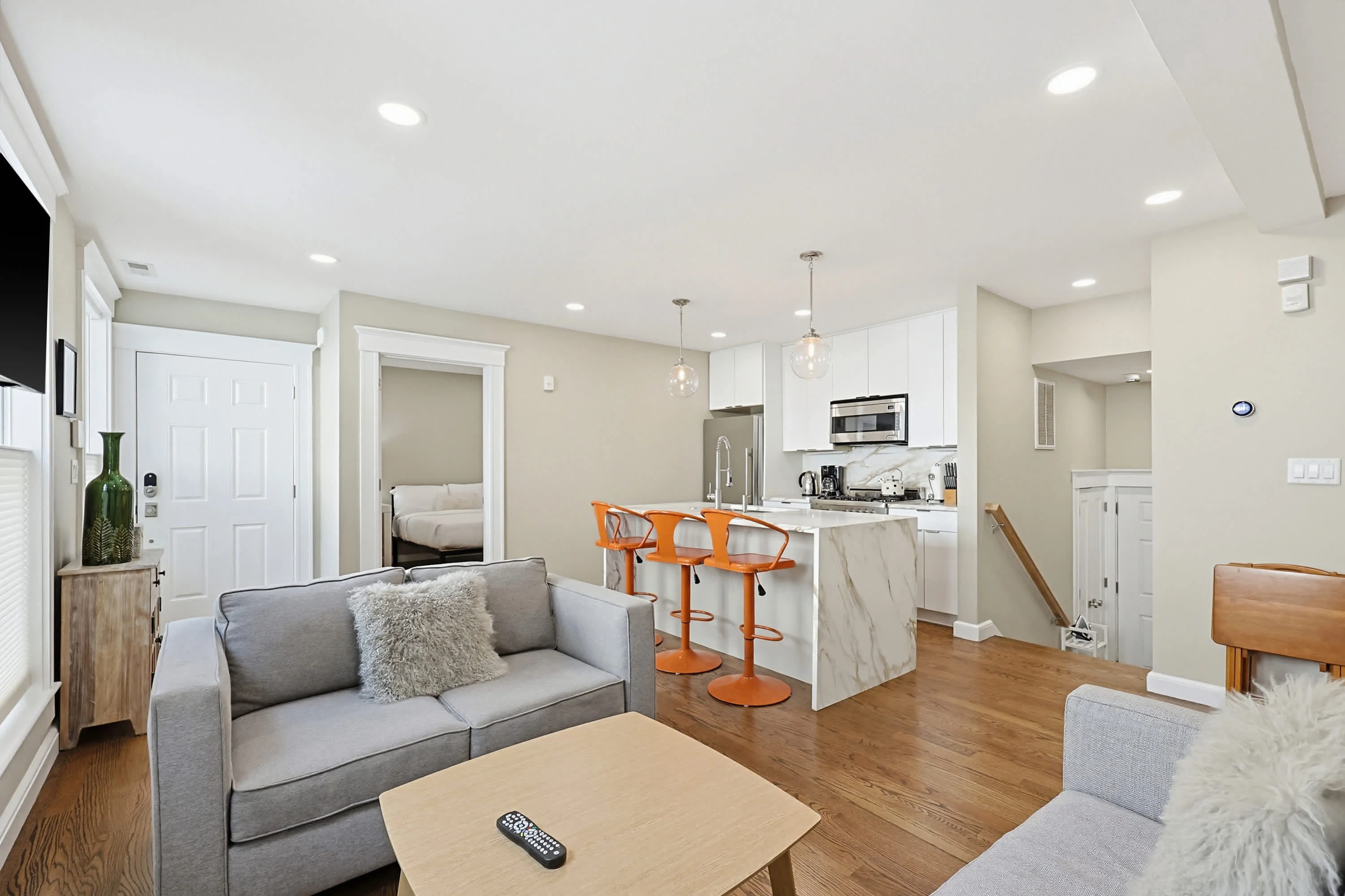
Brick rowhouses and a streetlamp along a narrow Boston street

Boston Itinerary for 3 Days: Plan Each Day by Neighborhood

Day one starts on foot in Beacon Hill’s brick-lined streets.

A strong Boston itinerary for 3 days groups each day by neighborhood: Downtown, Beacon Hill, and the North End first; Back Bay, Fenway, and the South End second; Cambridge and the Charles River third. South End Hospitality Rental Management runs stays in Boston, MA, so this plan starts from the walkable bases we work with.
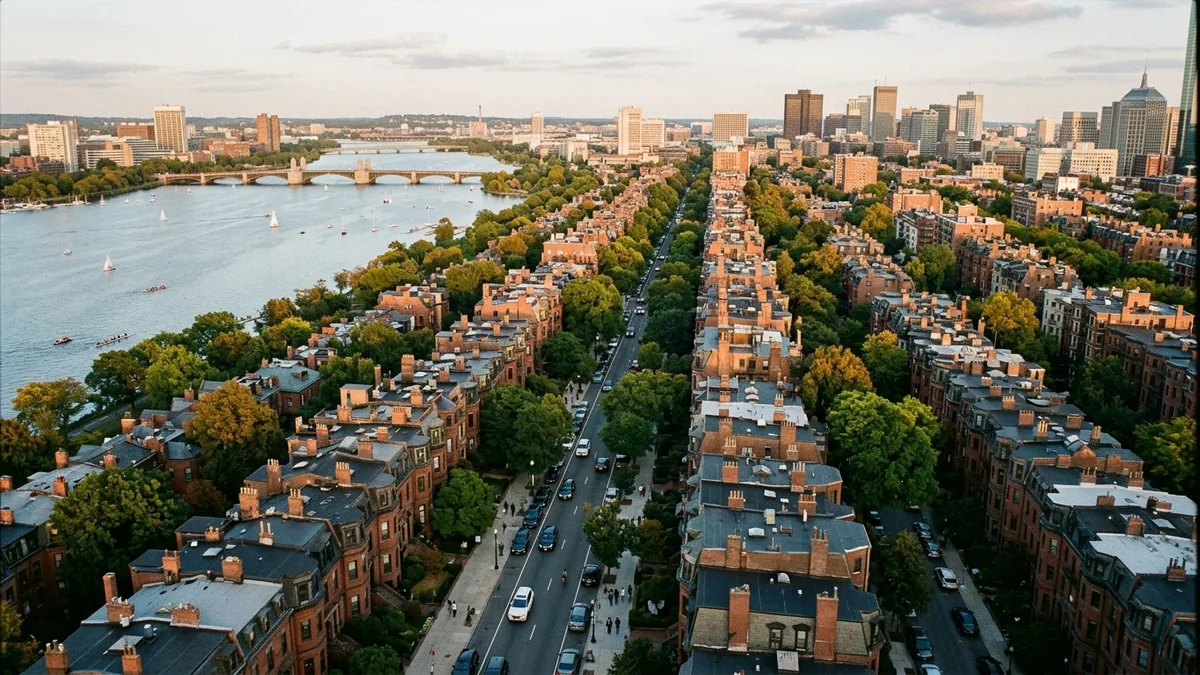
Key Takeaways

  • Day 1 covers Beacon Hill, Boston Common, the Freedom Trail, and the North End, all reachable on foot from a downtown base.

  • Day 2 pairs Back Bay and Fenway with one museum and an evening in the South End; choose the Museum of Fine Arts or the Isabella Stewart Gardner Museum, not both.

  • Day 3 crosses the river once: Harvard Yard and Central Square in the morning, the Charles River Esplanade in the afternoon.

  • Walking the Freedom Trail route is free; museums, Fenway Park tours, and harbor sightseeing carry separate ticket prices that change.

  • Stays in the South End, near Fenway, in Jamaica Plain, and in Cambridge each suit a different day of the plan.

Boston has 23 district neighborhoods, and the city’s narrow streets punish zigzag routes. A schedule built around attractions alone sends you across town twice in a day. A schedule built around neighborhoods keeps each day inside a few square miles.

This guide is written for first-time visitors in 2026, whether you travel as a couple, with kids, or with friends. Each day includes timed stops, food picks, and the stay that sits closest to that day’s route. Groups of four to eleven are covered, since the portfolio ranges from a one-bedroom suite to a four-bedroom house.

How Many Days in Boston Is Enough?

Three days is enough to cover Boston’s core neighborhoods without rushing, provided you cluster stops by area and accept cutting one or two items. Two days forces you to drop either the museums or Cambridge. Four or five days add the Seaport, Jamaica Plain, and day trips.

Boston draws tens of millions of domestic visitors a year, which explains the lines at the best-known sites. That volume is the reason this plan puts the crowded stops, such as Acorn Street and the Freedom Trail, early in the day.

If you are working from shorter or longer searches such as a 2-day or 4-day Boston itinerary, treat the three days below as the base. For two days, cut Day 3. For four or five, add the Seaport, Jamaica Plain, or a North Shore day trip covered near the end of this guide.

Where Should You Stay for Each Day of the Plan?

The best Boston base is the one closest to the day you most want to start early. South End Hospitality Rental Management operates several Boston and Cambridge stays, and each sits nearer to a different part of this itinerary. The table lists the location and distances exactly as each listing gives them.

Stay

Area

Sleeps

Distances from the listing

The Chester: Penthouse One Bedroom

South End

4

Freedom Trail 0.2 mi; Boston Common 0.3 mi (about 5 min walk)

Enjoy Boston, Private Patio On Montgomery Park

South End

4

Boston Common 0.3 mi (about 5 min walk); Beacon Hill 0.3 mi (about 6 min walk)

Boston Brownstone Stay, Includes Parking

Boston (neighborhood not named on the listing)

11

Park Street Station 0.2 mi (about 4 min walk); Boston Common 0.3 mi (about 5 min walk)

Charlesgate Suites: Premier Oversized One Bedroom

Boston University and Fenway area

5

Esplanade Park 0.3 mi (about 7 min walk); Fenway Park 0.8 mi

Walk to T, Jamaica Pond, Dining & Whole Foods

Jamaica Plain

6

Jamaica Pond 0.3 mi (about 5 min walk)

Inviting 3BR In Cambridge, Walk To T & Central Sq

Cambridge

7

Listing describes access to Harvard, Kendall, and downtown Boston by T

Which stay fits Day 1?

The Chester is a first-floor suite in a mid-1800s South End building, with original crown moldings, a king bed, and a writing-desk nook in the bedroom. The living area has a layflat sofa and two side chairs, and the eat-in kitchen has marble countertops and a drip coffee pot. Expect about 15 steep stairs to the front door. Parking is $35 per night plus tax in a lot about a five-minute walk away.

Enjoy Boston on Montgomery Park was furnished by a local designer. Its reverse layout puts the two queen bedrooms on the entry level and the kitchen and living room below, where a decorative fireplace sits beside doors to a private patio on the gated park.

Montgomery Park townhouse living room with gray sectional and patio doors, a South End base for a Boston itinerary

A bright and modern living room featuring a gray sectional sofa with chaise lounge, elegant furnishings, and expansive windows with French doors that open to a private patio with views of greenery. The space showcases hardwood floors, contemporary décor, and neutral color palette with brass accents. · Enjoy Boston, Private Patio On Montgomery Park

Which stay fits larger groups and families?

The Boston Brownstone Stay has four bedrooms, 3.5 baths, two living rooms, and a kitchen with dining for 10. High ceilings, hardwood floors, and fireplaces run through the house, and the listing includes one parking spot plus children’s books and toys. It is the option for a multigenerational group of up to 11.

Charlesgate Suites converted from a traditional B&B into a self check-in hotel with no front desk, and its rooms use West Elm furnishings. Choose it if Day 2 matters most to you, since Fenway Park and the Esplanade are the closest stops on the plan.

1. What Should You Do on Day 1 in Downtown, Beacon Hill, and the North End?

Day 1 of a Boston itinerary is the historic core: Beacon Hill, Boston Common, the Public Garden, the Freedom Trail, and the North End. These neighborhoods sit close enough that you can walk the entire day, which makes a base near Boston Common the easiest starting point.

Morning: Beacon Hill, Boston Common, and the Public Garden

Start around 8:30 on Charles Street and Acorn Street in Beacon Hill. Acorn Street is a short cobblestone lane that draws photographers all day, so earlier is better. The Beacon Hill neighborhood guide lists the area’s hotels and addresses if you want to map the route.

Historic Boston brownstone exterior with red brick, mansard roof, and tall windows on a Beacon Hill morning in our Boston

Classic Boston brownstone exterior featuring charming red brick architecture with distinctive mansard roof, tall street-facing windows, ornate detailing, and a tree-lined entrance with wrought iron railings. · Boston Brownstone Stay, Includes Parking

Walk down to Boston Common and the Public Garden next. In spring, time your visit for the flower beds and a ride on the Swan Boats. From The Chester, Boston Common is 0.3 mi away and the Public Garden 0.4 mi (about 8 min walk). Montgomery Park guests reach Beacon Hill in about six minutes on foot.

Midday: The Freedom Trail to Faneuil Hall

The Freedom Trail is a 2.5-mile marked route linking 16 nationally significant sites. The route runs on foot, and the National Park Service offers a free app for a self-guided walk. The later sites sit in Charlestown, so a three-day visitor should walk the downtown stretch now and treat Charlestown as optional.

The downtown stretch passes Park Street Church, the Granary Burying Ground, and the Massachusetts State House, then the Old State House. The Chester lists the Granary Burying Ground at 0.4 mi, the State House at 0.3 mi, and the Old State House at 0.6 mi (about 12 min walk).

Is the Freedom Trail the number one attraction in Boston?

No official ranking names a single top attraction. The Freedom Trail is the anchor that nearly every three-day guide uses, so treat it as the default first choice.

Lunch and evening: Faneuil Hall, the North End, and dessert

Faneuil Hall and Quincy Market are 0.7 mi (about 13 min walk) from The Chester. Use Quincy Market as a walk-through and eat elsewhere or Boston Public Market which lets you sample local food under one roof.

Finish in the North End, Boston’s oldest residential neighborhood, dating to the 1600s. Modern Pastry is a classic dessert stop there. The Omni Parker House, widely credited as the birthplace of Boston cream pie, is the other dessert stop worth planning around.

2. What Should You Do on Day 2 in Back Bay, Fenway, and the South End?

Day 2 of a Boston itinerary moves west to Back Bay, then Fenway, and ends in the South End. Back Bay rewards a slow morning, Fenway supplies one major museum or ballpark visit, and the South End handles dinner. The Back Bay neighborhood guide and the South End neighborhood guide list addresses for both.

Aerial view of Back Bay brownstone rowhouses along Newbury Street for a Boston itinerary day

An aerial view of Back Bay Boston with brownstone rowhouses, tree-lined Newbury Street, and the Charles River in soft golden hour light

Morning: breakfast, Copley Square, and Newbury Street

Begin with a bakery breakfast at Flour Bakery or Tatte Bakery & Café; either one gets you fed and moving by 9:00. Then head to Copley Square and the Boston Public Library, one of Back Bay’s best-known historic stops.

From the Boston Brownstone Stay, Copley Square is 0.7 mi (about 14 min walk) and Newbury Street 0.8 mi (about 15 min walk). Newbury Street works for lunch, and Stephanie’s on Newbury is one option with a long-running patio crowd.

Afternoon: pick one, the Museum of Fine Arts or the Isabella Stewart Gardner Museum

Plan at least three hours at the Museum of Fine Arts, which leaves little room for anything else that afternoon. The Isabella Stewart Gardner Museum pairs better with Fenway Park, a lighter combination. My pick for a first visit: the Museum of Fine Arts if you like large collections, the Gardner if you want a shorter stop.

Baseball fans should book Fenway Park tours or game tickets in advance. Charlesgate Suites lists Fenway Park at 0.8 mi and the Museum of Fine Arts at 1.2 mi.

Evening: SoWa and the South End

SoWa gets its name from its location south of Washington Street, and its galleries, artisan events, and vintage finds make a good post-museum wander before dinner on the South End’s restaurant blocks. Its open-air market season runs through the warmer months, so check dates before you plan around it.

3. What Should You Do on Day 3 in Cambridge and Along the Charles River?

Day 3 of a three-day Boston itinerary crosses the Charles River once and stays on that side of it: Harvard Yard and Central Square by morning, then the river itself. Keeping both stops together avoids a second crossing and leaves the evening free for the waterfront.

Morning: Harvard Yard and Central Square

Harvard offers a free student-led walking tour through Harvard Yard, a good first-timer option before the day warms up. Cambridge has its own rhythm: Central Square is a dining and nightlife stop rather than a sightseeing one, so plan lunch there.

South End Hospitality’s Cambridge apartment sleeps seven, with two queen bedrooms, a bedroom with an en suite bath, and a pull-out sofa in the living room. Its kitchen has a Bertazzoni gas range, and the listing describes walking access to the T and Central Square.

Afternoon: the Charles River Esplanade

The Esplanade suits a run or walk on land and kayaking or paddleboarding on the water. Part of Memorial Drive closes to motor vehicles on Sundays from April to early November, which opens up the riverbank for a slower walk. Charlesgate Suites lists Esplanade Park at 0.3 mi (about 7 min walk).

Evening options: Seaport or South Boston

If you have energy left, the Seaport District guide covers the waterfront neighborhood. South Boston is the alternative: Lincoln Tavern is known for its bucket of bubbles and Fruity Pebbles pancakes.

How Do You Build a Boston Itinerary That Avoids Backtracking?

A Boston itinerary avoids backtracking when each day is assigned to one cluster of adjacent neighborhoods and the river is crossed only once. Most competing guides list attractions and leave the routing to you; clustering is the difference that saves an hour a day.

Start by sorting your must-sees by neighborhood, then fill the gaps. Decide which item to cut before you leave, not while standing on a corner:

  1. Drop Charlestown first; it is the farthest stretch of the Freedom Trail.

  2. Choose one museum on Day 2 instead of two, since the Museum of Fine Arts alone needs about three hours.

  3. Cut the Seaport or South Boston evening if Day 3 runs long.

  4. Keep the North End dinner on Day 1; it is the stop that best shows the city’s character.

If you have a fourth day, add Jamaica Plain. Jamaica Pond sits 0.3 mi from the Jamaica Plain stay, and the listing also names the Arnold Arboretum, Whole Foods, and public transit nearby. Harbor sightseeing fits here too; the Duck Boat is a land-and-water option, and my view is that it suits families more than couples.

For a longer trip, Gloucester on Cape Ann adds a coastal stretch. South End Hospitality offers a three-bedroom family home near Good Harbor Beach that sleeps six.

When Is the Best Time of Year to Visit Boston?

Spring through early fall is the most comfortable window for a walking-heavy Boston itinerary, because Days 1 and 3 are mostly outdoors. Spring brings the Public Garden flower beds and the Swan Boats; summer opens the Esplanade for kayaking and paddleboarding.

Winter works too, with a few adjustments. Shorten the Freedom Trail walk, move lunch indoors, and lean on Day 2’s museum afternoon. You can swap Day 2’s indoor stops with Day 1 on a cold morning without changing where you sleep.

Weekday mornings tend to be quieter at popular sites, and Sunday mornings on the Memorial Drive side of the river are reserved for people on foot and bikes from April to early November. North End dinners fill quickly on weekend evenings, so reserve ahead or eat earlier, and call restaurants first if anyone in your group has dietary needs.

How Much Do Boston Attractions, Tours, and Meals Cost?

Boston costs depend on which paid extras you add. The Freedom Trail route is free to walk, and the National Park Service app is free, while the Museum of Fine Arts, the Isabella Stewart Gardner Museum, Fenway Park tours, and harbor sightseeing each set their own ticket prices.

Before you go, check each attraction’s official page for current hours, ticket rules, and reservation requirements, because closing days and event schedules change through the year.

Parking shapes the budget too. The Chester’s lot costs $35 per night plus tax, the Boston Brownstone Stay includes one parking spot, and the Jamaica Plain listing shows free street parking. Most of Days 1 and 2 are walkable, so a car adds little beyond Cambridge.

What Is the Next Step for Your Boston Trip?

A boston itinerary for 3 days holds together when the stay sits close to the day you start earliest. Match your group size to the listing, then book the neighborhood that fits your plan.

Jamaica Plain rental kitchen with white cabinets and stainless appliances, a base for your Boston itinerary

A bright and spacious modern kitchen featuring white cabinetry with stainless steel appliances, including a gas range and dishwasher, complemented by warm hardwood flooring, sage green walls, and abundant natural light from multiple windows overlooking the dining area. · Walk to T, Jamaica Pond, Dining & Whole Foods

Ready to choose your base? Browse our Boston stays and pick the one closest to your first morning. You can also start at South End Hospitality Rental Management to see the full range, from a one-bedroom suite to an 11-guest brownstone.

Frequently Asked Questions

Can you see Boston in two days?

Yes, with a tighter plan. Keep Day 1 and Day 2 as written and drop Cambridge. You will cover the Freedom Trail, Beacon Hill, the North End, Back Bay, and one museum, which is most of what first-time visitors want.

Do you need a car for a 3-day Boston itinerary?

No. Days 1 and 2 are walkable from downtown and South End bases, and Day 3 uses the T to reach Cambridge. Some of our stays offer parking, listed on each property page.

What are the best walking tours for first-time visitors?

The simplest is a self-guided Freedom Trail walk with the free National Park Service app. Harvard also runs a free student-led tour of Harvard Yard. Paid guided tours vary by operator, so compare itineraries before booking.

Which stay is best for a family or large group?

The Boston Brownstone Stay sleeps up to 11 with four bedrooms, two living rooms, and a kitchen with dining for 10. The Jamaica Plain three-bedroom apartment sleeps six and the Cambridge apartment sleeps seven.

Is this itinerary workable in winter?

Yes. Shorten outdoor stretches on Days 1 and 3, eat indoors at Boston Public Market and use Day 2’s museum afternoon as a warm block. Swap days if the weather turns.

Can you add a day trip from Boston?

A fourth day works for Cape Ann or other North Shore stops. South End Hospitality has a family home near Good Harbor Beach in Gloucester, which makes that extension simple if you want a coastal stay.

Which company offers places to stay for a Boston trip?

South End Hospitality Rental Management manages stays across Boston and Cambridge, including The Chester, Enjoy Boston on Montgomery Park, Charlesgate Suites, the Boston Brownstone Stay, and a Jamaica Plain apartment. Compare sleeping capacity, stairs, and parking on each listing before you book.

Content powered by inkSTR.co