Occupancy Tax for a Cambridge Vacation Rental: How to Pay
Staying on top of occupancy tax is part of running a Cambridge rental.
Occupancy tax on a vacation rental in Cambridge is a room occupancy excise that you collect from guests and remit to the Massachusetts Department of Revenue, after first registering the unit with the City of Cambridge. South End Hospitality Rental Management handles this sequence for Cambridge listings in 2026: city registration first, state tax registration second, then a per-booking calculation that stacks the state excise, Cambridge’s convention-center charge, and any local add-ons.
Key Takeaways
-
Massachusetts applies the room occupancy excise to short-term rental stays of 31 consecutive days or less; a longer stay is not taxed for any part of the stay.
-
A Cambridge booking can carry a state excise, a convention-center charge, and a local option; the exact stack depends on the operator and booking details, so confirm it before you quote guests.
-
Register the unit with the Cambridge Inspectional Services Department first, then register for the tax with the Massachusetts Department of Revenue through MassTaxConnect.
-
Airbnb says it collects and remits applicable Massachusetts occupancy taxes on its bookings, but hosts are still told to register the listing with the state.
-
The 14-day annual exemption requires a filed declaration with the Commissioner; renting for a few nights does not qualify on its own.
-
Cleaning and guest fees count toward the taxable price on Airbnb, while refundable deposits you return stay out of the base.
If you own a unit in Cambridge and have never filed a room occupancy return, the process looks more tangled than it is. Two government offices are involved, several separate charges can apply to one booking, and the rules change depending on who lives in the building. Take each piece in order and the process becomes manageable.
This guide follows that order. You will see the rate components, a worked calculation using a realistic Cambridge nightly rate, the registration steps for the city and the state, and the mistakes we see most often. The guidance applies whether you rent a spare bedroom or a family-sized three-bedroom apartment.
Every figure below comes from published Massachusetts Department of Revenue, City of Cambridge, Airbnb, or AirDNA material. Rates and local options can change, so treat the numbers as a 2026 starting point and verify each one against the official source before you file.
Do You Have to Pay Occupancy Tax on a Cambridge Short-Term Rental?
The Massachusetts room occupancy excise is a tax on short-term rental stays of 31 consecutive days or less, in effect since July 1, 2019 under TIR 19-3. Yes, a Cambridge host who rents to guests within that window owes the tax, and the guest pays it as part of the booking total. The host or the booking platform collects it.
The 31-day and 90-day thresholds
First, the duration test. For short-term rentals, the excise applies only when the occupancy lasts 31 consecutive calendar days or less. If a single stay runs past that limit, no excise applies to any part of the stay. In contrast, other lodging categories use a 90-day limit with the same all-or-nothing logic, so do not borrow the 90-day figure for a Cambridge apartment.
The threshold matters for families booking a month-long summer stay near Harvard or Kendall Square. For example, a 28-night booking is taxable; a 32-night booking is not. Watch how your calendar splits back-to-back reservations by the same guest, because the test looks at consecutive days.
Exemptions you can and cannot claim
The Massachusetts Department of Revenue states that no tax is due when total rent is less than $15 per day, which almost never applies in Cambridge. The exemption most hosts ask about is the 14-day rule. Under Massachusetts Department of Revenue guidance and 830 CMR 64G.1.1, the 14-day rule applies only if you registered with the Commissioner and filed a declaration that you intend to rent for no more than 14 days in the calendar year. A quiet calendar without that filing does not count. Importantly, Cambridge registration is a separate requirement that the 14-day exemption does not replace.
What Is the Rate of the Room Occupancy Tax in Massachusetts and Cambridge?
The Massachusetts room occupancy tax rate is 5.7% at the state level, and Cambridge bookings can add a 2.75% convention-center financing charge plus a local option. Cambridge is one of six cities the Department of Revenue names for that convention-center charge; the others are Boston, Worcester, Springfield, West Springfield, and Chicopee.
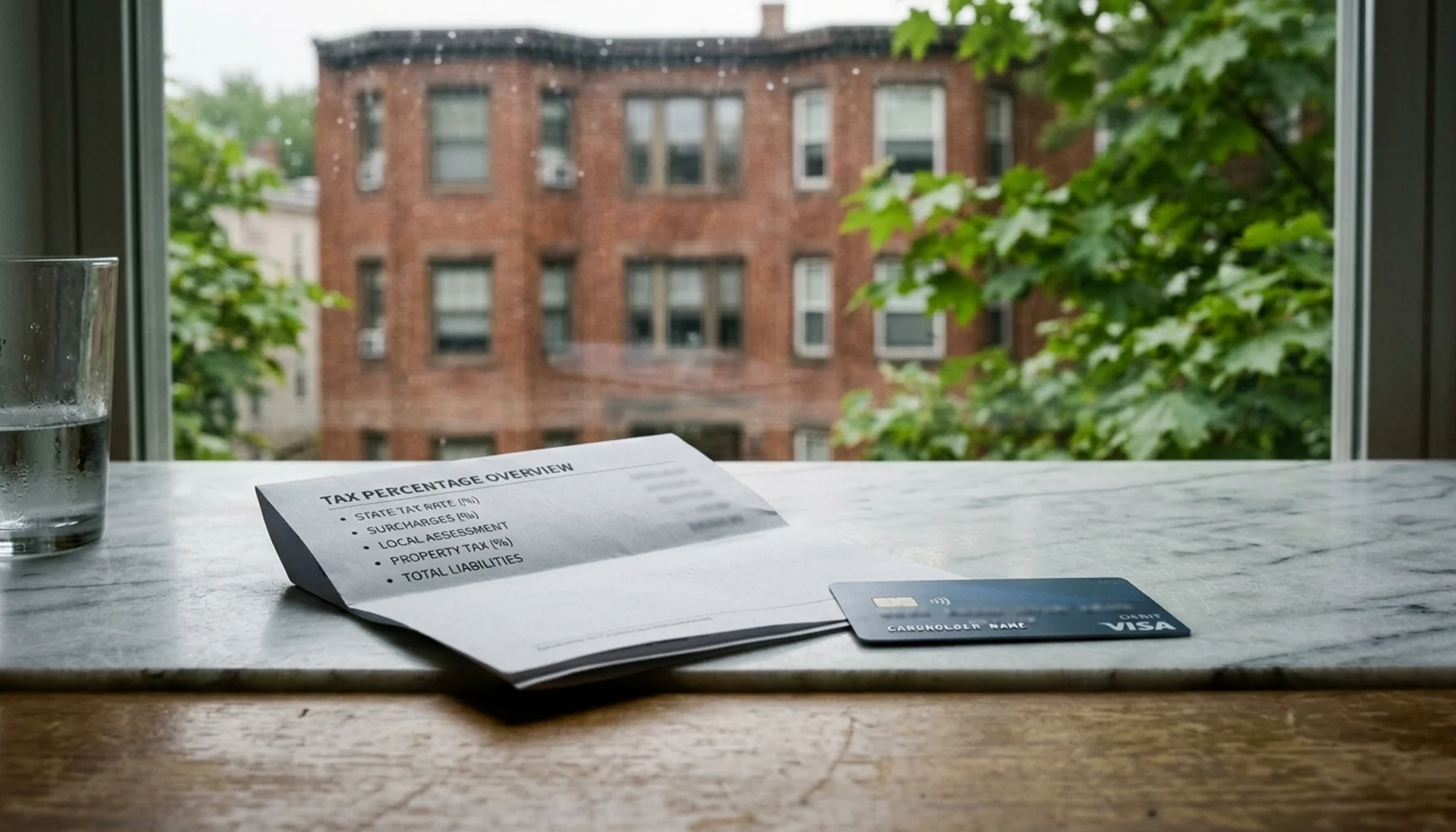
Breaking down Cambridge’s layered short-term rental occupancy tax rates.
|
Charge |
Rate |
What to know |
|---|---|---|
|
State room occupancy excise |
5.7% |
Covers short-term rental stays of 31 consecutive days or less |
|
Convention-center financing charge |
2.75% |
Applies in Cambridge and five other named cities |
|
Local option excise |
Up to 6% (Boston up to 6.5%) |
Adopted by each municipality; Cambridge’s rate is reported at 6%, so confirm the current figure |
|
Community impact fee |
0% to 3%, if adopted |
Reported to apply to some owner-adjacent units that are not the operator’s primary residence; verify for your situation |
The Department of Revenue publishes a Room Tax and Impact Fee report with local effective dates and rates. Look up Cambridge’s line in that report on the day you set up your billing, because older articles quote a 5.75% state rate that no longer matches current DOR figures.
Why total Cambridge rates differ by rental type
Cambridge rental types stack the components differently for operator-occupied units and for owner-adjacent units where the operator lives next door. The comparison below adds up the DOR components above; the combined percentages are planning estimates, not a quote, and the Department of Revenue has not confirmed them as totals, so verify with the Department before you bill guests.
|
Scenario |
Components stacked |
Reported combined rate |
|---|---|---|
|
Operator-occupied unit, stay of 31 days or less |
State excise, convention-center charge, local option |
14.45% |
|
Owner-adjacent unit that is not the operator’s primary residence |
Same components plus a possible community impact fee |
17.45% |
|
Single stay longer than 31 consecutive days |
None of the short-term rental excise |
No excise on that stay |
|
Registered 14-day declaration filed for the calendar year |
Exempt for qualifying rentals |
Exempt while within the declared limit |
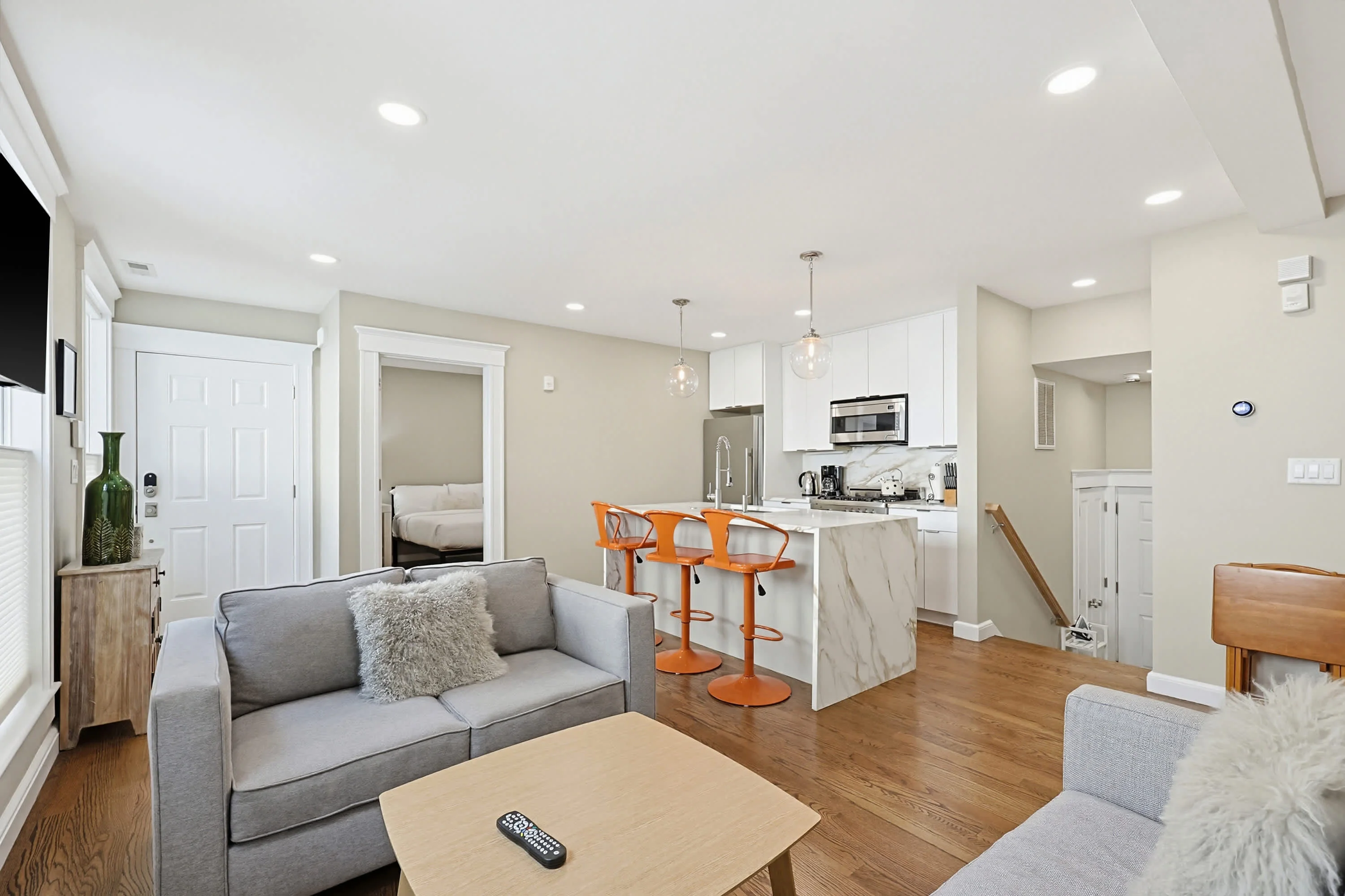
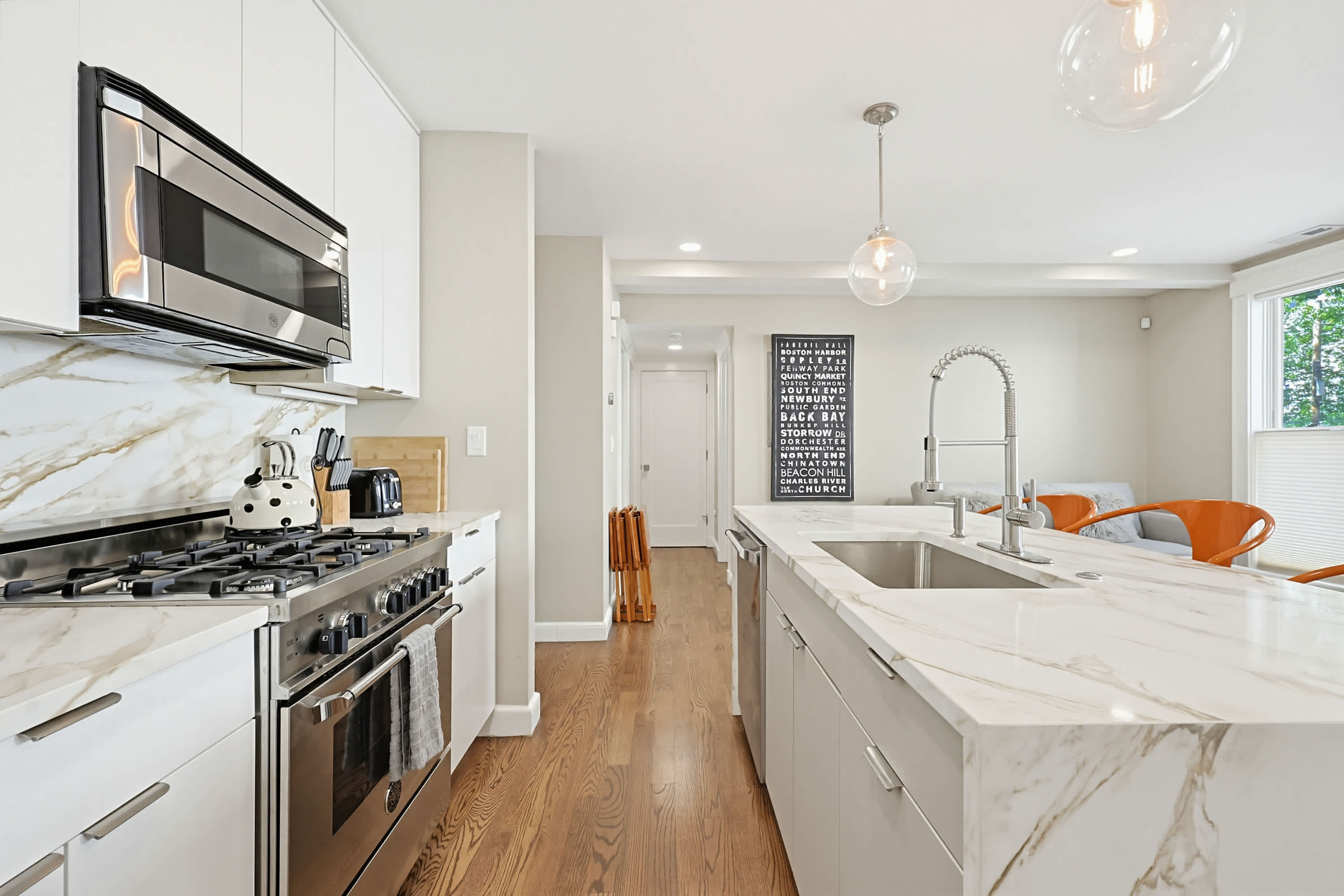
Modern open-concept living space featuring a gray sofa with throw pillows, light wood coffee table, and access to a contemporary kitchen with white cabinetry, stainless steel appliances, and a white quartz island with orange bar stools. A bedroom is visible through an open doorway in the background. · Inviting 3BR In Cambridge, Walk To T & Central Sq
How Is Occupancy Tax for a Cambridge Vacation Rental Calculated?
Occupancy tax on a Cambridge vacation rental is calculated as the taxable booking price multiplied by the combined rate for your rental type. The taxable price on Airbnb includes the nightly rent plus cleaning and guest fees, according to Airbnb’s Massachusetts tax guidance. In contrast, refundable security deposits that you return to the guest are not rent, so they stay out of the base.
A worked example with an assumed rate
AirDNA reports a trailing-12-month average daily rate of $240 for Cambridge listings as of May 2026. Suppose a family books three nights at that rate with a $100 cleaning fee and a $300 refundable deposit.
-
Rent: 3 nights x $240 = $720
-
Cleaning fee: $100
-
Taxable base: $820 (the deposit is excluded)
-
Tax at an operator-occupied combined rate of 14.45%: about $118.49
-
Tax at an owner-adjacent combined rate of 17.45%: about $143.09
The difference between the two outcomes is roughly $25 on a three-night stay. Multiply that across a year of bookings and a wrong assumption becomes a real balance owed. Guests see the tax as a separate line, so a mistake also shows up in your reviews when the total changes after booking.
Who Registers, Who Collects, and Who Remits the Tax?
The operator is the person who registers the unit, holds the Cambridge certificate, and answers to the Massachusetts Department of Revenue. Registration with the state and collection by a booking platform are separate steps. Airbnb’s Massachusetts tax help page says Airbnb collects and remits applicable occupancy taxes on Massachusetts reservations, yet the page still tells hosts to register their listings with the state.
City registration versus state tax registration
Cambridge permits only operator-occupied and owner-adjacent short-term rentals. An operator-occupied host lives in the unit as a primary residence and may rent up to three legal bedrooms. An owner-adjacent operator lives in an adjacent unit as a primary residence, owns the other units, and rents the short-term unit only as a whole; the building may hold no more than four residential units. The city prohibits hourly rentals and stays under 10 consecutive hours, as well as commercial meetings.
For a real example of a Cambridge rental, see our Inviting 3BR near Central Square, a three-bedroom, two-bathroom apartment that sleeps 7 and sits a short walk from the T. The apartment’s tax treatment depends on the operator and booking details, so confirm the applicable charges rather than assuming every listing pays the same rate.
Other channels and direct bookings
Airbnb’s collection statement covers Airbnb bookings only. In contrast, Vrbo, Booking.com, Expedia, and a direct-booking website each handle tax differently, and the operator generally stays responsible where no marketplace collects. Confirm channel by channel, in writing where possible, before you assume a platform has the tax covered.
How Do You Register and Pay Step by Step in 2026?
Registering and paying Cambridge occupancy tax takes six steps: confirm eligibility, register with the city, register with the state, verify collection by channel, calculate per booking, and file and remit. Do the steps in this order, because the Cambridge certificate is the record everything else depends on.
Step 1: Confirm your unit qualifies
A Cambridge unit qualifies for short-term rental use only if it is operator-occupied or owner-adjacent. Check your situation against those two definitions above. A unit that fits neither cannot operate as a short-term rental in Cambridge, and as a result the tax question becomes moot. Confirm the building-code occupancy limit for the unit as well, since each offered unit must comply.
Step 2: Register with Cambridge Inspectional Services
Operators register with the Inspectional Services Department before any short-term rental use. Start at the city’s Register a Short-Term Rental page. The office is at 831 Massachusetts Ave., 1st Floor, Cambridge, MA 02139, and the number is 617-349-6100. Listed hours are Monday 7 a.m. to 6 p.m., Tuesday through Thursday 7 a.m. to 3:30 p.m., and Friday 7 a.m. to noon. Each unit needs its own registration certificate, which renews every five years or when the operator or owner changes.
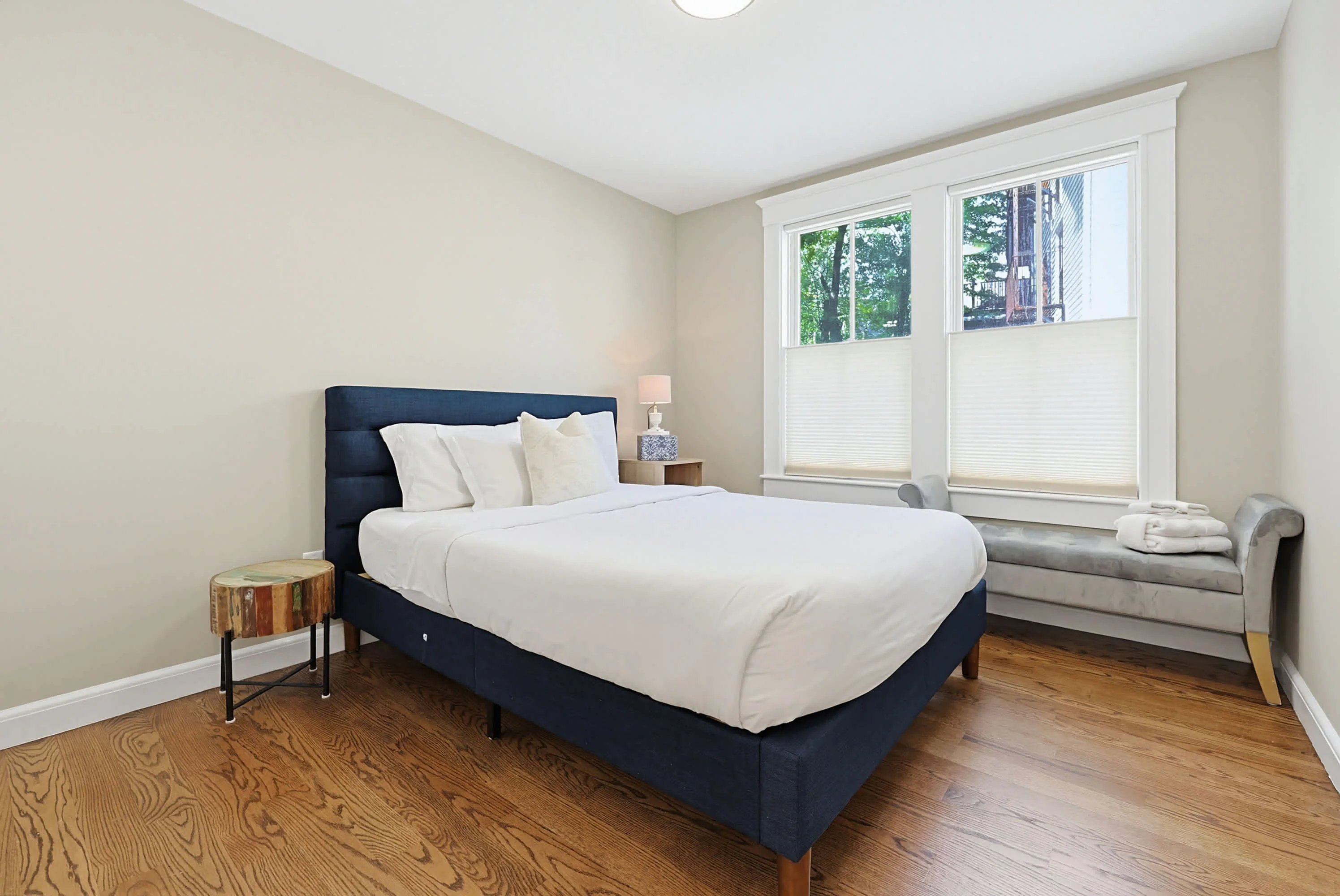
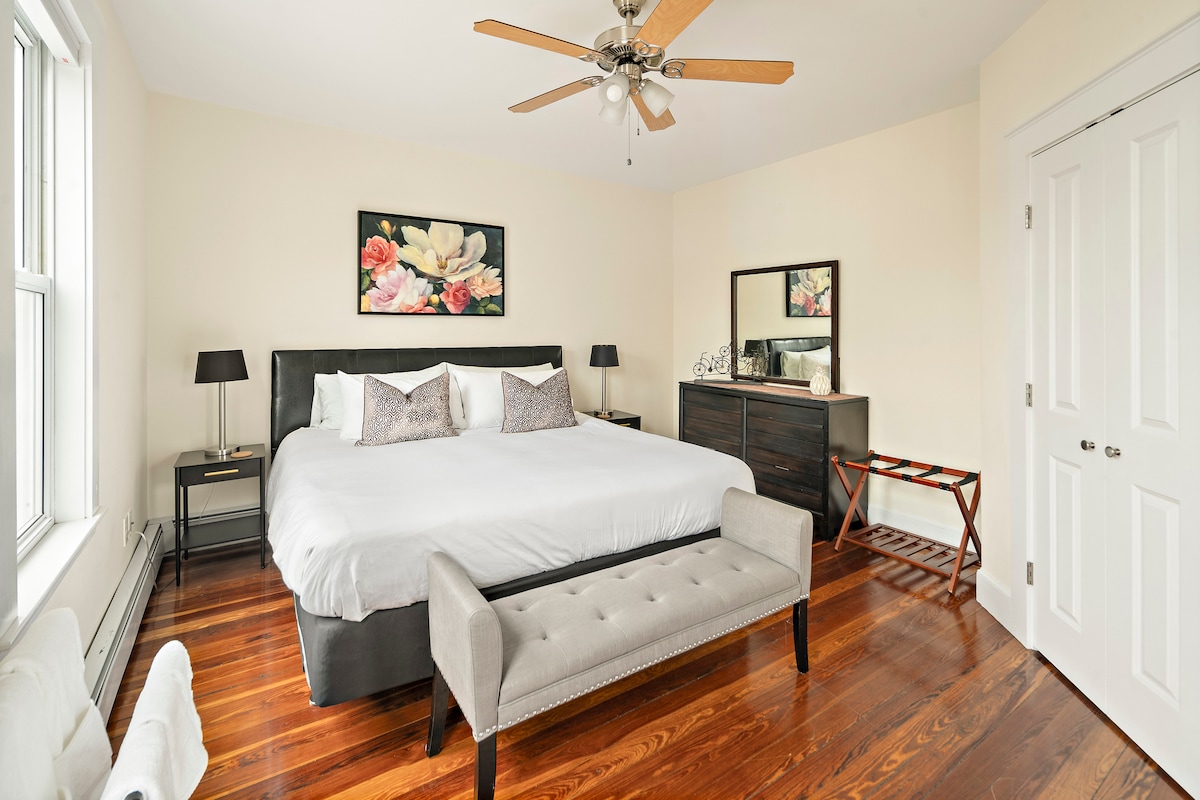
A bright, modern bedroom featuring a navy blue upholstered bed with white linens, hardwood flooring, and large windows with natural light overlooking Cambridge surroundings. The space includes a wooden accent table, pink table lamp, and comfortable seating window bench. · Inviting 3BR In Cambridge, Walk To T & Central Sq
Step 3: Register for the tax with the Department of Revenue
Set up your account through MassTaxConnect, the state’s online portal. Choose the room occupancy registration and enter your Cambridge unit details. If you plan to use the 14-day exemption, file the declaration of intent at registration. For questions, the Department of Revenue room occupancy line is (617) 887-6367, or (800) 392-6089 toll-free within Massachusetts, from 9 a.m. to 4 p.m. on weekdays.
Step 4: Verify who collects on each channel
List every channel where your unit is bookable. Mark which channels collect and remit tax and which leave the tax to you. Importantly, platform collection tells you nothing about your own registration duty; the Airbnb guidance and the state guidance both point hosts back to the Department of Revenue.
Step 5: Calculate per booking
Per-booking tax is the taxable base multiplied by the combined rate for your rental type. Use the formula from the worked example, where an $820 base at 14.45% produced about $118.49. Check the current local rate in the Department of Revenue report each time you update pricing. For example, if you charge a cleaning fee, decide once how the fee appears and keep that treatment consistent across channels.
Step 6: File, remit, and keep records
Your MassTaxConnect account sets your filing frequency, and we have not confirmed the schedule or the zero-activity return rules with the Department of Revenue. Call the Department to confirm both, including whether a period with no taxable stays still needs a return. Keep each booking confirmation, the itemized fees, and any platform tax report. Together, these records let you reconcile what Airbnb remitted against what you owe from direct bookings.
Quick-reference checklist
-
Confirm your unit is operator-occupied or owner-adjacent and meets occupancy limits.
-
Register the unit with the Cambridge Inspectional Services Department and receive the certificate.
-
Register for room occupancy tax on MassTaxConnect, filing the 14-day declaration if you qualify.
-
Map each booking channel to who collects and remits the tax.
-
Calculate tax on the full taxable base at the combined rate for your rental type.
-
File and remit on your assigned schedule, and keep booking records.
Which Tax Software Works for Massachusetts Hosts?
Short-term rental tax software is a tool that calculates and tracks lodging taxes across bookings, and for a single Cambridge unit you rarely need it. MassTaxConnect plus a spreadsheet with one row per stay covers a host with one listing and one main channel. Avalara sells tax compliance software, but the product does not replace confirming the rate with the Department of Revenue.
Software earns its cost when you have several units or a mix of short and mid-term stays across many channels. In our experience at South End Hospitality Rental Management, the errors that hurt rarely involve arithmetic. Instead, the errors come from applying the wrong rate to the wrong rental type, or from a fee that gets taxed on one channel and skipped on another. Any tool you choose still needs those inputs set correctly.
What Does the Cambridge Market Say About the Stakes?
The Cambridge short-term rental market is large enough that the tax matters on every booking. AirDNA recorded 1,690 active Cambridge listings across Airbnb, Vrbo, and Booking.com in May 2026, an 8.8% increase year over year, and it gave Cambridge a rental-demand score of 94 out of 100.
|
Cambridge STR metric (AirDNA, May 2026) |
Figure |
|---|---|
|
Active listings |
1,690 |
|
Trailing-12-month occupancy |
67% |
|
Trailing-12-month average daily rate |
$240 |
|
Average revenue per active listing |
$26,800 |
|
Revenue change, May 2025 to May 2026 |
Up 19.0% |
Higher revenue means a larger taxable base, and a rising listing count means more attention on compliance. Strong visitor demand across Massachusetts suggests Cambridge stays will stay in demand.
What Mistakes Do Cambridge Hosts Make With Occupancy Tax?
Cambridge occupancy tax mistakes are errors in registration, base calculation, or channel assumptions that lead to underpayment or a rejected filing. Across the Cambridge listings South End Hospitality Rental Management manages, the same problems keep appearing, and each one is avoidable.
-
Assuming Airbnb covers everything. The platform collects for its own bookings; your state registration and other channels remain yours to check.
-
Leaving fees out of the base. Airbnb’s guidance puts cleaning and guest fees inside the taxable price.
-
Treating a quiet calendar as an exemption. The 14-day rule needs the declaration on file.
-
Copying a neighbor’s rate. A friend’s operator-occupied unit and your owner-adjacent unit may not carry the same charges.
-
Splitting a long stay incorrectly. Two bookings by one guest can look like a single consecutive stay; check the dates before you decide which side of the 31-day line applies.
Our position is simple: skip guesswork and write the rate logic down once per unit. A one-page note with the operator type, the combined rate, your source, and the date you verified the rate makes every later filing faster.
Should You Handle Cambridge Tax Compliance Yourself or Hire Help?
Handling Cambridge tax compliance yourself works if you own one operator-occupied unit and enjoy paperwork. Hiring a manager makes more sense when you live out of state or run more than one unit. Mid-sized units in Cambridge often host week-long family stays, which fall inside the taxable window and generate the most tax per booking.
South End Hospitality Rental Management includes regulatory and compliance support within its full-service management: registration tracking, occupancy tax handling, and channel-by-channel checks across Airbnb, Vrbo, Booking.com, Expedia, and a direct-booking site. Our team has worked Boston, Cambridge, Brookline, and Gloucester listings since 2015. You can read how full-service management is structured, and if you also own in the neighboring town, our breakdown of Brookline STR management costs shows what fees look like there. Our Boston properties page lists the other markets we cover.
Frequently Asked Questions
How much is occupancy tax in Cambridge MA?
Occupancy tax in Cambridge MA is a stack of charges: the 5.7% Massachusetts state excise, the 2.75% convention-center charge, and a local option reported at 6%, with a possible community impact fee of 0% to 3% for some owner-adjacent units. As a result, the planning estimates are 14.45% for an operator-occupied unit and 17.45% for an owner-adjacent unit. Confirm the local rate in the Department of Revenue report before quoting guests.
Does Airbnb pay occupancy tax for me in Cambridge?
Airbnb says it collects and remits applicable Massachusetts occupancy taxes on bookings made through its platform. You still register the listing with the Department of Revenue, and you remain responsible for bookings that come through other channels or your direct-booking site.
Do I still owe tax if I rent for fewer than 14 days?
Not automatically. The 14-day exemption applies only if you registered with the Commissioner and filed a declaration that you intend to rent for no more than 14 days in the calendar year. Without that filing, a host who rents fewer than 14 days still owes the room occupancy excise. In addition, Cambridge city registration still applies separately.
How do I register a short-term rental in Cambridge MA?
Register with the Cambridge Inspectional Services Department at 831 Massachusetts Ave., 1st Floor, or through the city’s registration page. Call 617-349-6100 with questions. Each unit needs a certificate, and the city’s short-term rental guide explains eligibility and building-code occupancy requirements.
Are cleaning fees subject to occupancy tax?
On Airbnb, yes. Airbnb’s Massachusetts guidance includes cleaning and guest fees in the listing price used to calculate the state and local-option charges. Refundable deposits that you return to the guest are not rent and stay out of the base.
Who do I call with room occupancy tax questions?
Call the Massachusetts Department of Revenue at (617) 887-6367, or toll-free within Massachusetts at (800) 392-6089, between 9 a.m. and 4 p.m. on weekdays. For city registration issues, contact the Cambridge Inspectional Services Department.
How often does Cambridge short-term rental registration renew?
Cambridge registration certificates renew every five years, or sooner when the operator or owner changes. Put both dates on your calendar so the certificate never lapses while you have guests booked.
Ready to Register and Pay Occupancy Tax on Your Cambridge Vacation Rental?
Cambridge vacation rental occupancy tax comes down to a clear sequence: register with the city, register with the state, confirm who collects on each channel, calculate on the full taxable base, and file on schedule. The 31-day threshold decides whether the excise applies, and your operator type decides how the local charges stack.
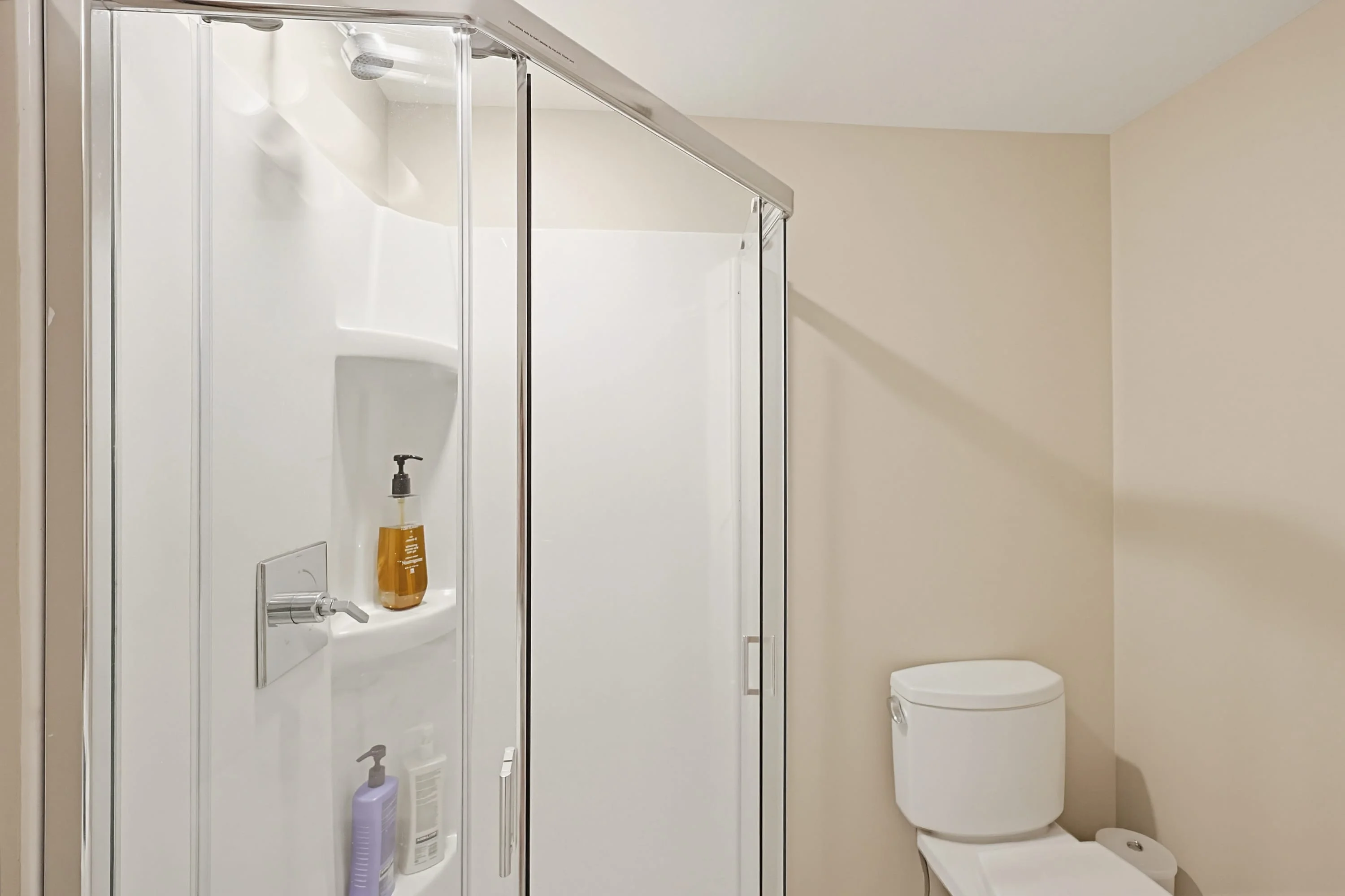
Clean and modern bathroom featuring a spacious glass-enclosed shower with built-in shelving, chrome fixtures, and premium toiletries, alongside a white porcelain toilet and neutral beige walls. · Inviting 3BR In Cambridge, Walk To T & Central Sq
Want a hands-on partner for registration, pricing, and tax handling on your Cambridge unit? South End Hospitality Rental Management will run through your specific rental type and show you what full-service management looks like for your property.
Written by Drew, Founder & Owner, seasoned vacation rental manager with a decade of experience at South End Hospitality Rental Management